
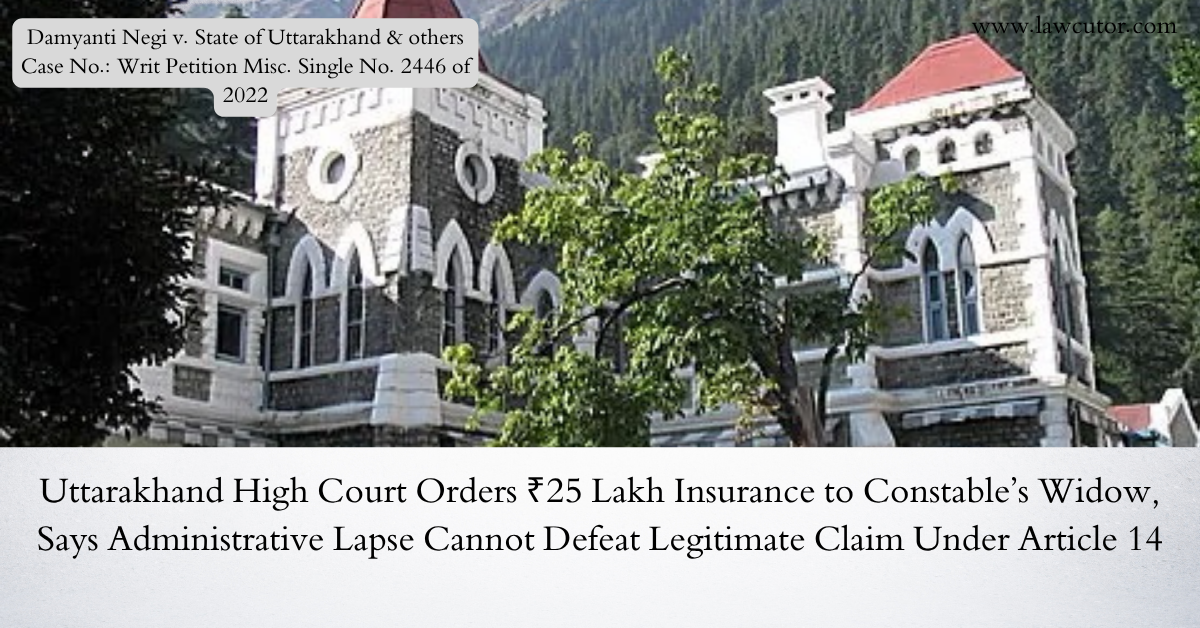
The Uttarakhand High Court has held that a bank cannot deny the benefit of a “Complimentary Police Accidental Death Insurance Cover” scheme to the widow of a deceased police constable merely on the technical ground that the name of the deceased was not included in the list of covered employees, particularly when such omission is an administrative lapse arising out of lack of coordination between the bank and the police department. Justice Pankaj Purohit observed that the petitioner cannot be made to suffer for lapses attributable to the respondents themselves and that the bank cannot take advantage of its own omission. The Court found the denial of benefit to be wholly arbitrary, illegal and violative of Articles 14, 16 and 21 of the Constitution of India.
The writ petition was filed by Damyanti Negi, widow of Late Narendra Singh Negi, who was serving as a constable in the Uttarakhand Police and was on deputation with the State Disaster Response Force (SDRF) on the post of driver. It is not in dispute that Late Narendra Singh Negi died in a road accident on 07.08.2021 during the course of his service. The deceased left behind the petitioner and three daughters, who are his legal heirs. The deceased was maintaining a salary account bearing No. 76009501185 with the respondent No.2 – Uttarakhand Gramin Bank, Branch Rajpur Road, Dehradun, wherein his salary was regularly credited since the year 2015. A loan had also been sanctioned by the bank against the said salary account, the instalments of which were being deducted from the account. The respondent-bank introduced a scheme known as “Complimentary Police Accidental Death Insurance Cover”, which came into effect from 12.04.2021, intended to provide accidental death insurance cover to police personnel whose salaries were being disbursed through accounts maintained with the bank, and the premium of the said policy was to be borne by the bank itself.
After the death of her husband, the petitioner made representations to the respondent-bank seeking grant of benefit under the aforesaid scheme. However, the respondent-bank, vide letter dated 06.01.2022, informed the petitioner that her husband’s name was not included in the list of employees covered under the scheme. Thereafter, a legal notice dated 29.04.2022 was served by the petitioner demanding payment of Rs.25,00,000/- under the insurance cover, to which a reply dated 21.05.2022 was furnished by the bank reiterating its stand. Aggrieved by the denial of the benefit under the said scheme, the petitioner approached the Court by way of the present writ petition seeking quashing of the impugned communication dated 21.05.2022 and a direction to the respondents to release the insurance amount.
Learned counsel for the petitioner submitted that the action of the respondent-bank in denying the benefit is wholly arbitrary and violative of Articles 14, 16 and 21 of the Constitution. It was contended that the deceased was admittedly a police employee whose salary account was being maintained with the bank since 2015 and therefore he squarely fell within the category of employees for whom the scheme was introduced. The scheme was automatic in nature and did not require any separate application or nomination, particularly when the premium was being borne by the bank itself. Once the scheme came into force on 12.04.2021, the deceased stood covered under the scheme by virtue of being a salary account holder, and any omission on the part of the bank or the police department in not including his name in the list cannot defeat the legitimate entitlement of the petitioner. The bank was fully aware of the status of the deceased as a police personnel, as his salary was being credited and a loan had been sanctioned against the account. The denial on the ground that the name was not included in the list of 676 employees is arbitrary and amounts to penalizing the petitioner for lapses attributable to the respondents.
Learned counsel appearing for the respondent-bank submitted that the name of the deceased was not included in the final list of employees covered under the scheme and therefore no premium was deposited in respect of him. It was contended that in absence of payment of premium, no insurance cover could be extended. The scheme has since expired and no person has any vested right to seek inclusion retrospectively. There was no memorandum of understanding between the bank and the police department requiring automatic inclusion of all police personnel, and the responsibility of providing correct details lay with the police department. Learned counsel for the State submitted that the deceased was indeed a police personnel and his death is a matter of record, but the issues relating to inclusion in the insurance scheme and payment of premium pertain to the respondent-bank, and the State has no direct role in the denial of the benefit.
Having heard the learned counsels for the parties and after perusal of the material on record, the Court found that the core issue is whether the petitioner can be denied the benefit solely on the ground that the name of her deceased husband was not included in the list of covered employees. It is not in dispute that the deceased was a police personnel, that he was maintaining a salary account with the bank, and that he died in a road accident during the currency of the scheme. The only ground for denial is non-inclusion in the list. The Court held that such omission is clearly an administrative lapse arising out of lack of coordination between the respondent-bank and the police department. The petitioner cannot be made to suffer for such lapse which is wholly beyond her control. The respondent-bank cannot plead lack of knowledge of the status of the deceased, inasmuch as the salary was being credited for several years and a loan had been sanctioned. The contention that no premium was deposited is misconceived, as the scheme itself provided that the premium was to be borne by the bank. The bank cannot be permitted to take advantage of its own omission. The action of the respondent-bank in denying the benefit while extending the same to other similarly situated employees is arbitrary and violative of Article 14 of the Constitution. The inter se stand of the respondents seeking to shift responsibility cannot defeat the legitimate claim of the petitioner.
In view of the aforesaid, the High Court found that the denial of benefit under the scheme to the petitioner is unjustified and unsustainable in law. Accordingly, the writ petition is allowed. The impugned communication dated 21.05.2022 issued by respondent No.2-Bank is hereby set aside. A writ of mandamus is issued directing respondent No.2-Uttarakhand Gramin Bank to pay to the petitioner an amount of Rs.25,00,000/- towards accidental death insurance cover of Late Narendra Singh Negi under the said scheme along with interest @ 5% per annum from the date of her entitlement till actual payment is made. Pending application, if any, stands disposed of.
Case Title: Damyanti Negi v. State of Uttarakhand & others
Case No.: Writ Petition Misc. Single No. 2446 of 2022
Date of Judgment: 19 March 2026
Click HERE for full Judgment

