
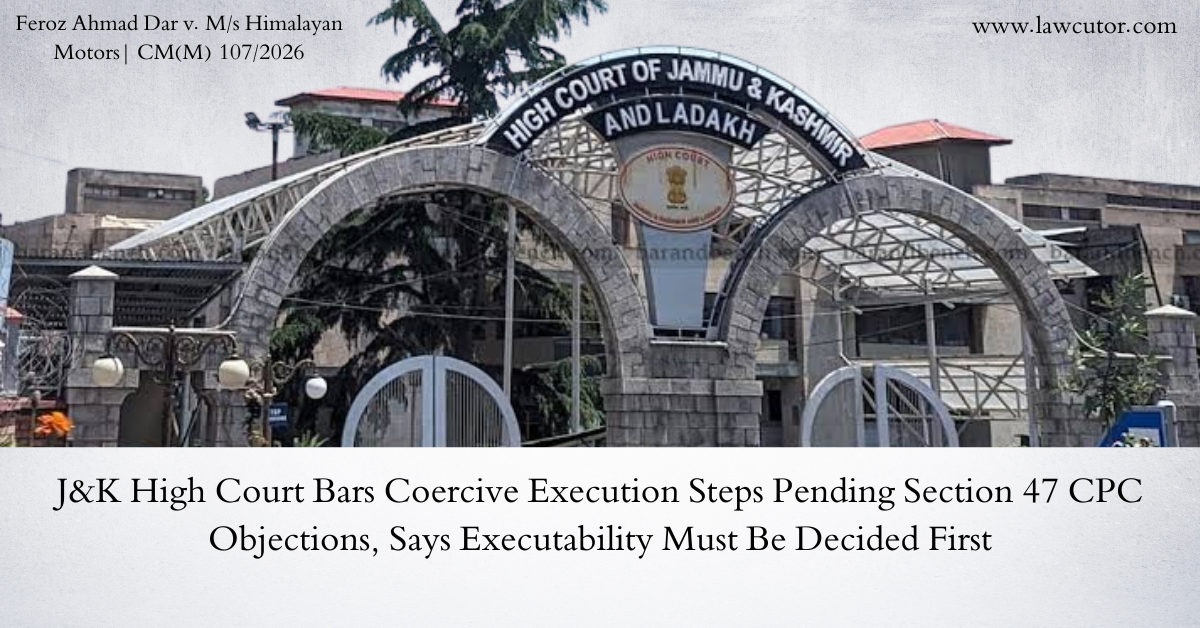
The Jammu & Kashmir and Ladakh High Court has held that an Executing Court cannot proceed with coercive steps such as issuance of levy warrants in execution proceedings while an application under Section 47 of the Code of Civil Procedure, 1908, questioning the executability or jurisdiction of the decree, remains pending and undecided. Justice Wasim Sadiq Nargal observed that Section 47 CPC mandates that all questions arising between the parties relating to the execution, discharge or satisfaction of the decree shall be determined by the Executing Court itself and not by a separate suit, and that when a decree is challenged under this provision, such challenge strikes at the very root of the decree and its execution. The Executing Court is therefore under a mandatory duty to adjudicate upon such objections before proceeding further in the matter, and it is not permissible that an application under Section 47 CPC pending consideration is brushed aside and execution is carried forward, as any such course would render the remedy under Section 47 CPC illusory.
The petition was filed under Article 227 of the Constitution of India by Feroz Ahmad Dar, the judgment debtor, calling in question the legality and propriety of the order dated 23.01.2026 passed by the learned 2nd Additional District Judge, Srinagar (Executing Court), whereby levy warrants were issued in execution of an ex parte money decree dated 02.11.2023 passed in a civil suit titled Himalayan Motors vs. Feroz Ahmad Dar. The respondent-decree holder had initiated execution proceedings on 10.02.2024. Upon appearance in the execution proceedings, the petitioner filed an application under Section 47 CPC on 29.05.2024, questioning the execution of the decree on the ground that the same is without jurisdiction and thus void ab initio. The respondent-decree holder filed objections thereto. During the pendency of the said application, the then Presiding Officer of the Executing Court came to be transferred, as a result whereof the application could not be taken to its logical conclusion and remained undecided. Thereafter, without adjudicating upon the said application, the learned Executing Court, vide order dated 23.01.2026, proceeded to issue levy warrants against the petitioner-judgment debtor.
Aggrieved thereby, the petitioner approached the High Court inter alia on the ground that the Executing Court has acted with material irregularity and in excess of jurisdiction by proceeding with coercive steps in execution without first deciding the objection as to execution of the decree. Learned counsel for the petitioner submitted that the impugned execution proceedings are vitiated by patent illegality and jurisdictional error inasmuch as an application under Section 47 CPC strikes at the very root of the decree and the Executing Court is under a mandatory duty to decide all questions relating to jurisdiction before proceeding further with execution. By bypassing this essential requirement, the Executing Court has acted without jurisdiction and in violation of the settled principles of natural justice, thereby subjecting the petitioner to coercive measures without adjudication of the application filed under Section 47 CPC. It was further contended that the decree dated 02.11.2023 is itself without jurisdiction and since this issue goes to the root of the matter, the execution proceedings could not have been lawfully continued until the said question was finally determined.
The High Court, after admitting the petition for hearing and having regard to the limited and innocuous nature of the prayer made, disposed of the matter at the threshold. The Court noted that a plain reading of Section 47 CPC shows that the basic purpose of the said provision is to determine any disputes or issues that arise out of the execution, discharge or satisfaction of a decree. Therefore, when a decree is challenged under Section 47 CPC, such challenge is essentially directed against the execution of the decree itself. Having said that, the Executing Court is bound to adjudicate upon such objections before proceeding further in the matter. It is not permissible that an application under Section 47 CPC pending consideration is brushed aside and execution is carried forward. Any such course would render the remedy under Section 47 CPC illusory. Applying the aforesaid principle to the facts of the present case, the course adopted by the Executing Court cannot be sustained. The petitioner had specifically pleaded that the decree sought to be executed is a nullity on account of lack of inherent jurisdiction. A bare perusal of the record shows that the petitioner had filed the application under Section 47 CPC on 29.05.2024 raising a substantive challenge to the execution proceedings. The respondent-decree holder filed objections on 21.06.2024. Thereafter, the Executing Court, upon taking cognizance of the rival pleadings, vide order dated 04.04.2025, directed the parties to file written arguments, and on 20.05.2025 deemed it appropriate to call for the trial court record for proper adjudication of the issues raised. The application, however, remained pending. Despite the pendency of the said application, the Executing Court, without returning any finding thereon, proceeded to issue levy warrants vide order dated 23.01.2026. The impugned order does not reflect any consideration, much less adjudication, of the objections raised under Section 47 CPC.
The High Court held that proceeding with coercive steps in execution in the face of a pending challenge, particularly one that goes to the root of the decree, is not in consonance with the scheme of Section 47 CPC and renders the remedy provided thereunder ineffective. In the considered view of this Court, the approach adopted by the Executing Court is legally not sustainable. The application under Section 47 CPC, which strikes at the very root of the decree and its execution, was required to be decided as a preliminary issue before proceeding further in execution. The pendency of such an application, particularly when it involves a jurisdictional challenge, casts a duty upon the Executing Court to first determine the same. The action of the Executing Court in issuing levy warrants during the pendency of the application filed under Section 47 CPC, without first deciding the same, is clearly contrary to law and amounts to material irregularity in the exercise of jurisdiction. In view of the aforesaid, this Court is satisfied that the impugned order dated 23.01.2026 cannot be sustained and is liable to be set aside.
Accordingly, the petition is disposed of with the following directions: (i) the order dated 23.01.2026 passed by the learned Executing Court, whereby levy warrants have been issued, is hereby set aside; (ii) the learned Executing Court i.e., Court of learned 2nd Additional District Judge, Srinagar, is directed to decide the application filed by the petitioner under Section 47 CPC at the first instance, on its own merits and strictly in accordance with law expeditiously, after affording an opportunity of hearing to both sides and continuation of execution proceeding thereafter shall be subject to the outcome of the said application; (iii) till such time said application is decided, no coercive steps shall be taken against the petitioner in the execution proceedings. Petition disposed of along with connected CM(s) in the manner indicated above.
Case Title: Feroz Ahmad Dar v. M/s Himalayan Motors
Case No.: CM(M) 107/2026
Date of Judgment: 16 April 2026
Click HERE for full update
 Lawcutor