
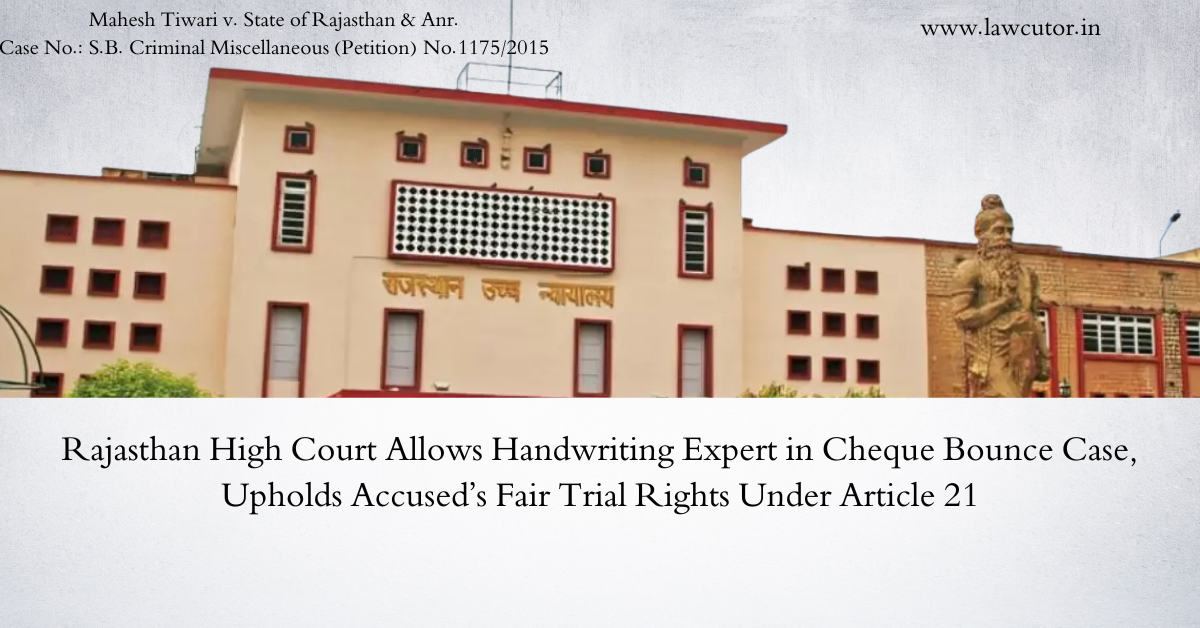
The Rajasthan High Court has held that when an accused in a proceeding under Section 138 of the Negotiable Instruments Act, 1881, disputes his signatures on the cheque right from the beginning and raises the same defence consistently during the trial, the court is duty-bound to allow an application filed under Section 45 of the Indian Evidence Act, 1872, for sending the disputed cheque to the Forensic Science Laboratory for expert opinion, particularly when the trial has reached the stage of recording the accused’s evidence. Justice Anoop Kumar Dhand observed that fair trial is the fundamental right of an accused as guaranteed under Article 21 of the Constitution of India and that fair trial implies that fair and proper opportunities, in accordance with the law, be granted to an accused in order to prove his innocence. The Court emphasised that every person is presumed to be innocent till proven guilty and that he has the right to defend himself as a part of his human right as well as fundamental right as enshrined under Article 21 of the Constitution of India. The right to defend oneself and for that purpose to adduce evidence is recognised by the legislature in terms of Section 243(2) of CrPC.
The petition arose from Criminal Case No.335/2012 pending before the Judicial Magistrate (First Class), Gangapur City, Sawai Madhopur, where the petitioner is facing trial for the offence under Section 138 of the Negotiable Instruments Act, 1881. The complainant-respondent presented a cheque bearing No.106880 dated 31.03.2011 before his banker which was dishonoured with the remark “funds insufficient”. After dishonour of the cheque, the complainant-respondent served a legal notice upon the accused-petitioner for refund of the cheque amount. Since receipt of the aforesaid notice, the accused-petitioner has disputed the signatures over the cheque in question with the averment in his reply that he never issued such a cheque in favour of the complainant-respondent. This has been his precise case right from the beginning and he has taken the same defence at every stage of the trial. When the trial reached the stage of recording the evidence of the accused-petitioner, he submitted an application under Section 45 of the Indian Evidence Act, 1872, with the prayer to allow FSL examination of the signatures on the cheque in question by a handwriting expert. The aforementioned prayer of the accused-petitioner has been declined by the court below on the technical count that he may examine the bank officer in order to prove his defence in this regard and that the application has been submitted by the accused-petitioner at the fag end of the trial, i.e., at the stage of recording his evidence.
The High Court, after hearing learned counsel for the petitioner and the complainant-respondent, perused the record and material available on it. The Court noted that under Section 139 of the Negotiable Instruments Act, 1881, a presumption is created in favour of the holder which reads that it shall be presumed, unless the contrary is proved, that the holder of a cheque received the cheque of the nature referred to in Section 138 for the discharge, in whole or in part, of any debt or other liability. Thus, while Section 139 of the Act of 1881 creates a presumption in favour of the holder of cheque, it also permits the accused-offender the right to prove ‘to the contrary’. Hence, it is not an absolute presumption, but a rebuttable one. The right to fair trial cannot be overemphasized. Needless to say, the right emanates from Article 21 of the Constitution of India which is the heart and soul of the Constitution. The first principle of common law is that every person is presumed to be innocent till proven guilty. But, Section 139 of the Act of 1881 reverses this presumption under the common law. Therefore, the burden of proof shifts to the accused in the case of offence under Section 138 of the Act. Since the presumption is in favour of the holder, it is for the accused to disprove his guilt. In such a scenario, naturally the right to fair trial becomes stronger. Thus, this right deserves to be protected more strongly and emphatically than in ordinary criminal offences under the Penal Code, 1860.
Placing reliance on the judgment of the Hon’ble Apex Court in Kalyani Baskar (Mrs.) Vs. M.S. Sampoornam (Mrs.) reported in (2007) 2 SCC 258, the Court extracted paragraph 12 of the said judgment which reads as under: “12. Section 243(2) is clear that a Magistrate holding an inquiry under CrPC in respect of an offence triable by him does not exceed his powers under Section 243(2) if, in the interest of justice, he directs to send the document for enabling the same to be compared by a handwriting expert because even in adopting this course, the purpose is to enable the Magistrate to compare the disputed signature or writing with the admitted writing or signature of the accused and to reach his own conclusion with the assistance of the expert. The appellant is entitled to rebut the case of the respondent and if the document viz. the cheque on which the respondent has relied upon for initiating criminal proceedings against the appellant would furnish good material for rebutting that case, the Magistrate having declined to send the document for the examination and opinion of the handwriting expert has deprived the appellant of an opportunity of rebutting it. The appellant cannot be convicted without an opportunity being given to her to present her evidence and if it is denied to her, there is no fair trial. ‘Fair trial’ includes fair and proper opportunities allowed by law to prove her innocence. Adducing evidence in support of the defence is a valuable right. Denial of that right means denial of fair trial. It is essential that rules of procedure designed to ensure justice should be scrupulously followed, and the courts should be jealous in seeing that there is no breach of them.”
The High Court observed that the question of fact as to whether the signature in question is original/authentic or not cannot be decided without the opinion of a handwriting expert. Thus, it is important to send the cheque in question to the FSL for its scientific opinion. Considering the proposition of law as laid down by the Hon’ble Apex Court in the case of Kalyani Baskar (Mrs.) (supra), this Court is of the considered opinion that the application submitted by the accused-petitioner under Section 45 of the Act of 1872 deserves to be accepted. Hence, the impugned order dated 02.03.2015 passed by the court below is liable to be and is hereby quashed and set-aside with directions to the Trial Court to send the cheque in question to the FSL for analysis of the disputed signatures. After taking the specimen signatures of the accused-petitioner in Court, the same along-with the cheque in question be sent to the FSL by writing a D.O. letter to the FSL for sending its report expeditiously, as the matter pertains to the year 2012 and more than 14 years have passed. The Trial Court is directed to make all possible endeavours to conclude the trial expeditiously as early as possible immediately after receipt of the report of the FSL. The Trial Court is further directed not to entertain any unnecessary and unwarranted requests for adjournment, made by either side and make all possible endeavours to decide the complaint expeditiously. Accordingly, the instant criminal misc. petition stands allowed.
Case Title: Mahesh Tiwari v. State of Rajasthan & Anr.
Case No.: S.B. Criminal Miscellaneous (Petition) No.1175/2015
Date of Order: 13 April 2026
Click HERE for full Judgment

