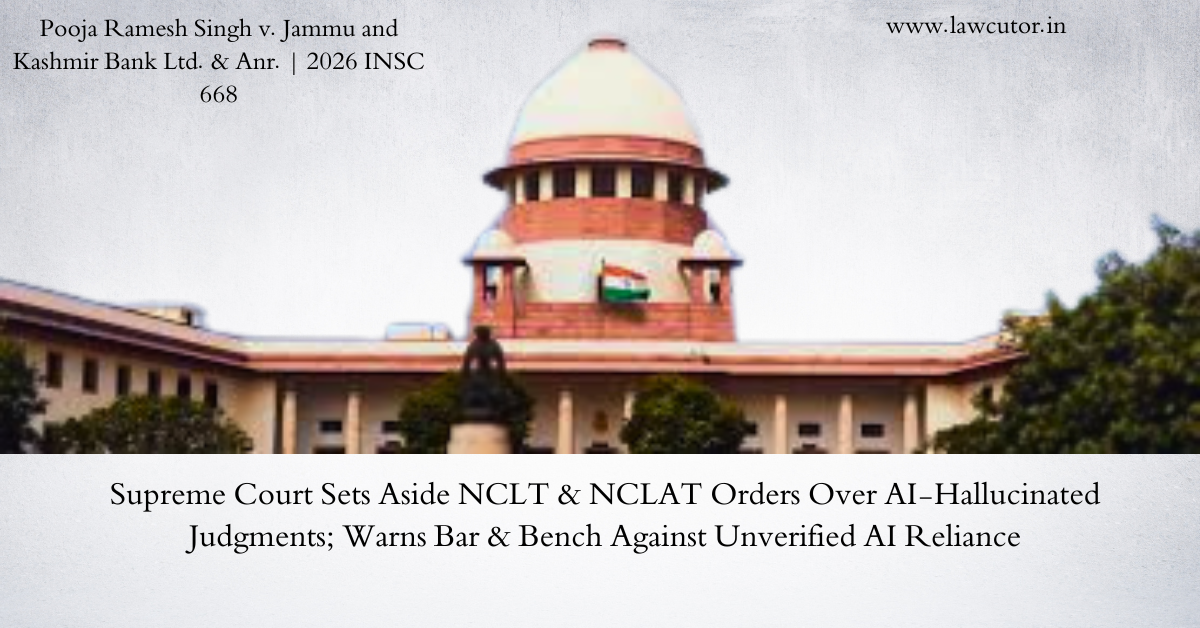
In a significant ruling highlighting the perils of unregulated Artificial Intelligence in the legal domain, the Supreme Court has set aside orders passed by the National Company Law Tribunal (NCLT) and National Company Law Appellate Tribunal (NCLAT) after discovering reliance on non-existent, AI-generated “hallucinated” judgments.
Background of the Case
The appeal arose from a Section 7 IBC application filed by Jammu & Kashmir Bank Ltd. against Essel Infraprojects Ltd. (corporate guarantor) for recovery of dues related to a corporate guarantee. NCLT admitted the application on 28.08.2024, and NCLAT upheld it on 11.09.2025.
During proceedings before the Supreme Court, senior counsel Ms. Madhavi Divan pointed out that several judgments cited by NCLT (and referenced by NCLAT) were fake or contained hallucinated paragraphs — classic symptoms of AI-generated content.
Supreme Court’s Observations & Ruling
Justices Pamidighantam Sri Narasimha and Alok Aradhe delivered the judgment on 02 July 2026:
- The cited precedents were either non-existent or contained fabricated excerpts, even where citations appeared partially correct.
- Reliance on such material vitiates the entire adjudicatory process. A decision based on fake/hallucinated precedents is “no decision in the eyes of the law.”
- Zero tolerance mandated for Bar and Bench: Citing or relying on unverified AI-generated material constitutes misconduct/lapse.
The Court set aside both NCLT and NCLAT orders, restored the Section 7 application for fresh adjudication on merits (preferably within two weeks), and directed status quo.
Key Directives on AI in Adjudication
The judgment extensively discusses the transformative potential and risks of AI:
- AI can aid efficiency but cannot substitute human reasoning and ethical judgment.
- “Hallucinations” (fabricated content) are particularly dangerous in law as they undermine truth-seeking.
- Human must remain “in the loop” at every stage.
- Calls for Bar Council of India to frame guidelines and disciplinary mechanisms.
- Emphasises collaboration between Bar and Bench for responsible AI adoption.
Key Takeaways
- AI Hallucinations in Courts: Unacceptable; decisions tainted by them liable to be set aside.
- Regulatory Need: Public policy and rules essential; self-regulation by legal fraternity critical.
- Integrity of Justice: Core of adjudication lies in human discernment, scientific temper, and verification.
- Practical Impact: Tribunals and lawyers must rigorously verify all cited precedents.
Case Details
Case Name: Pooja Ramesh Singh v. Jammu and Kashmir Bank Ltd. & Anr.
Citation: Civil Appeal No. 11950 of 2025 (2026 INSC 668)
Court: Supreme Court of India
Coram: Hon’ble Mr. Justice Pamidighantam Sri Narasimha & Hon’ble Mr. Justice Alok Aradhe
Date of Judgment: 02 July 2026
Click HERE for full Judgment

