
Introduction
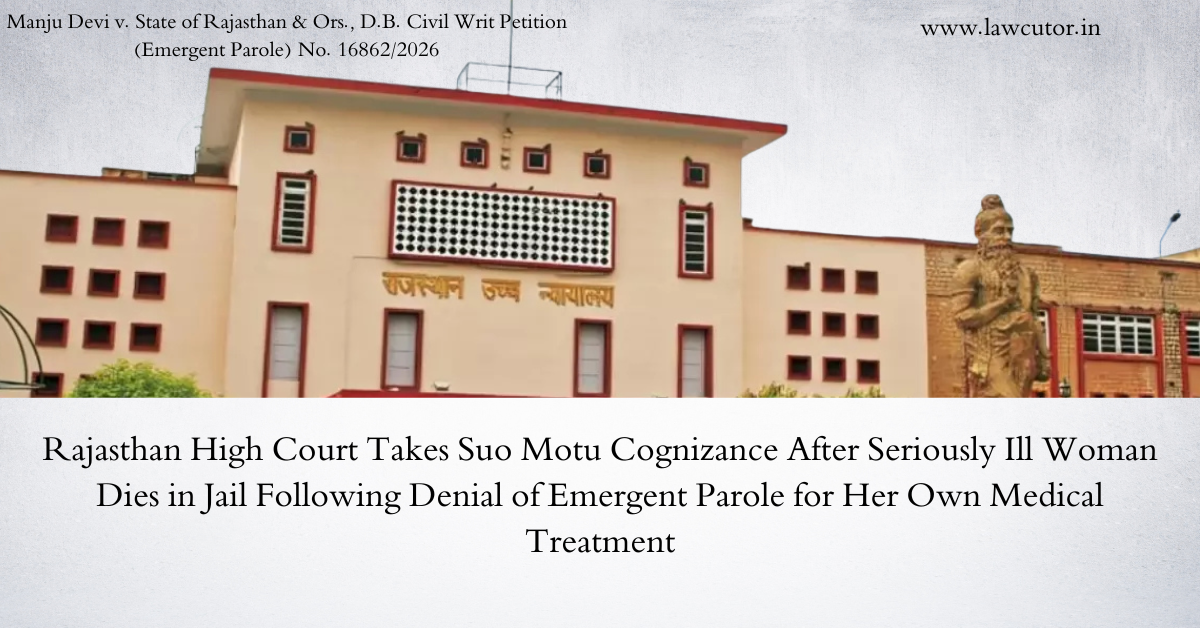
A Division Bench of the Rajasthan High Court, comprising the Acting Chief Justice Mr. Sanjeev Prakash Sharma and Justice Sanjeet Purohit, has taken suo motu cognizance of a troubling case in which an inmate died in custody after being denied emergent parole sought on the ground of her own serious illness. The order flags a gap in the Rajasthan Prisoners Release on Parole Rules, 2021, which allows parole where a near relative of an inmate is seriously ill, but contains no corresponding provision allowing parole where the inmate herself is seriously ill.
Facts of the Case
The petitioner, Smt. Manju Devi, wife of Shri Murlidhar, aged about 57 years and a resident of Nathesar Bas, Police Station Naya Sahar, District Bikaner, was lodged in Central Jail, Bikaner. She was suffering from a severe medical condition. Her son, Ravi Kant Swami, filed the present writ petition on her behalf seeking emergent parole so that she could be properly treated outside jail.
The concerned District Magistrate, however, denied her parole application. While the petition for parole was pending before the High Court, Smt. Manju Devi passed away in jail on account of her illness.
The Court’s Observations
Since the petitioner had died, the Court dismissed the parole petition itself as having abated — there was, strictly speaking, no surviving petitioner to grant relief to. But the Bench did not stop there. It went on to record its serious concern about the circumstances that led to her death.
The Court described the District Magistrate’s denial of parole as “a classic case of insensitiveness,” noting that the applicant was suffering from a severe medical condition and that her son had specifically requested parole so that she could receive proper treatment. Examining the reasons given in the rejection order, the Bench found that the denial stemmed from the concerned officer’s interpretation of the Rajasthan Prisoners Release on Parole Rules, 2021.
Specifically, the Court pointed to Rule 11(1)(i) of the 2021 Rules, which permits parole to be granted where a near relative of an inmate is seriously ill, but contains no provision allowing parole to be granted where the inmate herself or himself is seriously ill. It was this asymmetry in the Rules — and its rigid application by the Magistrate — that appears to have contributed to the denial of parole and, ultimately, to the petitioner’s death in custody.
Directions Issued
Rather than leave the matter at that, the Division Bench directed the Registry to register a suo motu petition to examine the provisions of the Rules of 2021, with specific focus on Rule 11(1)(i) and the gap it identified. Ms. Sambhavi Mardia, who had appeared as counsel for the petitioner, was appointed as Amicus Curiae to assist the Court in the suo motu proceedings, and a copy of the paper book and the order was directed to be made available to her. The suo motu matter has been listed for further hearing on 19.08.2026.
Key Takeaway
This order is a significant one for prison administration and parole jurisprudence in Rajasthan. It highlights how a rule framed to address compassionate grounds for parole — illness of near relatives — inadvertently excludes the more direct and arguably more compelling ground of the inmate’s own serious illness. The suo motu proceedings that follow could well result in an amendment or reading down of Rule 11(1)(i) of the Rajasthan Prisoners Release on Parole Rules, 2021, to close this gap and prevent similar tragedies in the future.
CASE DETAILS: Manju Devi v. State of Rajasthan & Ors., D.B. Civil Writ Petition (Emergent Parole) No. 16862/2026, Rajasthan High Court, order dated 05.08.2026 (Sanjeev Prakash Sharma, ACJ & Sanjeet Purohit, J.)
Click HERE for full JUDGMENT.

