
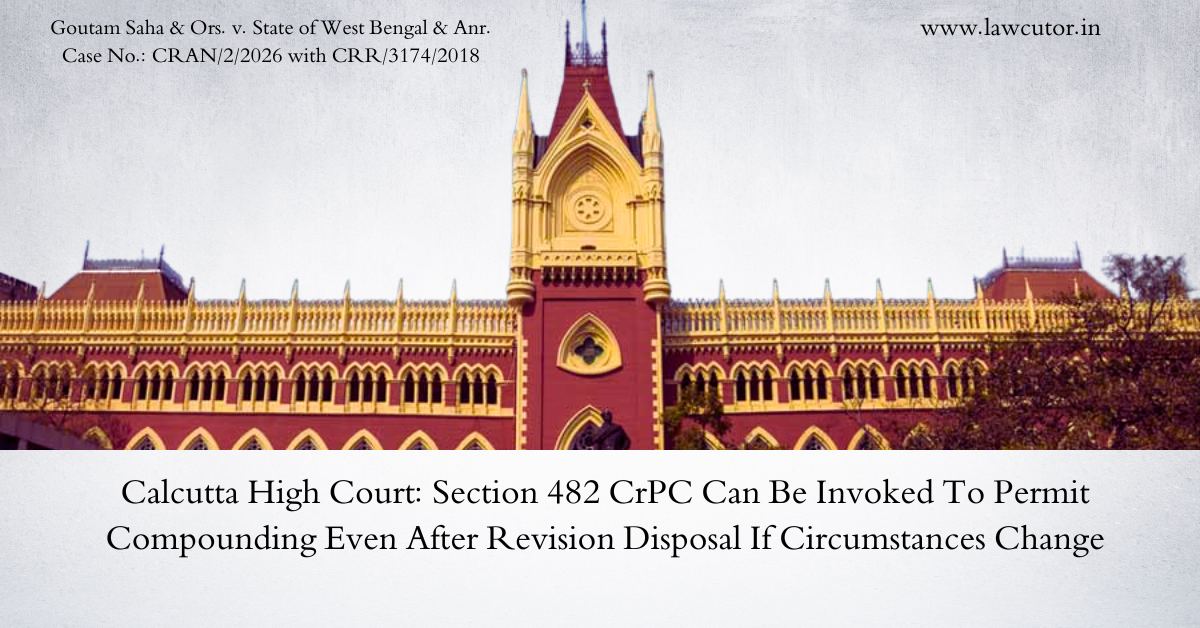
The Calcutta High Court has ruled that even after a criminal revision is finally disposed of and the court has become functus officio, it can still exercise its inherent powers under Section 482 CrPC to permit compounding of an offence where a subsequent change in circumstances creates a statutory right to compound. Justice Dr. Ajoy Kumar Mukherjee delivered the judgment on 12th May 2026 in CRAN/2/2026 connected with CRR/3174/2018 titled Goutam Saha & Ors. versus The State of West Bengal & Anr.
The case originated from an FIR lodged on 21st March 2010 alleging offences under Sections 326/34 IPC against six accused persons. The trial court convicted all six accused under Section 326/34 IPC and sentenced them to one year rigorous imprisonment along with fine. The conviction was affirmed in appeal. In the criminal revision, the High Court on 2nd March 2026 partly allowed the petition, altering the conviction from Section 326 IPC (non-compoundable) to Section 325 IPC (compoundable) and reducing the sentence to six months simple imprisonment with fine. Thereafter, the parties entered into a compromise and the accused filed the connected application seeking composition of the offence.
The State opposed the application contending that after disposal of the revision, the High Court had become functus officio and was barred under Section 362 CrPC from altering or reviewing its judgment. The State relied upon judgments such as P.A. Damodaran, Tanveer Aquil and Hari Singh Mann. Rejecting this contention, the Court held that the present case presented a unique situation where the right to compound the offence accrued to the parties for the first time only after the revisional court converted the conviction from a non-compoundable to a compoundable offence. The compromise was entered into at the earliest opportunity after the change in circumstances.
Justice Dr. Ajoy Kumar Mukherjee observed that while a court which has pronounced a final judgment ordinarily cannot reopen the matter on merits, the doctrine of functus officio yields to the demands of justice. The Court relied upon the Supreme Court’s decision in Mostt. Simrikhia v. Smt. Dolley Mukherjee, which recognises that inherent powers under Section 482 CrPC can be exercised afresh where there is a change in circumstances. It was emphasised that refusing composition in such a case would compel the convicts to undergo imprisonment despite a lawful settlement, defeating the legislative intent behind making certain offences compoundable. The power under Section 482 CrPC being sui generis and meant to secure the ends of justice and prevent abuse of process, can be invoked even after disposal of revision in appropriate cases involving changed circumstances.
Accordingly, the High Court allowed the application and directed that the sentences imposed on the six convicts shall not be executed on the condition that each of them deposits an amount of Rs. 2,500 with the Calcutta High Court Legal Services Authority within six weeks from the date of the order. In case of default by any convict, the sentence as modified in the revision shall be executed. The judgment strikes a balance between the principle of finality of judgments and the need to do complete justice when parties have amicably settled their disputes after the offence became compoundable.
Case Title: Goutam Saha & Ors. v. State of West Bengal & Anr.
Case No.: CRAN/2/2026 with CRR/3174/2018
Date of Judgment: 12.05.2026
Coram: Justice Dr. Ajoy Kumar Mukherjee
Click HERE for full Judgment.

