
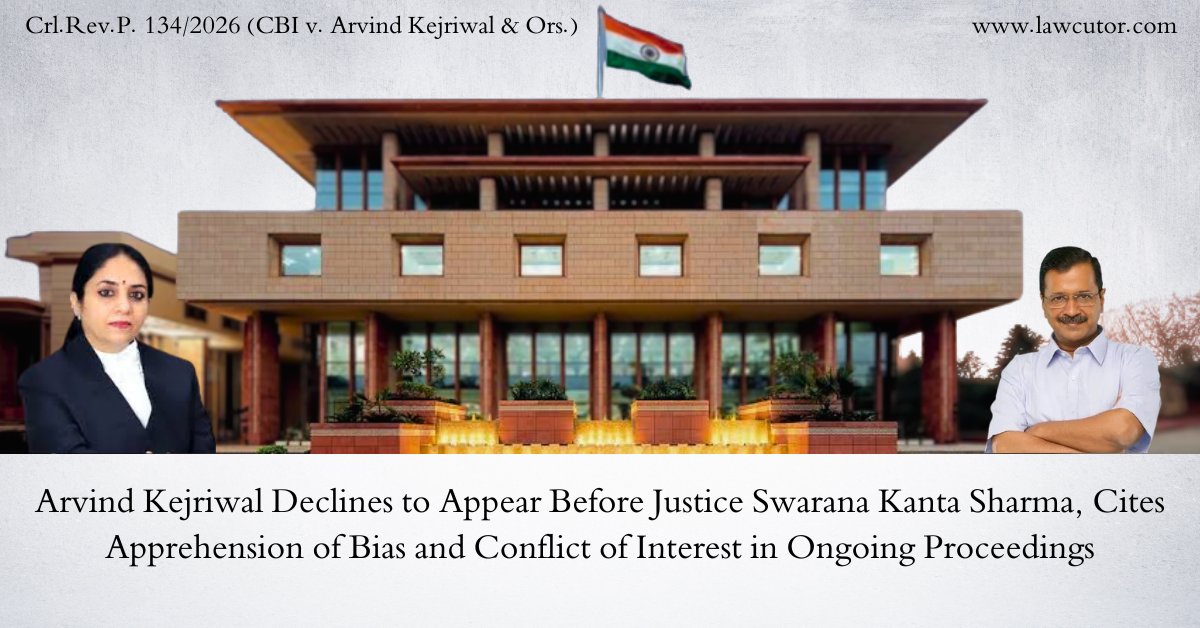
Aam Aadmi Party national convenor Arvind Kejriwal has written a detailed four-page letter to Justice Swarana Kanta Sharma of the Delhi High Court, informing her of his inability, in conscience, to participate in further proceedings in Crl.Rev.P. 134/2026 pending before her bench. In the letter, Kejriwal stated that he was writing “with utmost respect to your office and to the institution of the judiciary” and “with pain, with humility, and with an abiding faith in the role of judiciary.” He clarified that the letter was not written in anger or disrespect but out of a deep concern for the faith of ordinary citizens in the impartiality of the judicial process.
Kejriwal explained that he had earlier filed an application seeking recusal on the ground of genuine apprehension whether justice would not only be done but also be seen to be done. After the dismissal of that application by order dated 20 April 2026, he reflected deeply and concluded that his well-grounded apprehensions had not been removed. He wrote that the language of the judgment conveyed that his plea had been perceived as a personal attack, making it impossible for him to believe that he would receive a hearing which appears impartial. He said, “Those are not, with respect, answers to the case I had brought. They show me that my plea of apprehension has been judicially understood as a personal and institutional affront. And once that has happened, how do I expect that I would be heard on a wholly clean slate.”
In the letter, Kejriwal reiterated two principal concerns. First, Justice Sharma’s repeated public association with the RSS’s legal front, the Akhil Bharatiya Adhivakta Parishad (ABAP), an organisation belonging to the ideological ecosystem of the ruling dispensation. He noted that politically and ideologically, he and his party have been staunch opponents of the ruling dispensation at the Centre and of RSS ideology. He referred to the public statement of former Justice Abhay S. Oka, who said he would have declined an invitation from the Adhivakta Parishad while serving as a sitting judge because of its political inclinations, to indicate that the apprehension expressed was neither fanciful nor idiosyncratic.
Second, and more seriously, Kejriwal highlighted a direct conflict of interest arising from the professional engagements of Justice Sharma’s children on multiple advocates’ panels of the Union Government. He pointed out that the CBI, represented by Solicitor General Tushar Mehta, is the opposite party in the case, and both children are directly assigned cases by Mr. Mehta. Kejriwal referred to RTI material showing that her son had been marked an extraordinarily high number of dockets — 5,904 between 2023 and 2025 — placing him among the top ten counsels receiving the highest number of allocations. He stated that in financial terms, such volume of appearances would translate into substantial professional remuneration running into crores of rupees. He also noted the timeline of empanelment of both children shortly after her elevation to the High Court, describing the sequence as “troubling” and bound to deepen public apprehension.
Kejriwal invoked the Gandhian principle of Satyagraha, stating that after giving the authority an opportunity to consider and correct what he perceived to be a grave miscarriage of justice, he had reached a point where he could no longer meaningfully participate in the proceedings without feeling that he was lending his presence to a process in which his faith stands deeply shaken. He wrote, “I cannot, in good conscience, argue as though nothing is amiss in these proceedings. To do so would be a betrayal of my conscience, a disservice to the dignity of the judiciary, and an injustice to the people of India who still believe that courts are the last refuge against the overreach of power.” He acknowledged that the decision may prejudice his own legal interests and that he was prepared to bear the consequences.
He clarified that his inability was confined to this matter and to future proceedings in which the same apprehensions arise with equal force. He stated that he would continue to appear before Justice Sharma in matters unconnected with the Union Government, the BJP, or the RSS. He also reserved his right to challenge the judgment rejecting recusal and to pursue remedies before the Supreme Court.
Kejriwal reiterated that his faith in the Constitution of India remains unwavering and his respect for the judiciary remains intact. He said his objection was not to the institution but only to the continuance of this matter before Justice Sharma under a cloud of grave and unresolved questions and circumstances that have generated grave public doubt in her ability to dispense impartial justice. He requested that the letter be taken on record and that the Court proceed further as it may deem fit.
The letter was signed by Arvind Kejriwal as Respondent No. 18 in the CBI liquor policy case.
Case Reference: Crl.Rev.P. 134/2026 (CBI v. Arvind Kejriwal & Ors.)

