
Introduction
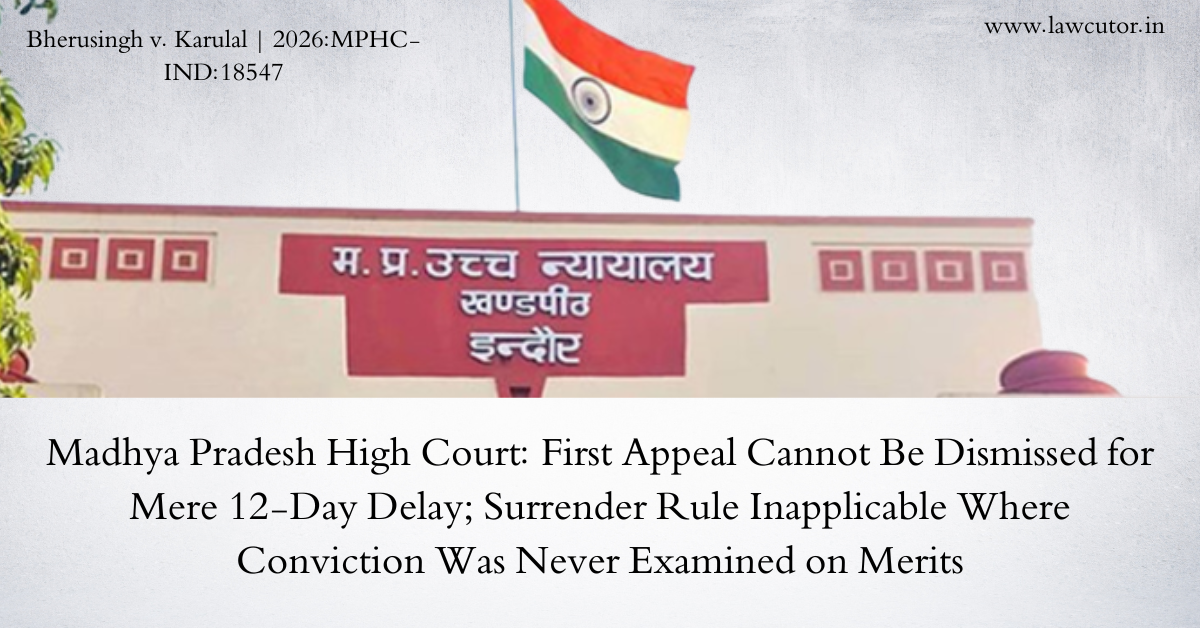
The Madhya Pradesh High Court, Indore Bench, has set aside a Sessions Court order that dismissed a convict’s first appeal solely on the ground of a 12-day delay in filing, without examining the appeal on its merits. In doing so, the Court also clarified an important procedural question: whether the mandatory surrender requirement under Rule 48 of the M.P. High Court Rules applies where a convicted person’s very first appeal was rejected at the threshold on limitation grounds, without any judicial scrutiny of the conviction itself.
Background Facts
The respondent had filed a complaint under Section 138 of the Negotiable Instruments Act before the trial court at Jaora, alleging dishonour of a cheque for Rs. 1,40,000 due to insufficient funds. The Judicial Magistrate, Jaora, convicted the petitioner by judgment dated 30.01.2026, sentencing him to rigorous imprisonment and directing him to deposit Rs. 1,40,000 as compensation with 6% interest within three months.
Aggrieved, the petitioner filed a criminal appeal before the Sessions Judge, Jaora, but the appeal was filed 12 days beyond the limitation period. Along with the appeal, an application under Section 5 of the Limitation Act was moved, citing the petitioner’s rural background, his lack of awareness of the limitation period, and intervening court holidays as reasons for the delay. By the impugned order dated 02.04.2026, the IInd Additional Sessions Judge, Jaora, dismissed the Section 5 application at the threshold, without hearing the appeal on its merits — resulting in the trial court’s conviction and sentence standing affirmed by default.
Contentions of the Petitioner
The petitioner argued that the Sessions Court had adopted a hyper-technical and pedantic approach in rejecting a delay of merely 12 days, disregarding the settled principle that “sufficient cause” under Section 5 of the Limitation Act must be liberally construed to advance substantial justice. It was submitted that refusing to condone a short delay effectively defeated the statutory right of appeal — a valuable right available to an accused — and that the Sessions Court had rejected the application mechanically, without recording cogent reasons, contrary to the liberal approach required in quasi-criminal matters under the N.I. Act. The petitioner also raised merits-based grounds regarding alleged contradictions in witness testimony and the absence of proof of a legally enforceable debt, submitting that these could not even be considered because the appeal had been shut out at the threshold.
Alongside the revision, the petitioner also moved an application (IA No. 5618/2026) seeking exemption from the requirement of surrender under Rule 48 of the M.P. High Court Rules read with Section 482 Cr.P.C., relying on the Supreme Court’s decision in Vivek Rai v. State of Jharkhand, (2015) 12 SCC 86, for the proposition that the High Court retains inherent power to grant such exemption in exceptional circumstances, and citing prior decisions of the same High Court in Sanjay Nagayach v. State of Madhya Pradesh (CRR No. 729/2024) and Devnarayan v. Prateek Goyanka (CRR No. 1912/2024).
Contentions of the Respondent
The respondent opposed both the revision and the exemption application, arguing that the Sessions Court’s order was legally sound and that the petitioner’s stated grounds — rural background and court holidays — were merely formal and unconvincing. On the surrender question, the respondent relied on the Madhya Pradesh High Court’s own decision in Deepak Sahu v. State of M.P., 2012(3) MPLJ 534, which held that a criminal revision against a conviction is maintainable only where it contains a declaration that the convicted person is in custody or has surrendered after conviction, except where the sentence has been suspended by the court below.
The Court’s Analysis
On the scope of revisional jurisdiction
The Court reiterated that revisional jurisdiction under the Cr.P.C. is supervisory and corrective, and that a revisional court ordinarily does not re-appreciate evidence afresh unless necessary to prevent a manifest miscarriage of justice. Importantly, the Court noted that the Sessions Court had dismissed the appeal purely on the 12-day limitation bar and had never touched the merits of the conviction at all.
On the condonation of delay
The Court examined the Sessions Court’s original order (reproduced in Hindi in the judgment) and found that it had rejected the explanation for delay — the petitioner’s rural, uneducated background engaged in agricultural labour, coupled with the Holi festival period — on the footing that these circumstances did not plausibly explain the entirety of the delay, and had accordingly held the delay inexcusable. The High Court found this reasoning to reflect a hyper-technical, rigid, and pedantic approach, holding that a short delay of 12 days is minimal and deserves a liberal, justice-oriented construction so as to advance substantial justice rather than defeat a key statutory right at the threshold. The failure to exercise jurisdiction judiciously in this regard was held to constitute a patent material irregularity warranting revisional intervention.
On the surrender requirement under Rule 48
This was the more significant part of the ruling. The Court set out Rule 48 of the M.P. High Court Rules, which mandates that a memorandum of appeal or revision against a conviction must contain a declaration that the convicted person is in custody or has surrendered after conviction, except where the sentence has been suspended by the court below. It also examined the earlier ruling in Deepak Sahu, which held this declaration to be mandatory based on the plain language of Rule 48, and the Supreme Court’s decision in Vivek Rai, which upheld an analogous surrender rule of the Jharkhand High Court on the reasoning that its object is to ensure a convicted person — whose conviction has already been scrutinised and sustained by two consecutive courts — does not evade the law by absconding.
The High Court held that this rationale presupposes that the conviction has, in fact, been substantively scrutinised by two courts. Here, however, the Sessions Court’s dismissal on a technical limitation bar meant the appeal itself was never heard on merits, and the petitioner had been entirely deprived of his initial statutory right of first appeal owing to a marginal delay of only 12 days. In this different operational context, the Court held that Rule 48 would not apply, since enforcing a strict surrender requirement at this stage — where the first appellate court had rejected the petition mechanically over a brief 12-day limitation window — would impose an excessive procedural hardship not intended by the framework of the subordinate court rules.
The Order
The Court passed the following directions:
- The Criminal Revision Petition was allowed, and the impugned order dated 02.04.2026 passed by the IInd Additional Sessions Judge, Jaora, was set aside.
- The matter was remanded to the Sessions Court, which was directed to decide the appeal on its merits, condoning the 12-day delay.
- The petitioner was directed to approach the Sessions Court within 30 days.
- The application seeking exemption from surrender (IA No. 5618/2026) was allowed until the petitioner approaches the Sessions Court.
Case Details: Bherusingh v. Karulal High Court of Madhya Pradesh, Indore Bench | Criminal Revision No. 1718 of 2026 | Neutral Citation: 2026:MPHC-IND:18547 Before: Justice Jai Kumar Pillai | Reserved on 06.07.2026, Pronounced on 10.07.2026
Click HERE for full judgment.
 Lawcutor