
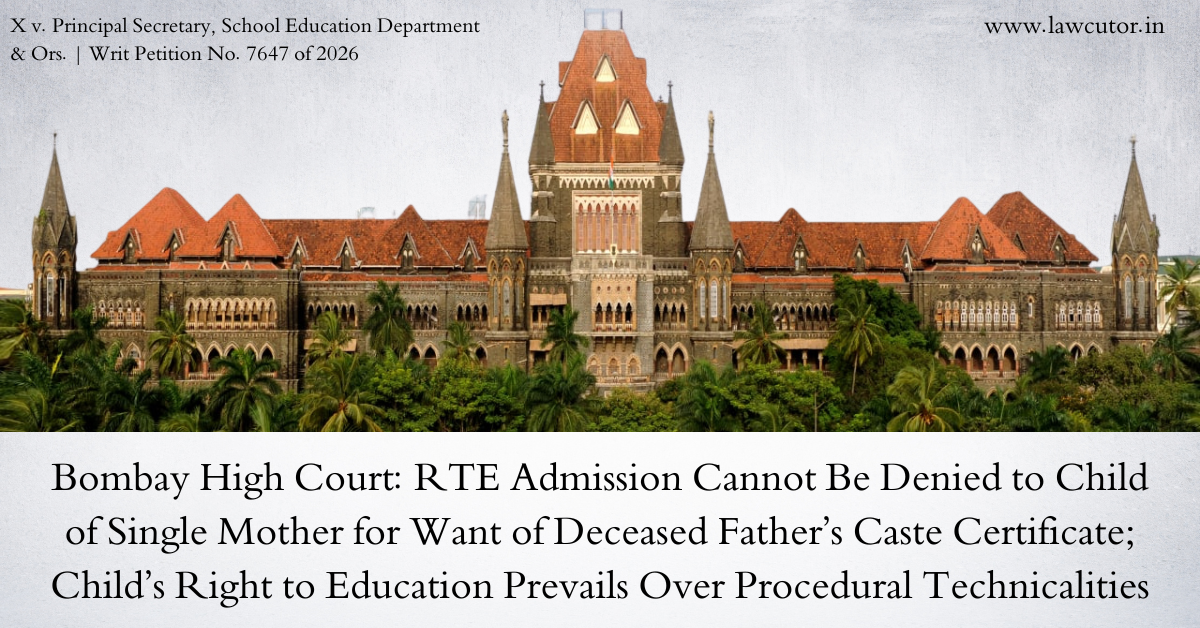
Background
X, a single mother working as a house help in Pune, applied for her daughter’s admission under the Right to Education (RTE) Act, 2009 quota in an English Medium School.
The family belongs to the Dhangar community (Nomadic Tribe – C). The father had passed away in December 2021. The authorities rejected the application solely because the father’s caste certificate was not produced, despite the mother’s valid caste certificate and the father’s School Leaving Certificate clearly showing Dhangar community.
Appeals before the Education Officer and Deputy Director were dismissed on the same hyper-technical ground.
Key Legal Issue
Can admission under RTE be denied to a child of a single mother solely for want of the deceased father’s caste certificate when the mother’s caste certificate and other evidence are available?
Bombay High Court’s Ruling
The High Court allowed the writ petition and directed immediate admission.
Landmark Observations:
- Mother as Natural Guardian: When the father is deceased, the mother is the natural guardian. Insisting on the father’s documents in such cases is unsustainable.
- Caste Determination Not Rigid: Citing Supreme Court judgments (Rameshbhai Dabhai Naika v. State of Gujarat and Githa Hariharan), the Court held that caste of a child is not exclusively determined by the father. In cases of disadvantage, the child can legitimately take the mother’s caste.
- Child’s Fundamental Rights Prevail: Denial of RTE admission on technical grounds violates the child’s right to free and compulsory education and equality under the Constitution. Procedural rigidity cannot override substantive justice.
- Evidence Considered Holistically: The mother’s caste certificate + father’s School Leaving Certificate (verified by the school) were sufficient proof of the child’s eligibility.
Directions Issued:
- Impugned orders quashed.
- Authorities directed to grant admission to the petitioner’s daughter under RTE quota on or before 31 July 2026 without insisting on the father’s caste certificate.
Significance of the Judgment
- Progressive & Child-Centric: Strongly discourages patriarchal and hyper-technical approaches in RTE implementations.
- Protects Single Mothers & Vulnerable Children: Provides relief in cases where one parent is unavailable.
- Reinforces RTE Objectives: Ensures that bureaucratic hurdles do not deny educational opportunities to children from marginalized communities.
Key Precedents Relied Upon
- Rameshbhai Dabhai Naika v. State of Gujarat (2012) 3 SCC 400
- Githa Hariharan v. Reserve Bank of India (1999)
- Division Bench rulings of Bombay High Court on similar issues
Quote from the Judgment:
“The constitutional guarantee of free and compulsory education to children, and the substantive equality could not have been sacrificed at the altar of procedural rigidity…”
This judgment is a significant win for single parents and underscores that welfare schemes like RTE must be implemented with sensitivity and constitutional values.
Case Title: X v. Principal Secretary, School Education Department & Ors.
Writ Petition No. 7647 of 2026
Coram: Justice N.J. Jamadar
Pronounced on: 22 July 2026
Click HERE for full JUDGMENT
 Lawcutor