
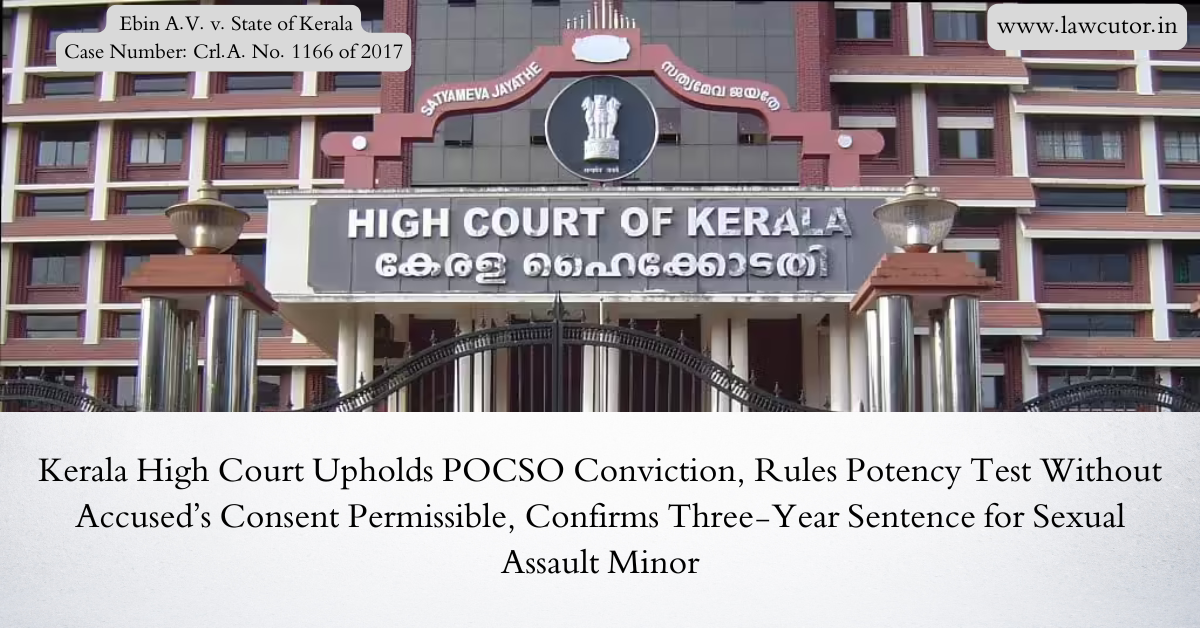
In a judgment dated *25th May 2026, the Kerala High Court dismissed Criminal Appeal No. 1166 of 2017 filed by the accused, **Ebin A.V., confirming his conviction and sentence under *Section 7 read with Section 8 of the Protection of Children from Sexual Offences (POCSO) Act, 2012. The appeal challenged the judgment dated 14.11.2017 passed by the Additional District & Sessions Court (Special Court for cases relating to atrocities and sexual violence against women and children), Ernakulam, in S.C. No. 756 of 2016.
The prosecution case was that the accused, then aged 21 years, committed sexual assault on a 17-year-old victim on multiple occasions in April and May 2016. The allegations included the accused entering the victim’s house at night, kissing her, hugging her, and touching her private parts. The trial court convicted him under Section 7 r/w 8 of the POCSO Act and sentenced him to three years’ rigorous imprisonment and a fine of Rs.10,000 (with default sentence of one month).
Dismissing the appeal, Justice A. Badharudeen held that the evidence of the victim (PW1) was reliable to the extent that it established the ingredients of sexual assault under Section 7 of the POCSO Act. The victim had deposed about the accused kissing her, hugging her, and touching her private parts. Although she turned hostile regarding penetration/sexual intercourse, her testimony on the other overt acts remained unchallenged in cross-examination and was corroborated by her father (PW3), sister (PW4), and other witnesses.
The Court rejected the contention that the victim’s testimony was uncorroborated or riddled with contradictions sufficient to discard it entirely. It observed that merely because a witness turns hostile on certain aspects, the reliable portions of the testimony cannot be eschewed, especially when not effectively challenged by the defence.
On the issue of the victim’s age, the Court relied on the birth certificate (Ext.P4) issued by the Panchayat Secretary (PW5), which showed the victim’s date of birth as 24.12.1998, making her a minor at the time of the incident. The Court held this to be a reliable document for proving age under the POCSO Act.
A notable observation in the judgment was regarding the potency test conducted on the accused. The appellant had argued that the test was done without his informed consent, violating his fundamental right to privacy and bodily integrity under Article 21 of the Constitution. Rejecting this ground, the Court held:
“In fact, a challenge raised regarding the potency test on the ground that it was conducted without the consent of the accused in a criminal case is not tenable with the aid of Article 21 of the Constitution of India, since such a test is legally permissible, without the consent of the accused and is not prohibited under Article 21 of the Constitution.”
The Court also dismissed other grounds raised by the appellant, including alleged ineffective assistance of trial counsel, procedural lapses in the medical certificate, and the constitutional validity of the age threshold under the POCSO Act. It reiterated that a person below 18 years is considered a child under the POCSO Act and that the rigid age limit does not warrant judicial interference in this context.
Since the sentence of three years was the statutory minimum prescribed under Section 8 of the POCSO Act for the offence under Section 7, the Court held that no reduction was legally permissible. Consequently, both the conviction and sentence were upheld, and the appeal was dismissed..
Case Title: Ebin A.V. v. State of Kerala
Case Number: Crl.A. No. 1166 of 2017
Court: Kerala High Court, Ernakulam
Date of Judgment: 25th May 2026
Coram: Hon’ble Mr. Justice A. Badharudeen
Click HERE for full Judgment.

