
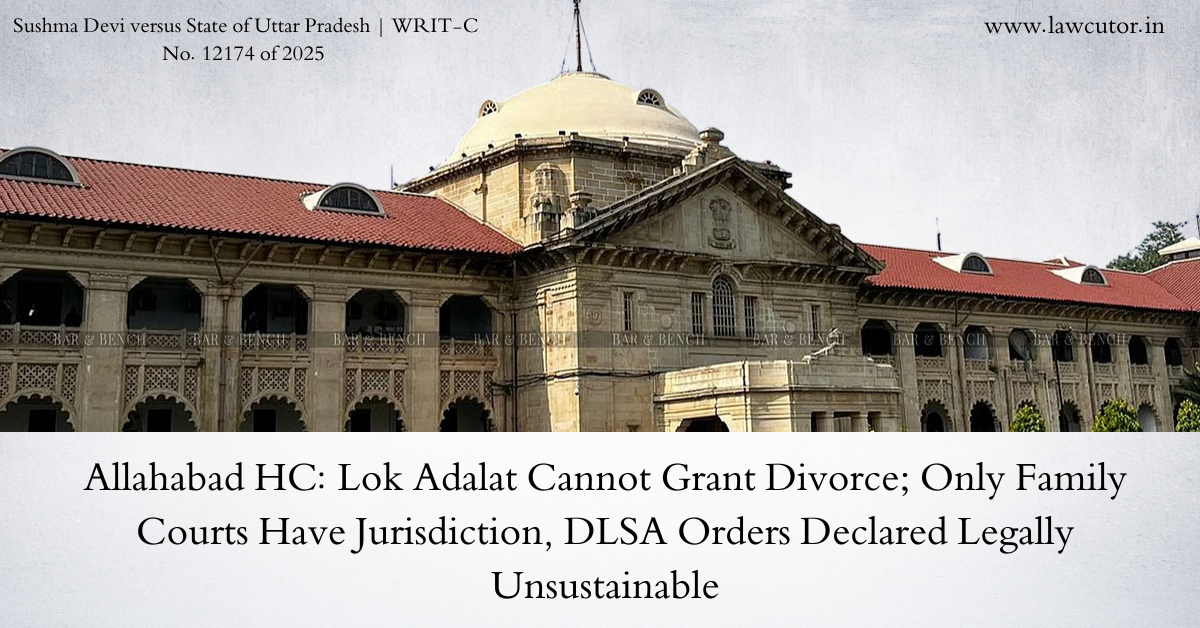
The Allahabad High Court (Lucknow Bench) has held that a Lok Adalat or District Legal Services Authority has no legal competence or jurisdiction to grant a decree of divorce, as this power vests exclusively in regular civil and family courts. A division bench of Justice Shekhar B. Saraf and Justice Abdhesh Kumar Chaudhary made these observations while disposing of a writ petition filed by Smt. Sushma Devi, who had challenged two orders passed by the District Legal Services Authority, Unnao — the first being an order/report dated June 12, 2018 based on a mediation settlement, and the second being a review order dated June 30, 2025 dismissing her challenge to the said settlement.
The facts of the case reveal that Respondent No. 3, the husband, had preferred a pre-litigation suit bearing No. 92/2018 before the DLSA, Unnao, in June 2018. A notice was issued on June 1, 2018, and on June 12, 2018 itself, the matter was referred to mediation. The petitioner-wife alleged that the husband fraudulently obtained her signatures on the settlement terms, which purportedly recorded a divorce by mutual consent. The Authority thereafter disposed of the matter vide order dated July 14, 2018 in terms of the said settlement. The wife disputed the settlement in its entirety, contending that it was a complete farce, as the parties had continued to live together as husband and wife even after the said proceedings, and a girl child named Gunjan was born out of their wedlock on November 22, 2019 — more than a year after the alleged settlement. The controversy reached its peak when the husband began justifying his second marriage on the basis of the settlement/orders of the Authority. The wife’s review application was dismissed by the DLSA vide order dated June 30, 2025, following which she approached the High Court.
In an earlier order dated February 3, 2026, a co-ordinate bench of this Court had taken note of the fact that the counsel appearing for Respondent No. 2/Secretary, DLSA had fairly conceded that the impugned order was way beyond the jurisdiction of the Lok Adalat, as such an order could only have been passed under Section 13B of the Hindu Marriage Act, 1955 by a Family Court or Civil Court. The Court had accordingly directed Mohd. Rashid, who had acted as Mediator in the proceedings and was at the relevant time working as ADJ/FTC-I, Unnao, and is presently serving as Registrar in the State Consumer Disputes Redressal Commission, Lucknow, to file an affidavit explaining the order passed by him on June 12, 2018. In his personal affidavit dated February 18, 2026, Mohd. Rashid categorically stated that he had not ratified any divorce and that his role was confined solely to facilitating discussions and recording terms of settlement, if any. He specifically clarified: “At the pre-litigation stage, a Mediator is not empowered to grant, ratify, or pass any order of divorce, his role being confined solely to facilitating discussions and recording the terms of settlement, if any.”
The division bench, after examining the matter in depth, adverted to the scheme of the Legal Services Authorities Act, 1987 and the National Legal Services Authority (Lok Adalats) Regulations, 2009. The Court noted that Regulation 9 specifically provides that Lok Adalats shall have the power only to help the parties to arrive at a compromise or settlement and that they shall not issue any direction or order in respect of a dispute. Referring to the proviso to Regulation 10(2), the bench underscored that matters relating to divorce simply cannot be referred to a Lok Adalat. The Court observed: “This Court fails to comprehend that when a divorce matter itself cannot be referred to Lok Adalat, how a decree of divorce could have been expected to be granted by any Lok Adalat in a prelitigation matter.”
The bench also examined Regulation 17 in detail, noting that the drawing up of an award by the Lok Adalat is merely an administrative act of incorporating the terms of settlement or compromise agreed upon by the parties. Regulation 17(5) specifically casts a duty upon the members of the Lok Adalat to ensure that the terms of settlement are not unreasonable, illegal or one-sided, and that the parties have entered into the settlement voluntarily and not on account of any threat, coercion or undue influence. Regulation 17(6) further provides that members of the Lok Adalat should affix their signatures only to settlements reached before them and should avoid affixing signatures to settlements reached by parties outside the Lok Adalat with the assistance of third parties, so as to prevent the forum from being used to commit fraud or forgery. The Court noted with concern that none of these safeguards appeared to have been observed in the present case.
Taking strong exception to the terms of the settlement agreement, the bench found that the clause stating “each party are free to re-marry,” recorded at point no. 6(cha) of the settlement, was absolutely illegal and forbidden by law. The Court observed: “This court is unable to understand as to how and in what manner the said settlement could had been signed and would had passed the eye-test of the members of the Lok Adalat in the first place, especially when it is quite understandable from the facts that parties had approached the Lok Adalat and/or Authority under a prelitigation suit and had not been divorced as per law as on that date.” The bench held that any such term in a settlement, if at all included, ought to have explicitly stated that it would come into effect only after a divorce is granted by a competent court.
Referring to Regulation 17(7), which specifically proscribes the grant of divorce by mutual consent by a Lok Adalat, the bench remarked: “The Lok Adalat/Authority should be conscious and remember that when Regulation 17(7) specifically proscribes grant of divorce by mutual consent, which means it was not within the legal competency of the Lok Adalat to grant any such prayer of divorce, it is starting to see this kind of cryptic orders passed under the Regulations.” The Court accordingly held that the contention of Respondent No. 3/husband that the settlement/orders of the Authority amounted to a divorce was without any basis or force of law, and that the principle of ignorantia juris non excusat — ignorance of law excuses no one — applied with full force.
The bench also noted with displeasure the speed with which the entire proceedings had been conducted by the DLSA — the notice to the opposite party, the reference to mediation, and the settlement agreement all having taken place on the very same date of June 12, 2018. The Court cautioned that such “tearing hurry” in resolving sensitive matrimonial matters must be avoided in all circumstances, and that the Lok Adalat/DLSA ought to have acted reasonably and dispassionately, especially in matrimonial cases which carry an emotional dimension beyond mere legal rights. The bench observed that in all matrimonial cases, no party truly wins as it is a defeat for both the individuals and the institution of marriage, and the Lok Adalats ought therefore to be empathetically sensitive to the issues placed before them.
While affirming the pivotal role played by Lok Adalats in unclogging judicial backlog and providing accessible, affordable and expeditious justice, the bench drew a clear distinction between that role and the usurpation of the powers of competent courts. The Court held: “It is expected that these Lok Adalats/DLSA, who are harbingers of early disposal should exercise their powers strictly within the four corners of law as provided under the provisions of the Act and the Regulations framed therein and should not wander into the realms, which is exclusively reserved for regular courts/tribunals.” The Court found that the cryptic orders passed by the DLSA, Unnao had not only usurped the power of the Family Court to grant a decree of divorce but had also given rise to a multiplicity of proceedings, adversely affecting the status and rights of several persons, which was neither envisaged nor intended by the provisions of the Act.
Disposing of the writ petition, the Court categorically declared that till date there has been no formal divorce decree between the petitioner and Respondent No. 3. The petitioner was granted liberty to proceed in accordance with law against Respondent No. 3 as legally advised. The Court further directed that a copy of the order be placed before the Registrar General of the Allahabad High Court with a direction to circulate the same among all Lok Adalats and DLSAs across the State of Uttar Pradesh for necessary compliance and future reference.
Case Details:
High Court of Judicature at Allahabad (Lucknow Bench)
Sushma Devi versus State of Uttar Pradesh | Case No.: WRIT-C No. 12174 of 2025
Bench: Justice Shekhar B. Saraf and Justice Abdhesh Kumar Chaudhary
Date: April 30, 2026
Click HERE for full Judgment.
 Lawcutor