
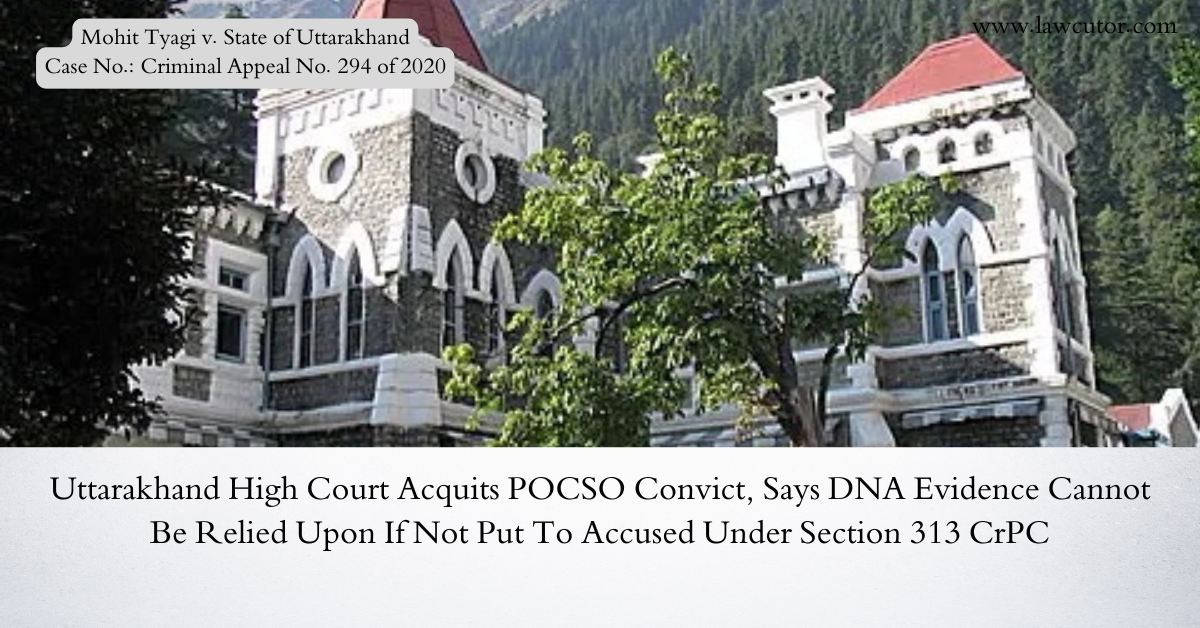
The Uttarakhand High Court has allowed the criminal appeal filed by Mohit Tyagi and set aside the judgment and order dated 13.01.2020 passed by the Fast Track Court/Special Judge (POCSO), Dehradun, thereby acquitting the appellant of all charges under Sections 363, 377 and 506 of the Indian Penal Code and Section 4 of the Protection of Children from Sexual Offences Act, 2012. The Division Bench comprising Justice Ravindra Maithani and Justice Siddhartha Sah held that the prosecution miserably failed to prove its case beyond reasonable doubt, primarily on account of serious doubts regarding the identification of the accused and the complete inability to rely upon the FSL report.
The prosecution case was that on 15.08.2018 at about 6:30 p.m., the 13-year-old victim, while returning from tuition, was forcibly taken by the appellant on his motorcycle to a secluded place near Shanti Dham, Dakpathar, where he committed unnatural sexual assault upon the victim and threatened him with dire consequences. The FIR was lodged at 11:30 p.m. the same day on the basis of the victim’s statement to his father. The appellant was arrested the next day. The Trial Court convicted him primarily on the basis of the victim’s testimony, medical evidence showing tenderness in the anus, and the FSL report indicating matching of DNA from the victim’s blood with semen detected on the appellant’s underwear.
The High Court, after a detailed scrutiny of the evidence, found the prosecution story highly doubtful from its very inception. The victim (PW-1) himself admitted in cross-examination that he had seen the appellant for the first time on the date of the incident and that it was dark at the time of the occurrence. He did not know the appellant previously. The informant (PW-2), father of the victim, also admitted that he did not know the appellant from before and that no Test Identification Parade was conducted either at the police station or before the Magistrate. The police had shown a photograph to the victim for identification, a fact which was not stated in the statements given to the Investigating Officer. The Court observed that the prosecution failed to give any satisfactory explanation as to how the appellant’s name was mentioned in the FIR and how he could be identified when the incident allegedly took place in darkness.
The Bench further held that the FSL report dated 15.11.2018, which showed matching of DNA, could not be relied upon against the appellant. The medical examination report of the appellant recorded that he had taken a bath and changed clothes in the morning before examination. Moreover, the conclusions of the FSL report were never put to the appellant during his examination under Section 313 CrPC, depriving him of an opportunity to explain the same. The Court emphasised that incriminating material not confronted to the accused cannot be used against him for sustaining conviction. Serious doubts were also expressed regarding the chain of custody of the underwear allegedly seized from the appellant.
The High Court concluded that the prosecution utterly failed to prove the charges beyond reasonable doubt. The testimony of the victim and other prosecution witnesses suffered from material inconsistencies and lacked corroboration on vital aspects. Consequently, the conviction and sentence of 20 years rigorous imprisonment under Section 4(2) of the POCSO Act along with other sentences were set aside. The appellant, who was in jail, was directed to be released forthwith if not required in any other case, upon furnishing personal bond and two sureties to the satisfaction of the trial court.
This judgment underscores the importance of proper identification of the accused in cases involving a single witness, especially where the incident allegedly occurred in darkness, and reiterates the mandatory requirement of confronting the accused with incriminating evidence under Section 313 CrPC before it can be used against him.
Case Details:
Title: Mohit Tyagi v. State of Uttarakhand
Case No.: Criminal Appeal No. 294 of 2020
Coram: Justices Ravindra Maithani and Siddhartha Sah
Date of Judgment: 29.04.2026
Click HERE for full Judgment.

