
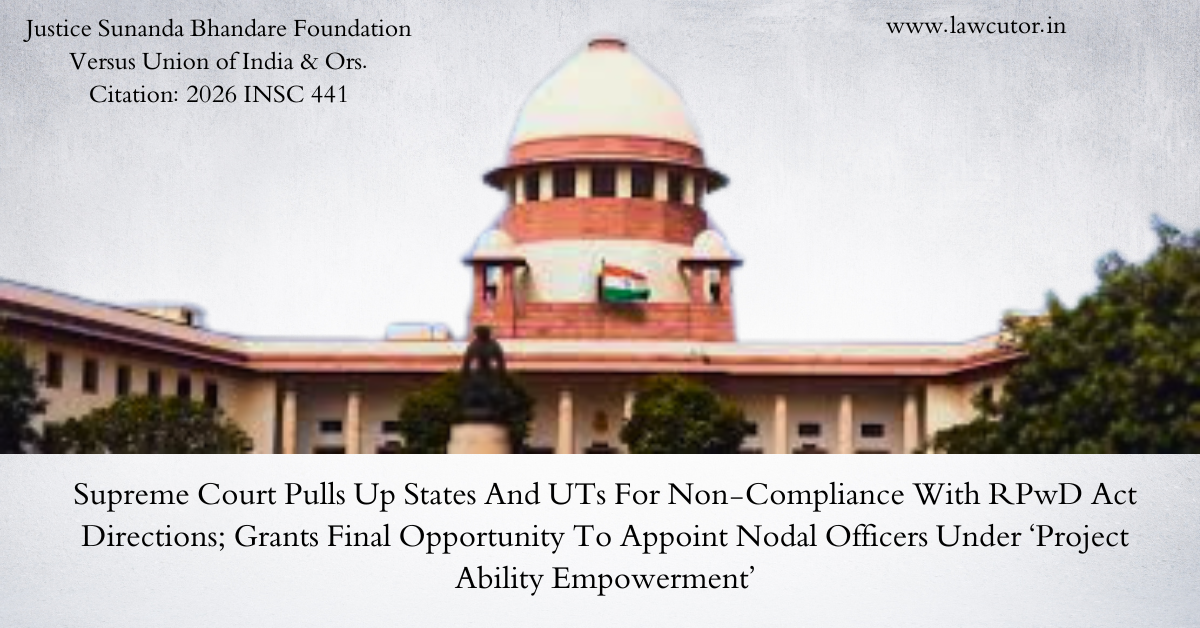
The Supreme Court has expressed serious displeasure at the continued inaction by several States and Union Territories in appointing Nodal Officers in compliance with its earlier directions issued in the judgment dated 12th September, 2025. In an order passed on 28th April, 2026, a bench comprising Justices Vikram Nath and Sandeep Mehta granted a final opportunity to the defaulting States and Union Territories to appoint the Nodal Officers before the next date of hearing. The Court noted that despite the lapse of seven months, multiple States and Union Territories had failed to act, thereby impeding the effective functioning of National Law Universities in discharge of the mandate of this Court and undermining the implementation of statutory mandates affecting vulnerable sections of the society.
The Court recorded that out of the defaulting States and Union Territories referred to in its earlier order dated 15th April, 2026, several had since appointed Nodal Officers, including the States of Chhattisgarh, Meghalaya, Manipur, Sikkim, Tripura, Mizoram and Uttarakhand as well as the Union Territory of Delhi. However, the States of Kerala, Jharkhand, Odisha, Arunachal Pradesh, Madhya Pradesh and Telangana as well as the Union Territories of Puducherry, Lakshadweep Islands, Ladakh, Chandigarh and Andaman and Nicobar Islands had still not appointed Nodal Officers. Counsel appearing for these States and Union Territories submitted that Nodal Officers have since been appointed on different dates in April, 2026. Consequently, only the Union Territories of Lakshadweep Islands and Ladakh are yet to appoint Nodal Officers. In respect of these Union Territories, Mr. K.M. Nataraj, learned Additional Solicitor General, submitted that Mr. Vatsal Joshi, Advocate-on-Record, shall take necessary steps in the matter. A final opportunity was granted to the Union Territories of Lakshadweep Islands and Ladakh to appoint Nodal Officers positively on or before 15th May, 2026. The Registry was directed to forthwith transmit a copy of this order as well as the order dated 15th April, 2026 to Mr. Vatsal Joshi for ensuring compliance.
On the issue of upward movement of meritorious candidates with benchmark disabilities, the Court took note of the compliance affidavit filed by the Union of India on 2nd January, 2026 through the Department of Personnel and Training (DoPT). The affidavit referred to Office Memoranda dated 15th January, 2018; 17th May, 2022; and 27th September, 2022 which collectively provide that a PwBD candidate selected on the basis of his/her own merit, without availing relaxed standards, is to be adjusted against unreserved (UR) vacancies and not against the quota reserved for PwBD category. Conversely, candidates who avail relaxed standards are to be adjusted against reserved vacancies. The executive instructions extend this principle to both direct recruitment and promotions, including seniority-cum-fitness and selection-based promotions. It was clarified that certain facilitative measures such as the provision of a scribe or compensatory time shall not be treated as relaxation of standards, whereas relaxations in cut-off marks, age, number of attempts or other eligibility criteria would amount to relaxed standards. The disability of a person shall not be treated as a relaxed standard in the medical fitness test for the purpose of determining “own merit.” The affidavit further emphasized that reservation for PwBD candidates operates horizontally across categories and that the policy of “own merit” is consistently applied to ensure that meritorious candidates are not denied their rightful placement while also safeguarding the interests of those requiring reservation benefits.
Having considered the aforesaid affidavit and the policy framework placed on record, the Court was satisfied that the Union of India has adequately addressed the query raised in paragraph 53 of the judgment dated 12th September, 2025. The position in law, as clarified, ensures that meritorious candidates belonging to the PwBD category are entitled to be considered against unreserved vacancies on the basis of their own merit, while preserving the efficacy and purpose of reservation. The Court endorsed the said position and exhorted the Union of India, as well as all States and Union Territories, to scrupulously adhere to and implement the policy of upward movement in its true letter and spirit, so as to advance the constitutional mandate of equality, dignity and inclusion for persons with disabilities.
On the broader issue of implementation of the Rights of Persons with Disabilities Act, 2016, the Court noted that the status report filed by the petitioner in Writ Petition (Civil) No. 116 of 1998 reveals that the issue of non-compliance is longstanding and persists despite repeated judicial directions. The status report traces the history of the proceedings, noting that even under the earlier regime of the Persons with Disabilities (Equal Opportunities, Protection of Rights and Full Participation) Act, 1995, compliance by States and Union Territories remained inadequate, necessitating continued monitoring by this Court. Despite multiple subsequent orders wherein timelines were fixed, affidavits of compliance were sought, and senior officials were directed to ensure implementation, the status report indicates persistent gaps. While some States and Union Territories have filed compliance affidavits, a significant number continue to remain either non-compliant or only partially compliant. The status report also highlights deficiencies such as failure to establish mandatory institutional mechanisms, including State Funds for Persons with Disabilities, and inadequate implementation across key areas of the Act, 2016. It further notes that although monitoring mechanisms such as “Project Ability Empowerment” was put in place pursuant to this Court’s directions, the interim reports have not adequately addressed the issue of implementation of the Rights of Persons with Disabilities Act, 2016. Overall, the status report underscores that, nearly eight years after the coming into force of the Rights of Persons with Disabilities Act, 2016, full and effective compliance by all States and Union Territories remains elusive, thereby necessitating continued judicial oversight.
Considering the status report placed on record and the submissions advanced, the Court was of the opinion that, in view of the fact that almost all the States and Union Territories have now appointed Nodal Officers, the issue relating to the implementation of the Rights of Persons with Disabilities Act, 2016 can be more effectively and comprehensively examined by the National Law Universities entrusted with the exercise under “Project Ability Empowerment.” The appointment of Nodal Officers provides an institutional framework for coordination and accountability, which was hitherto lacking, and is expected to facilitate the collection of accurate data, identification of deficiencies, and prompt redressal of gaps in implementation across jurisdictions. The Court considered it appropriate that the National Law Universities entrusted with the exercise under “Project Ability Empowerment”, in terms of the directions issued by this Court, undertake a detailed and structured assessment of the implementation of the Rights of Persons with Disabilities Act, 2016 across all States and Union Territories. Such monitoring shall not be merely formal but must involve a substantive evaluation of compliance with statutory mandates, including the creation of requisite institutional mechanisms, enforcement of rights, and accessibility measures. The concerned authorities and more particularly the Nodal Officers shall extend full cooperation to the National Law Universities to enable an effective and time-bound assessment, so that the object and purpose of the enactment are meaningfully realized.
The Court further directed that National Law University, Delhi shall undertake the exercise of mapping the extent of compliance with the provisions of the Rights of Persons with Disabilities Act, 2016 achieved by the Union of India. For the purpose of ensuring effective coordination and meaningful engagement, the Secretary, Department of Social Justice and Empowerment, Union of India, shall depute an officer not below the rank of Joint Secretary to participate in the meetings to be convened by National Law University, Delhi in relation to the directions issued by this Court in the present order. A copy of this order shall be transmitted to the Registrar of each of the eight National Law Universities as mentioned in paragraph 36 of the judgment and order dated 12th September, 2025, as well as to the Secretary, Department of Social Justice and Empowerment, Union of India and Chief Secretaries of all States and Union Territories, for immediate compliance. The matter was directed to be listed on 22nd September, 2026 for receiving the updated status reports from the National Law Universities.
Case Details:
Title: Justice Sunanda Bhandare Foundation Versus Union of India & Ors.
Citation: 2026 INSC 441
Case No.: Writ Petition (Civil) No(s). 116 of 1998 with connected matters
Coram: Justices Vikram Nath and Sandeep Mehta
Date of Order: April 28, 2026
Click HERE for full Judgment.

