
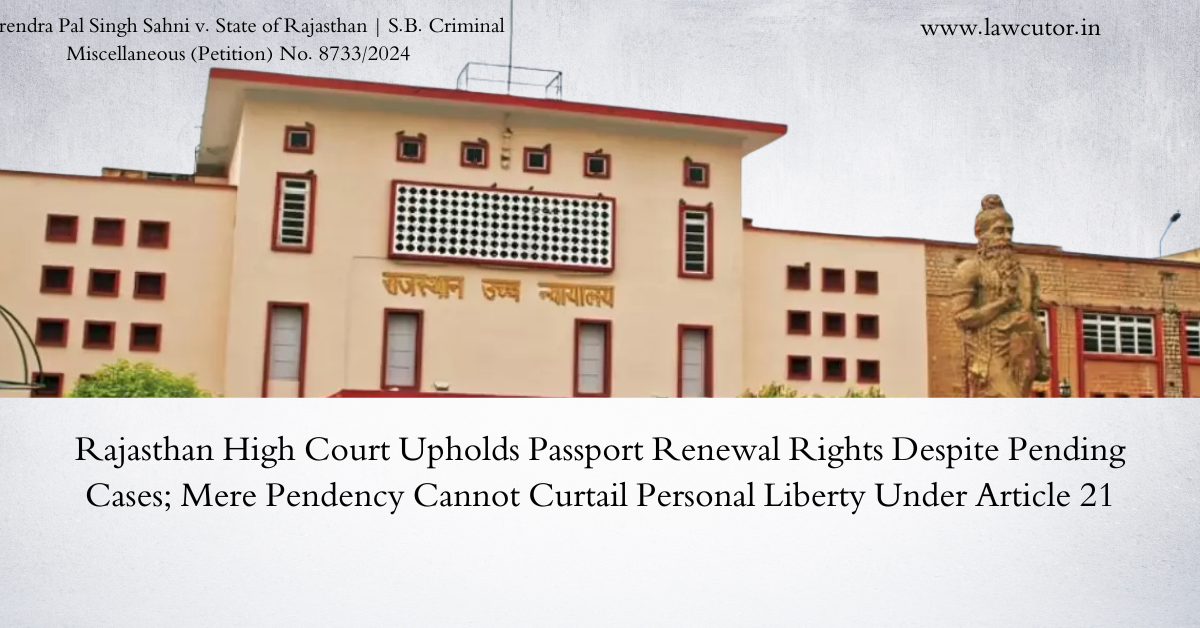
The High Court of Judicature for Rajasthan, Bench at Jaipur, by an order dated April 15, 2026, allowed a criminal miscellaneous petition filed under Section 528 of the Bharatiya Nagarik Suraksha Sanhita by a 66-year-old petitioner, Surendra Pal Singh Sahni, and set aside the order dated April 8, 2024 passed by the Learned Chief Judicial Magistrate, Kota, whereby the petitioner’s application for a No Objection Certificate for renewal of his passport bearing No. B-6021432 had been rejected on the ground of 23 criminal cases pending against him. The order was passed by Justice Chandra Prakash Shrimali.
The petitioner faced a chargesheet in FIR No. 136/2022 registered at Police Station Kotwali, Kota City, for offences under Sections 420, 406, 467, 468, 471 and 120-B of the Indian Penal Code, and 23 criminal cases were stated to be pending against him, all pertaining to alleged acts of a similar nature. However, the petitioner had not been convicted in any of the 23 pending cases and trial had not concluded in any of them. The petitioner’s children reside abroad and he sought passport renewal in order to visit them. The Learned Chief Judicial Magistrate, by the impugned order, refused to issue a No Objection Certificate for passport renewal solely on the ground of the pendency of these 23 cases.
The petitioner contended before the High Court that without any just and reasonable ground, preventing him from travelling abroad by refusing passport renewal amounted to a violation of his fundamental right to personal liberty under Article 21 of the Constitution of India, particularly when he had not been convicted in any of the pending cases.
The Court referred to Section 6(2) of the Passports Act, 1967, which enumerates the exhaustive and specific grounds on which the passport authority may refuse to issue or renew a passport, and noted that Section 6(2)(f) covers the situation where proceedings in respect of an offence alleged to have been committed by the applicant are pending before a criminal court in India. The Court further took note of the Central Government Notification GSR 570(E) dated June 28, 1993, issued under Section 22 of the Passports Act, which exempts citizens of India against whom criminal proceedings are pending from the rigour of Section 6(2)(f), subject to the condition that they produce orders from the concerned court permitting them to depart from India. The Court noted that this Notification, in its reading, makes it clear that the issuance of the passport, the period of its validity and the period of travel are under the control of the Court.
The Court placed reliance on the judgment of the Telangana High Court in Sannith Reddy Mandhadi v. The Union of India & Another [2024 SCC OnLine TS 767], which had extensively referred to the position settled by the Supreme Court, observing that “merely because a person is an accused in a case it cannot be said that he cannot ‘hold’ or possess a passport. As per our jurisprudence every person is presumed innocent unless he is proven guilty. Therefore, the mere fact that a criminal case is pending against the person is not a ground to conclude that he cannot possess or hold a passport.” The Court also noted that the pendency of cases, even post-conviction where conviction itself is not a ground to impound the passport unless both the conditions of moral turpitude and imprisonment of not less than two years are satisfied, is not a ground to refuse renewal or demand surrender of a passport.
The Court also referred to the Supreme Court’s observation in Sumit Mehta v. State of NCT of Delhi [(2013) 15 SCC 570] that “the law presumes an accused to be innocent till his guilt is proved. As a presumable innocent person, he is entitled to all the fundamental rights including the right to liberty guaranteed under Article 21 of the Constitution of India.” The Court further placed reliance on the constitutional proposition settled in Maneka Gandhi v. Union of India [(1978) 1 SCC 248], wherein the Supreme Court held that no person can be deprived of his right to go abroad unless there is a law prescribing the procedure for such deprivation and the deprivation is effected strictly in accordance with such procedure, and that such procedure cannot be arbitrary, unfair or unreasonable. The Court also referred to Satish Chandra Verma v. Union of India [2019 SCC OnLine SC 2048], wherein the Supreme Court held that “the right to travel abroad is an important basic human right for it nourishes independent and self-determining creative character of the individual, not only by extending his freedoms of action, but also by extending the scope of his experience.”
The Court held that in light of the legal provisions and the binding judicial precedents, it was clear that since the petitioner had not been convicted in any of the 23 pending cases and all cases remained sub judice, refusing renewal of his passport solely on the ground of the pendency of criminal cases and thereby depriving him of the right to travel abroad was a violation of the provisions of Article 21 of the Constitution of India. The Court further held that Section 6(2)(e) of the Passports Act, which pertains to conviction for an offence involving moral turpitude and imprisonment of not less than two years, was not attracted in the petitioner’s case, and no other ground for refusing renewal of the passport had been stated by the Learned Public Prosecutor.
Accordingly, the petition under Section 528 of the Bharatiya Nagarik Suraksha Sanhita was allowed and the impugned order dated April 8, 2024 passed by the Learned Chief Judicial Magistrate, Kota, was set aside. The Court directed that upon the petitioner submitting a fresh application for passport renewal before the competent authority, the concerned authority shall process the application in accordance with the provisions of Section 5 of the Passports Act, 1967, without being influenced by the impugned order, and shall pass appropriate orders within 30 days of the date of submission of the application.
Surendra Pal Singh Sahni v. State of Rajasthan
S.B. Criminal Miscellaneous (Petition) No. 8733/2024
High Court of Judicature for Rajasthan, Bench at Jaipur
Justice Chandra Prakash Shrimali | Decided on April 15, 2026
Click HERE for full Judgment.

