
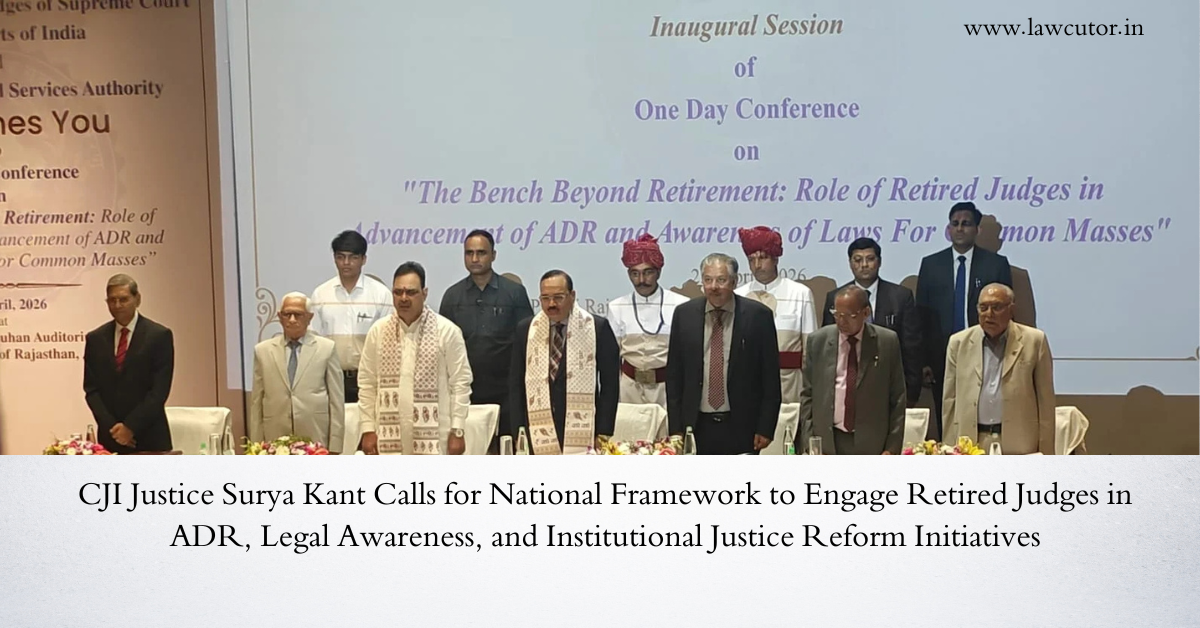
Chief Justice of India Justice Surya Kant, delivering the keynote address at a conference of the Association of Retired Judges of the Supreme Court and High Courts held in Jaipur, called for the creation of a structured national framework to harness the experience of retired judges in Alternative Dispute Resolution (ADR) and legal awareness initiatives. The Chief Justice emphasised that the continued engagement of retired judges should be treated as institutional service with dignity, support and accountability, rather than as informal volunteerism. The lecture was delivered on the topic “The Bench Beyond Retirement: The Role of Retired Judges in Advancement of ADR and Awareness of Laws for Common Masses.”
The Chief Justice underscored that the retirement of a judge should not mark the end of public service, observing that while the judicial office may cease upon retirement, the judicial role endures. He stated that ad hoc engagement of retired judges was insufficient and that a formal institutional mechanism was necessary to channel their expertise effectively. He specifically proposed the establishment of a National Registry of Former Judges willing to serve in ADR and legal awareness capacities, along with formal Memoranda of Understanding between the Association of Retired Judges, State Legal Services Authorities and High Courts. The Chief Justice stressed that such engagement must be recognised as service in the fullest sense of the term and that it should not be treated as voluntary participation without obligations, but as institutionalised participation supported by clear structures and accountability mechanisms.
The Chief Justice outlined four specific roles in which retired judges could significantly strengthen the justice delivery system. He stated that retired judges could serve as mediators and arbitrators, particularly in commercial and family disputes where authority and neutrality are crucial. They could further serve as legal educators, spreading awareness of rights in schools, colleges and local communities. He also envisaged their role as pre-litigation counsellors, helping resolve disputes before they escalate into prolonged litigation, and as institution builders, mentoring young mediators, training legal aid lawyers and preserving institutional memory.
Reflecting on the emotional transition from active judicial service to retirement, the Chief Justice observed that the sense of untethering experienced by many retiring judges stems from the sudden disappearance of a lifelong sense of duty. He stated, “Unlike most professions, we do not enter the law for material reward. We enter it for a purpose, for a mission. And when the courtroom falls silent, when the cause list no longer arrives, when the familiar discipline of judicial life recedes, the sense of untethering can be real and profound.”
Reiterating the central theme of his address, the Chief Justice stated that a wise Republic must preserve and draw upon the experience of its former judges, comparing them to traditional stepwells that sustain communities during difficult times. He concluded with the observation that “the robe may be retired. The judge never is. It is a truth universally known that once a judge, is always a judge.”

