
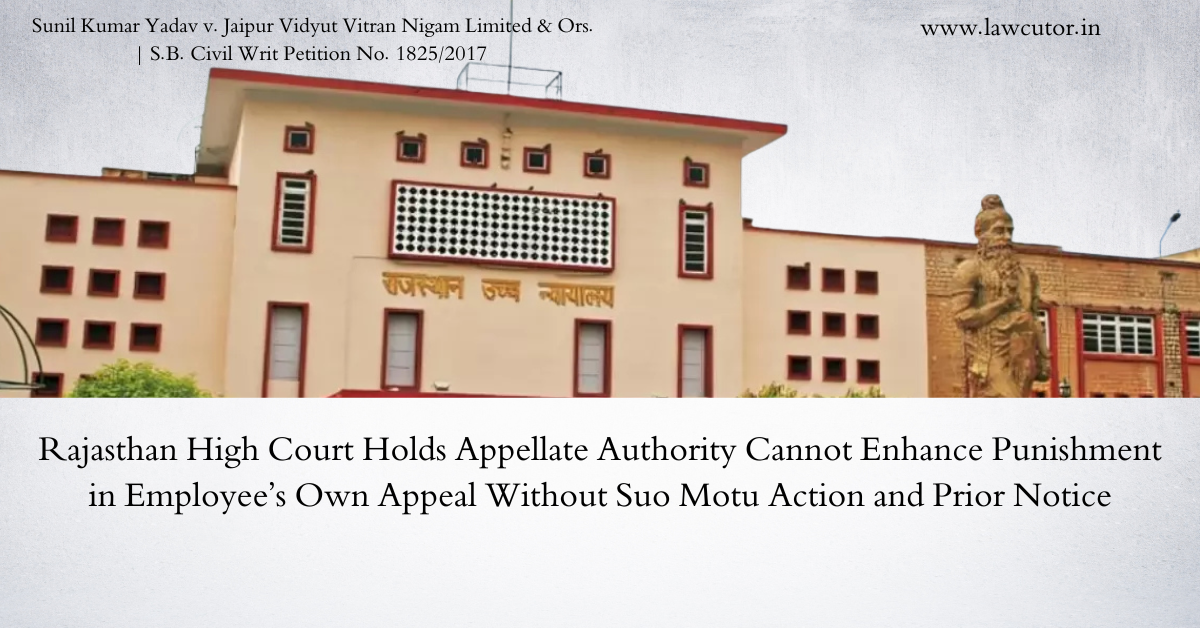
The High Court of Judicature for Rajasthan, Bench at Jaipur, has held that an appellate authority under disciplinary rules cannot enhance the punishment imposed upon a delinquent employee in an appeal preferred by the delinquent himself against his own interest. The order was passed by Hon’ble Mr. Justice Munnuri Laxman while partly allowing a writ petition filed by a Junior Engineer of Jaipur Vidyut Vitran Nigam Limited (“JVVNL”) challenging both the order of the disciplinary authority as well as the order of enhancement of punishment passed by the appellate authority.
The Petitioner, Sunil Kumar Yadav, was working as a Junior Engineer in the Office of O&M, Malakhera, District Alwar, for the period May 31, 2007 to March 1, 2009. Two charges were levelled against him in the chargesheet — first, that he had not deposited 383 burnt transformers lying in his custody with the Assistant Engineer’s Office, resulting in loss on account of expiry of their guarantee period; and second, that the oil from the burnt transformers had not been collected and deposited with the Assistant Engineer’s Office. The Petitioner submitted an explanation to the disciplinary authority contending that both the transformers and the oil had been promptly deposited within the 72-hour period prescribed under the applicable regulation and that the same was duly reflected in the stock register. The disciplinary authority, however, was not satisfied with this explanation and proceeded to impose a minor penalty of stoppage of one annual grade increment without cumulative effect. The Petitioner preferred an appeal before the appellate authority, challenging both the finding that charges were proved and the imposition of punishment. The appellate authority concurred with the finding on charges but went a step further and enhanced the penalty from stoppage of one annual grade increment to stoppage of two annual grade increments without cumulative effect. Aggrieved by both the original order and the enhancement of punishment, the Petitioner approached the High Court.
On the challenge to the findings of the disciplinary authority regarding the charges, the Court verified the stock register maintained by the Petitioner and found that while it reflected the dates on which transformers were received, the dates of their deposit were conspicuously absent. The Court noted that the Petitioner had been given ample opportunity to access records and cross-verify his stock register with that of the Assistant Engineer to demonstrate timely deposit, but had failed to undertake this exercise. The findings of the disciplinary authority, having been arrived at upon due examination of the stock register, were found to be not liable to be interfered with, and the Court declined to exercise its extraordinary jurisdiction under Article 226 of the Constitution of India in relation to the same.
On the critical question of enhancement of punishment by the appellate authority in the Petitioner’s own appeal, the Court found considerable merit in the Petitioner’s contention. The Court held that “the appellate powers are exercisable upon the appeal filed by aggrieved party…Since the provision as referred above enables the appellate authority to enhance the punishment, it does not mean that the appellate authority can enhance the punishment in the appeal filed by the delinquent against his own interest.”
The Respondents had placed reliance upon Regulation 16 of the Rajasthan State Electricity Board Employees (Classification, Control & Appeal) Regulations, 1962, which empowers the appellate authority to suo moto initiate proceedings for enhancement of punishment, even in the absence of any appeal. The Court, however, carefully analysed the scope of this provision and held that whenever the authority wishes to take cognizance of proceedings for enhancement of punishment under Regulation 16, it must first take suo moto cognizance independently, and then issue notice to the delinquent of the proposed enhancement, affording him an opportunity to make a representation, before passing any order enhancing the punishment. In the present case, there was no record whatsoever to show that any suo moto cognizance had been taken before the enhancement was ordered, and no notice proposing enhancement had been issued to the Petitioner. The Court held that “the entire exercise done in violation of Regulation 16 of the Regulations of 1962, therefore, the order of enhancement is unsustainable.”
Accordingly, the writ petition was partly allowed. The order of the appellate authority enhancing the punishment from stoppage of one annual grade increment to two annual grade increments without cumulative effect was quashed and set aside. The findings of both the disciplinary authority and the appellate authority on the charges, as well as the original penalty of stoppage of one annual grade increment, were confirmed.
Cause Title: Sunil Kumar Yadav v. Jaipur Vidyut Vitran Nigam Limited & Ors. | Case No.: S.B. Civil Writ Petition No. 1825/2017 | Coram: Hon’ble Mr. Justice Munnuri Laxman | Date of Decision: April 20, 2026
Click HERE for full judgment
 Lawcutor