
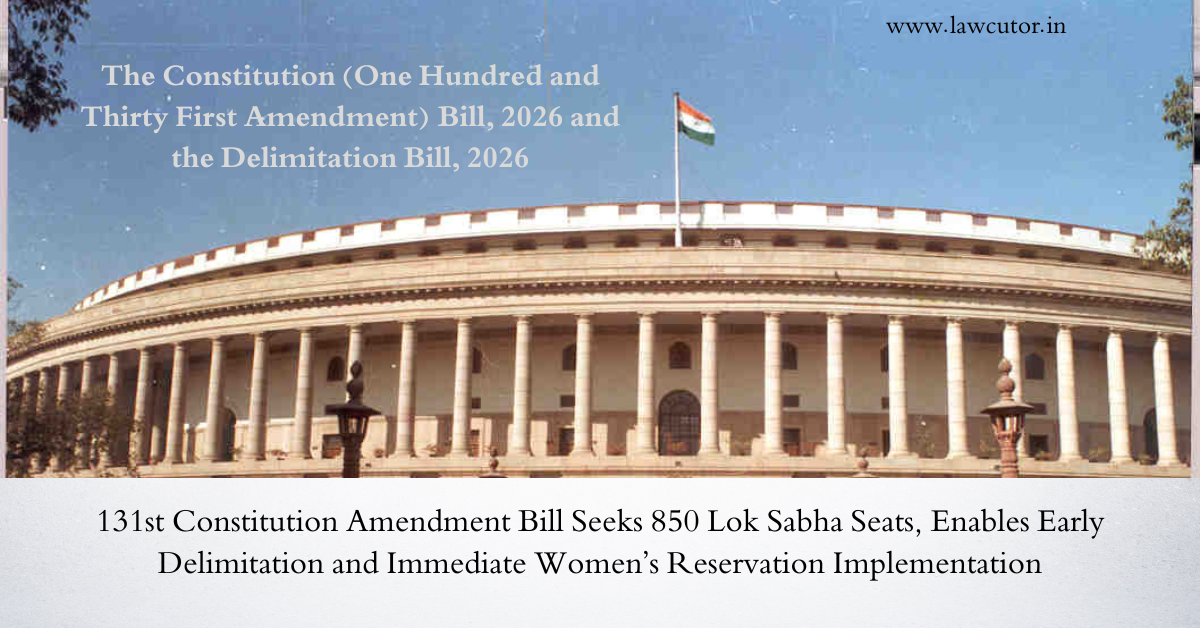
The Union Government has introduced the Constitution (One Hundred and Thirty First Amendment) Bill, 2026, which proposes a substantial increase in the strength of the Lok Sabha from the present 543 members to 850 members. The Bill is scheduled to be taken up for consideration during the Special Session of Parliament convened on 16 and 17 April 2026.
The proposed legislation seeks to amend Article 81 of the Constitution to provide that the House of the People shall consist of not more than 815 members to be chosen by direct election from the States and not more than 35 members to be chosen from the Union Territories in such manner as Parliament may by law provide. It also proposes to amend Article 82 by deleting the third proviso, which currently mandates that the next delimitation exercise shall be undertaken on the basis of the first Census conducted after the year 2026. By removing this constitutional linkage, the Bill seeks to enable delimitation to be carried out on the basis of available census data without waiting for the 2026-27 Census.
A key objective of the amendment is to facilitate the early implementation of one-third reservation for women in the Lok Sabha and State Legislative Assemblies. The Constitution (106th Amendment) Act, 2023 had provided for one-third reservation for women, but its enforcement was made contingent upon the completion of delimitation following the first Census after 2023. The present Bill proposes to amend Article 334A so as to allow the reservation to take effect immediately after the delimitation exercise is completed, thereby delinking it from the post-2026 Census requirement.
Alongside the constitutional amendment, the Government is also introducing the Delimitation Bill, 2026 to repeal and replace the Delimitation Act, 2002. The new Bill empowers the Central Government to constitute a Delimitation Commission by notification in the Official Gazette. The Commission will be chaired by a person who is or has been a Judge of the Supreme Court and will include the Chief Election Commissioner or a nominated Election Commissioner and the State Election Commissioner of the concerned State as ex officio members.
For the purpose of its work in each State, the Commission will associate ten members comprising five Members of Parliament and five Members of the State Legislative Assembly nominated by the respective Speakers. These associate members will, however, have no voting rights and will not be entitled to sign any decision or report of the Commission.
The Delimitation Commission will be tasked with readjusting the allocation of seats in the Lok Sabha and State Legislative Assemblies and redrawing the boundaries of parliamentary and assembly constituencies on the basis of the latest census figures. The Bill notes that the existing allocation of seats is based on the 1971 Census while the division of territorial constituencies is based on the 2001 Census, despite significant demographic changes since then. The Commission will determine the number of seats to be allocated to each State and Union Territory in the Lok Sabha, the total number of seats in the State Legislative Assemblies, the number of seats to be reserved for Scheduled Castes and Scheduled Tribes, and the delimitation of constituencies.
The Bill requires that constituencies shall be geographically compact and shall take into account administrative boundaries, communication facilities and public convenience. It further provides for reservation of as nearly as may be one-third of the total number of seats in the Lok Sabha and State Legislative Assemblies for women, including women belonging to Scheduled Castes and Scheduled Tribes. Seats reserved for women will be allotted by rotation to different constituencies, and seats reserved for women belonging to Scheduled Castes and Scheduled Tribes will rotate within the constituencies already reserved for those categories.
Once published in the Gazette of India, the orders of the Delimitation Commission will have the force of law and shall not be called in question in any court. However, the representation in the existing House or Assembly will remain unaffected until its dissolution, and bye-elections held before dissolution will continue to be conducted on the basis of the existing delimitation.
The proposed amendments, if passed, are expected to significantly reshape the composition of the Lok Sabha and State Assemblies, address long-pending demands for delimitation in view of population changes, and pave the way for the early implementation of women’s reservation in legislative bodies.
Case / Bill Reference: The Constitution (One Hundred and Thirty First Amendment) Bill, 2026 and the Delimitation Bill, 2026

