
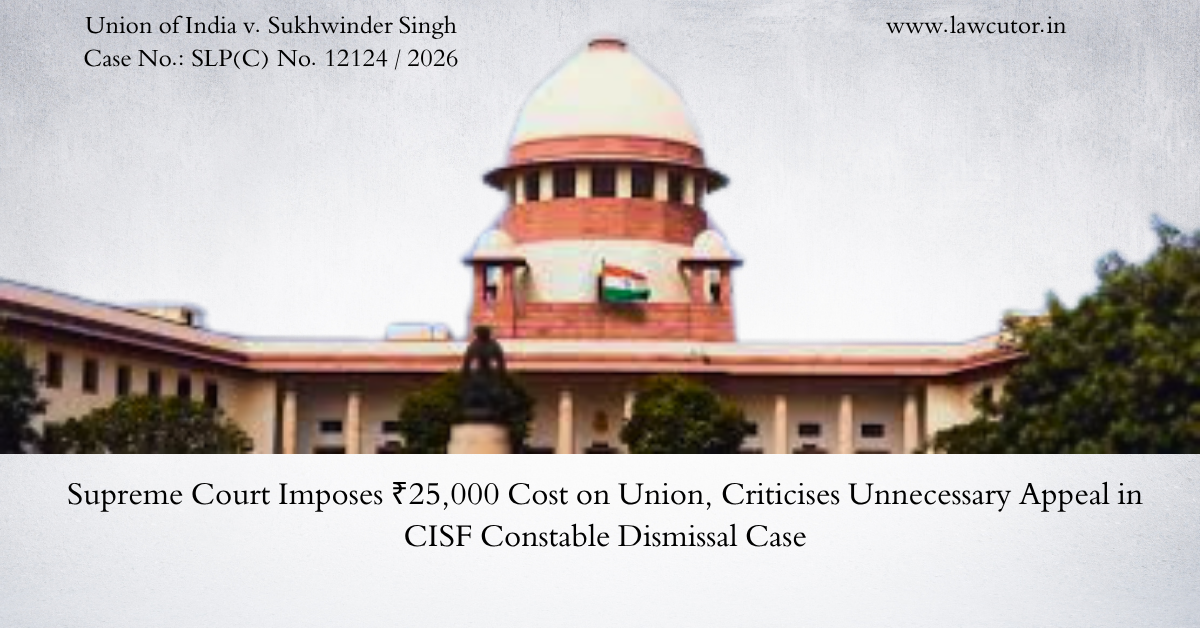
The Supreme Court today imposed a cost of ₹25,000 on the Union of India for challenging a judgment of the Punjab and Haryana High Court that had set aside the dismissal of a CISF constable and granted him 25% back wages. A bench comprising Justice BV Nagarathna and Justice Ujjal Bhuyan dismissed the Special Leave Petition, strongly criticising the Union for pursuing the matter despite the High Court’s reasoned order.
Justice Nagarathna observed that the Union of India remains the largest litigant before the Court and contributes significantly to the heavy pendency of cases. She remarked, “We fail to understand why the Union of India and others have approached this court by assailing the order of the Division Bench of the High Court.” The bench directed the Union to pay the cost while dismissing the SLP.
The case related to a CISF constable who was dismissed from service after about ten years on two charges — unauthorised absence from duty for 11 days and alleged misconduct for allegedly assisting his younger brother in marrying the daughter of another CISF constable at an Arya Samaj Mandir in Raipur. The absence had occurred during a period of sanctioned medical leave, though the constable was not found at his residence during an inspection. On the second charge, the woman concerned appeared before the disciplinary authority and stated that she had no grievance. It was also not disputed that she had married the constable’s brother.
The Single Judge of the High Court set aside the punishment orders and directed reinstatement with continuity of service. The Division Bench upheld the order, holding that there was no illegality or perversity in the findings and that the misconduct alleged was not grave enough to justify removal from service. The Union approached the Supreme Court, seeking to set aside the grant of back wages on the principle of “no work, no pay”.
During the hearing, Justice Nagarathna referred to the family circumstances behind the constable’s absence and noted that he had to resolve a family situation involving the elopement and subsequent marriage. She questioned why the Union was contesting the matter when the High Court had found the punishment disproportionate. The bench also highlighted discussions at the recent Supreme Court Bar Association conference where unnecessary litigation by the government was flagged as a major contributor to pendency.
The Court refused to interfere with the grant of 25% back wages and only condoned the delay in filing the SLP. When the counsel for the Union continued to press for removal of back wages, the bench decided to impose costs while dismissing the petition.
Case Title: Union of India v. Sukhwinder Singh
Case No.: SLP(C) No. 12124 / 2026
 Lawcutor