
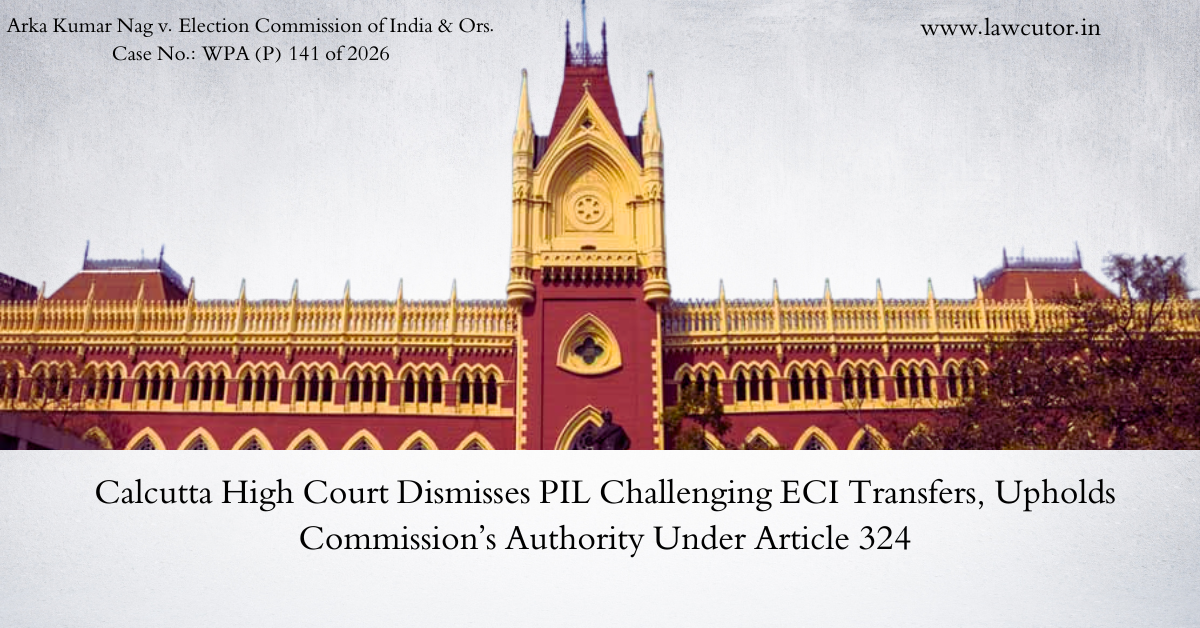
The Calcutta High Court has dismissed a Public Interest Litigation (PIL) filed by Advocate Arka Kumar Nag seeking to quash the transfer orders issued by the Election Commission of India (ECI) after the election notification dated 15 March 2026 for five States, including West Bengal. A Division Bench comprising Chief Justice Sujoy Paul and Justice Partha Sarathi Sen held that the petition was fundamentally flawed on pleadings and maintainability.
The Court observed that in paragraph 28 of the writ petition, the petitioner himself expressly admitted that the power to transfer officers is vested in the ECI to uphold a level playing field during elections and must be exercised with caution. This admission left no room for doubt that the petitioner accepted the ECI’s authority under Article 324 of the Constitution and could not later argue lack of jurisdiction or arbitrariness in a PIL.
The Bench emphasised that the petitioner, a practising advocate with no personal grievance, failed to establish any concrete public injury caused by the transfers. Relying on the seven-Judge Bench decision in S.P. Gupta v. Union of India, the Court held that a PIL is maintainable only when there is a demonstrated public wrong or public injury. Here, each transferred officer was promptly replaced, and no administrative “vacuum” or “numb” situation was created that would paralyse the State machinery.
The Court also rejected the claim that West Bengal was being singled out. It noted from the ECI’s press note dated 17 March 2026 that the number of All India Service officers shifted in other States (e.g., 40 in Jharkhand and 49 in Madhya Pradesh) was significantly higher than in West Bengal (23), rebutting any allegation of vindictiveness.
The Bench held that the ECI is not required to give elaborate reasons for transferring officers for the limited duration of elections. Such administrative decisions fall within the ECI’s domain to ensure free and fair polls, and courts cannot sit in appeal over them unless clear arbitrariness or mala fides is established with concrete material. The Court further expressed concern that the petitioner had access to confidential internal correspondence between the ECI and the State, observing that this raised questions about the bonafides of the PIL and suggested it was aimed at canvassing political interest rather than genuine public interest.
The extensive statutory arguments advanced by the petitioner and supported by the Advocate General—relating to Sections 13CC, 20A, 20B, and 28A of the Representation of the People Acts, 1950 and 1951, and the scope of Article 324—were not entertained, as the petition contained no foundational pleadings challenging the ECI’s statutory authority. The Court declined to undertake an academic exercise on the limits of Article 324 when the petition itself did not dispute the existence of the power.
The Bench clarified that individual aggrieved officers remain free to challenge their transfers on merits before the appropriate forum, and this judgment would not prejudice such challenges. Finding the PIL “sans substance,” the Court dismissed it, reiterating that the independence of the Election Commission must be protected during the conduct of elections and that courts cannot second-guess its administrative choices in the context of conducting free and fair elections.
Case Title: Arka Kumar Nag v. Election Commission of India & Ors.
Case No.: WPA (P) 141 of 2026
Date of Judgment: 31 March 2026
Coram: Hon’ble The Chief Justice Sujoy Paul & Hon’ble Justice Partha Sarathi Sen
Click HERE for full Judgment
 Lawcutor