
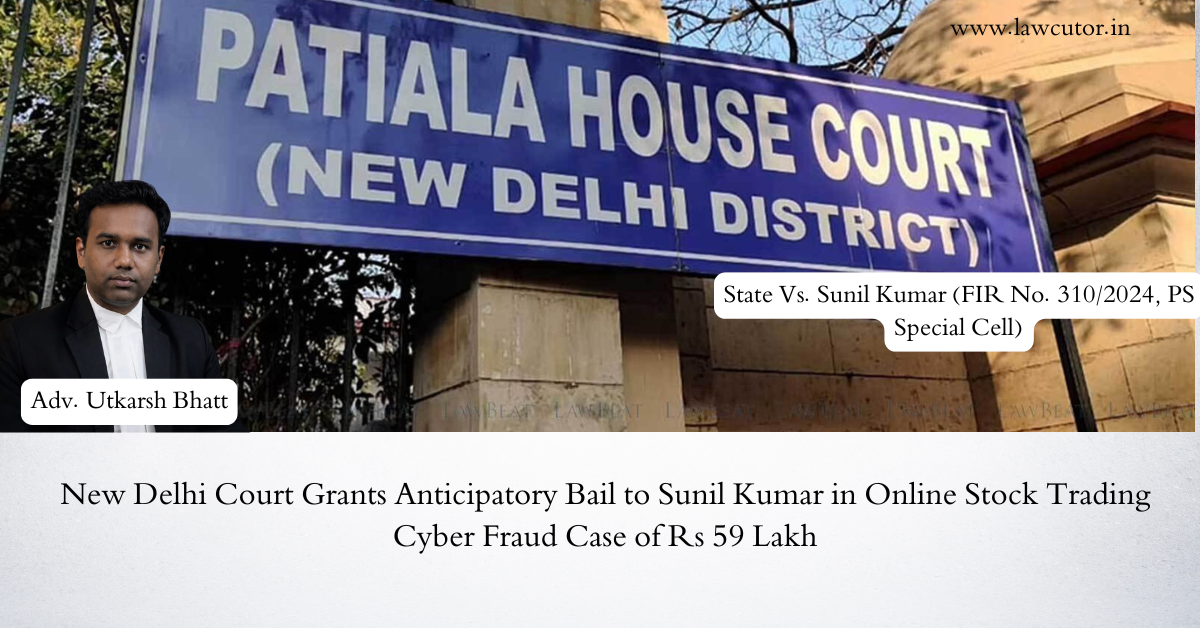
In a detailed order passed on 10 November 2025, the Additional Sessions Judge-05, Patiala House Courts, New Delhi, allowed the anticipatory bail application of Sunil Kumar in FIR No. 310/2024 registered at Police Station Special Cell (IFSO). The case involves serious allegations of cheating, criminal conspiracy, and cyber fraud under Sections 419, 420, 120-B IPC and Sections 66C & 66D of the Information Technology Act, 2000.
The complaint was lodged by Rajiv Anand, a former Indian Air Force officer residing in Defence Colony, New Delhi. According to the FIR, Anand was lured into investing nearly ₹59.41 lakh through a fraudulent mobile application called “UWMIN App.” The platform falsely claimed to be linked to a legitimate international stock trading firm (“US Bancorp”) and promised abnormally high returns. The money was allegedly transferred to accounts controlled by the accused persons. When the promised profits and commissions failed to materialise and further demands were made under the pretext of taxes and penalties, Anand realised he had been duped. The FIR named several other individuals who allegedly ran WhatsApp groups and facilitated the transactions, but Sunil Kumar’s name did not appear in the original complaint.
Sunil Kumar moved the court under Section 438 Cr.P.C. apprehending arrest after his name surfaced during investigation on the basis of a disclosure statement made by another person. His counsel, Sh. Utkarsh Bhatt, argued that the applicant is a law-abiding citizen with no criminal antecedents and has no direct connection with the alleged fraud. He pointed out that Sunil Kumar is neither a registered stock broker nor authorised to deal in securities. Crucially, there was no incriminating chat, communication, or financial trail linking him to the transactions or to Amit Jain (a key figure mentioned in the case). The only material against him was a disclosure statement, which, as per settled law, is not admissible as evidence unless it leads to the recovery of incriminating material — something that never happened.
The prosecution, represented by Sh. Mukul Kumar, Additional Public Prosecutor, opposed the bail, contending that the investigation was still at an early stage and custodial interrogation was necessary to trace the money trail and unravel the larger conspiracy. However, the APP could not place any concrete evidence beyond the disclosure statement before the court.
After hearing both sides and examining the record, the court held that the power under Section 438 Cr.P.C. must be exercised to protect personal liberty when the allegations appear prima facie unsubstantiated or mala fide. Relying on the Supreme Court’s landmark rulings in Gurbaksh Singh Sibbia v. State of Punjab (1980) and Sushila Aggarwal v. State (NCT of Delhi) (2020), the judge observed that anticipatory bail cannot be denied merely because the offence is serious if there is no tangible material connecting the applicant to the crime.
The court noted that digital and financial evidence can be examined without detaining the applicant. It further recorded that the CDR details, without the context of actual conversations, do not by themselves establish conspiracy. In the absence of any recovery, incriminating chats, or direct involvement, continued detention was not warranted at this stage.
Accordingly, the court granted anticipatory bail to Sunil Kumar, directing him to furnish a personal bond of ₹20,000 with one surety of the like amount. The relief was made subject to standard conditions:
- Full cooperation with the Investigating Officer whenever called;
- No tampering with evidence or influencing of witnesses;
- No departure from the country without court permission;
- No contact with the complainant or witnesses; and
- No indulgence in similar criminal activity.
The court made it clear that the order does not amount to an expression of opinion on the merits of the case, which will be decided only after trial.
This judgment once again highlights the judiciary’s balanced approach in cyber fraud cases — protecting individual liberty while ensuring that the investigation is not hampered. It also serves as a reminder that disclosure statements alone, without corroborative material, cannot become the sole basis for depriving a person of personal freedom in anticipatory bail matters.
The application was disposed of accordingly by ASJ Saurabh Partap Singh Laler on 10 November 2025.
Case Name: Bail Application No. 1466/2025 titled State Vs. Sunil Kumar (FIR No. 310/2024, PS Special Cell)
Advocate Representing the Applicant/Accused: Sh. Utkarsh Bhatt
Click HERE for full ORDER.
 Lawcutor