
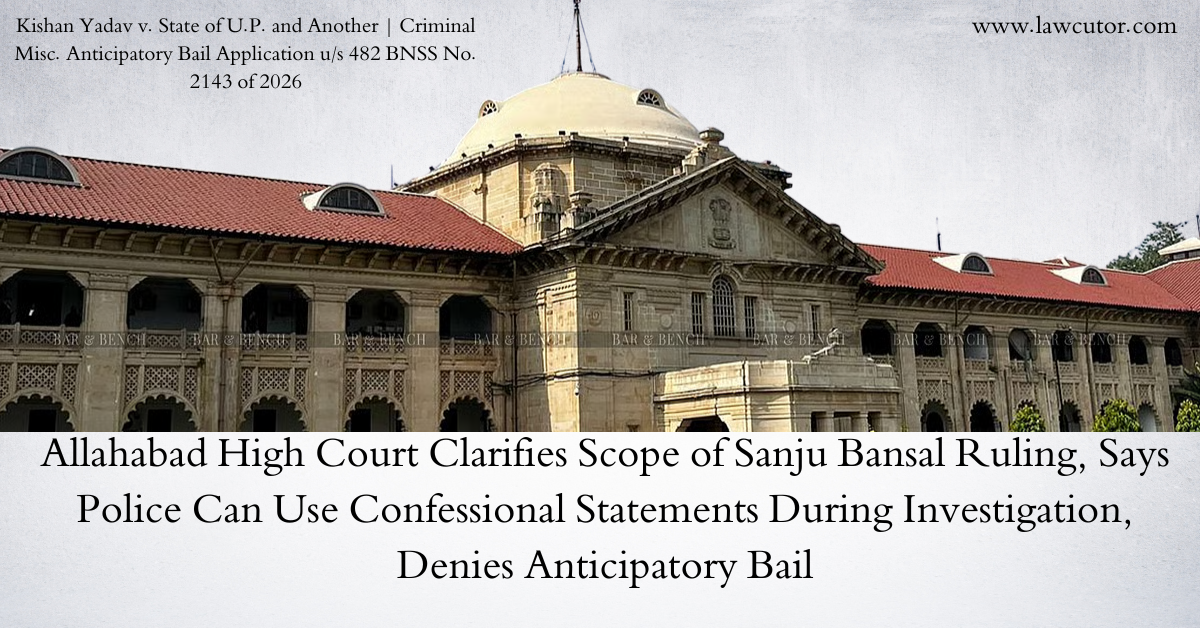
The Allahabad High Court has clarified that the Supreme Court’s observations in Sanju Bansal v. State of Uttar Pradesh are limited to the exclusion of police-recorded confessional statements from the formal charge-sheet and do not bar the police from relying upon such statements while conducting an ongoing investigation. A single bench of Justice Rajiv Lochan Shukla passed this order while rejecting the anticipatory bail application filed by Kishan Yadav in Case Crime No. 727 of 2025 under Section 105 of the Bharatiya Nyaya Sanhita, 2023, registered at Police Station Geeda, District Gorakhpur.
The applicant was accused of murdering a 20-year-old youth with diminished mental capacity. It was alleged that the deceased had come to the applicant’s liquor shop, after which he was assaulted and later disposed of. The applicant contended that he was falsely implicated solely on the basis of the confessional statement of a co-accused and that he was not even visible in the CCTV footage collected during investigation. Heavy reliance was placed on the Supreme Court’s order in Sanju Bansal, wherein it was directed that confessional statements recorded by police officers cannot form part of the charge-sheet and must be ignored.
The Additional Government Advocate, opposing the bail, submitted that the investigation is still in progress. In the confessional statement of the co-accused, it was disclosed that the applicant had assaulted the deceased and directed the co-accused to confine him. When the co-accused informed the applicant that the deceased had become unconscious, the applicant allegedly directed them to dispose of the body. The mobile number of the applicant was also disclosed in the confessional statement of co-accused Suneel Pathak, who was a salesman in the applicant’s liquor shop. It was argued that the applicant is required for custodial interrogation.
At the outset, the Court observed that the Supreme Court’s remarks in Sanju Bansal were strictly confined to the inclusion of confessional statements as part of the formal charge-sheet. Justice Shukla clarified that these observations do not prevent the police from taking note of confessional statements recorded during the investigation phase. The bench noted that though a confessional statement is inadmissible in evidence, recoveries or discovery of a new fact under Section 23 of the Bharatiya Sakshya Adhiniyam, 2023, made on the basis of such a statement, as well as the part of the confession which leads to the discovery of a new fact, remains admissible in evidence. The observations of the Supreme Court were restricted only to the inclusion of such statements in the charge-sheet and cannot be read to mean that the police are barred from proceeding on the basis of any confession given by an accused during investigation.
Taking into account the record, the Court found that the confessional statement of the co-accused clearly points to the complicity of the applicant and the fact that the applicant had slapped the deceased. The CCTV footage, which allegedly shows the co-accused transporting the deceased on a motorcycle to allay suspicion, is yet to be examined in detail during investigation. The Court further noted that the matter involves the unprovoked death of a 20-year-old youth with diminished mental capacity. In these circumstances, the Court held that it was not appropriate to grant anticipatory bail to the applicant during investigation.
The anticipatory bail application was accordingly rejected. The Court clarified that the observations made in the order are restricted to the disposal of the anticipatory bail application and shall not be construed as an opinion on the merits of the case. The applicant may appear and apply for regular bail, which shall be considered and disposed of on its own merits without being influenced by the observations made in this order.
Cause Title: Kishan Yadav v. State of U.P. and Another
Case No.: Criminal Misc. Anticipatory Bail Application u/s 482 BNSS No. 2143 of 2026
Click HERE for full Judgment
 Lawcutor