
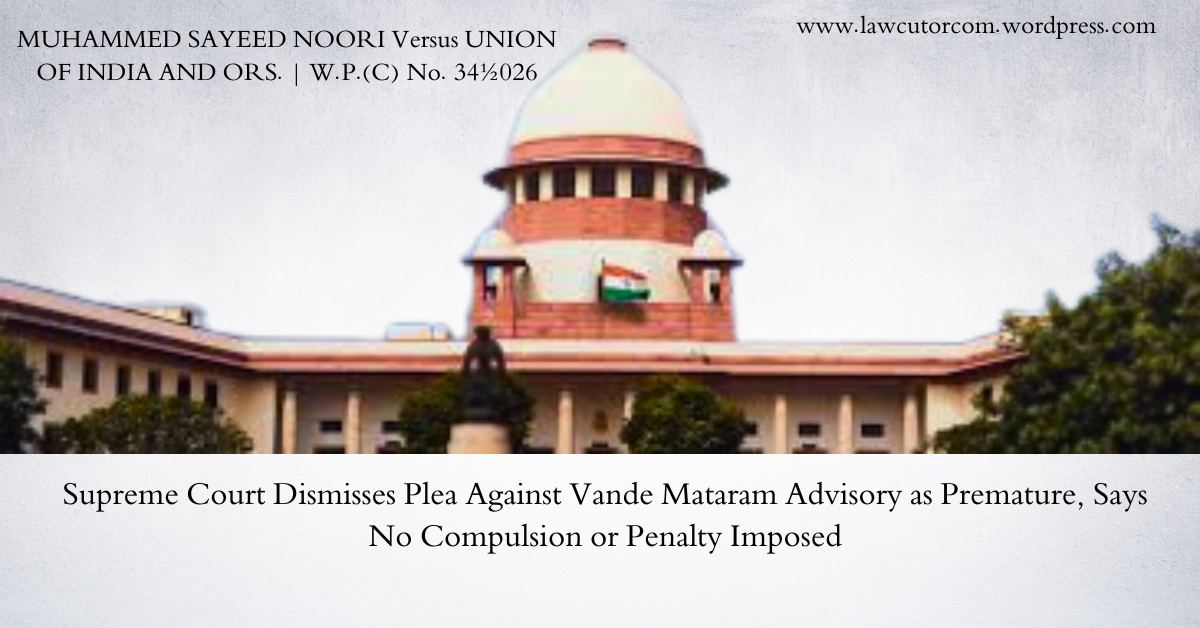
The Supreme Court on Wednesday dismissed as premature a writ petition challenging the Ministry of Home Affairs circular dated 28 January 2026 prescribing the manner in which Vande Mataram is to be played and sung in public functions and educational institutions. A bench comprising Chief Justice of India Surya Kant, Justice Joymalya Bagchi and Justice Vipul M Pancholi observed that the circular was merely an advisory and did not make the singing of the national song compulsory, nor did it prescribe any penalty for non-participation.
Senior Advocate Sanjay Hegde, appearing for the petitioner Muhammed Sayeed Noori, stressed the importance of protecting individual conscience and contended that patriotism cannot be compelled. He submitted that the circular presented a threat to conform and that under the garb of enforcing an advisory, citizens, irrespective of religion or even atheists, could be compelled to participate in a social demonstration of loyalty which goes against one’s conscience. Hegde argued that the circular violated the fundamental right to freedom of conscience and the right to freely profess and practice religion under Article 25, as the official version of the song employed devotional language and invocations associated with particular religious imagery, creating difficulty especially for members of monotheistic faiths. He further contended that the circular paved the way for compelled expression, thereby violating freedom of speech and expression under Article 19(1)(a), and undermined the commitment to secularism.
When the Chief Justice questioned whether the same argument would apply in the context of the National Anthem as well, Hegde replied that patriotism per se cannot be compelled. He emphasised that if the Constitution has to mean anything as far as an individual is concerned, it has to protect individual conscience, and that our tradition teaches tolerance. Hegde pointed out that while the National Anthem has statutory protection under the Prevention of Insults to National Honour Act, the National Song has no such legal framework. He relied on the Supreme Court’s decision in Bijoe Emmanuel v. State of Kerala, where students who stood respectfully during the national anthem but declined to sing it on grounds of religious faith could not be compelled to participate.
Solicitor General Tushar Mehta, who was present in Court but not appearing in the case, referred to Article 51A of the Constitution and commented whether citizens needed to be advised to respect the national song. Hegde responded that there is a difference between the national anthem and the national song, and that Article 51A does not speak of the national song. The bench observed that there was no specific direction to the petitioner to sing the song in his institution and that the apprehensions about discrimination were vague. Ultimately, the petition was dismissed as premature.
The petitioner had contended that the circular created a framework which made participation in singing of the national song a component of school activity, and in practice, non-participation could result in pressure, disciplinary action or social stigma against students, teachers and educational institutions.
Cause Title: MUHAMMED SAYEED NOORI Versus UNION OF INDIA AND ORS. | W.P.(C) No. 341/2026
 Lawcutor