
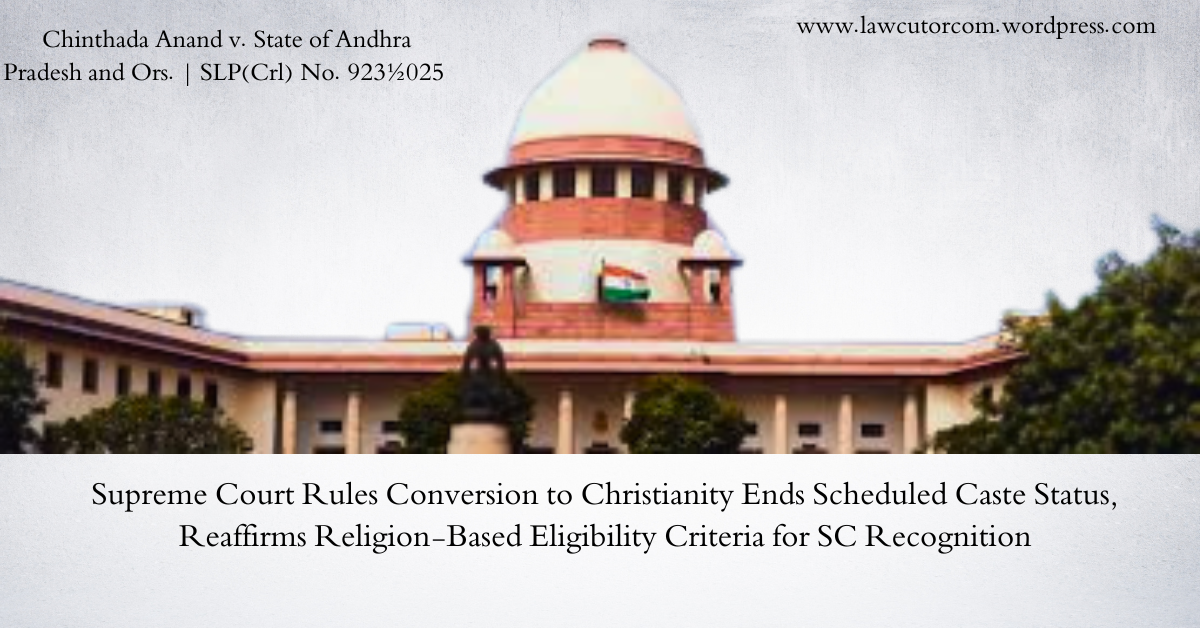
The Supreme Court on Monday upheld the Andhra Pradesh High Court’s order and ruled that once an individual converts to Christianity and actively professes and practices the faith, he ceases to be regarded as a member of the Scheduled Caste community and cannot invoke the protection of the Scheduled Castes and Scheduled Tribes (Prevention of Atrocities) Act.
A bench comprising Justices Prashant Kumar Mishra and Manmohan held that the bar under the Constitution (Scheduled Castes) Order, 1950 is absolute. Clause 3 of the 1950 Order makes it clear that no person who professes a religion different from Hinduism, Sikhism or Buddhism can be deemed to be a member of a Scheduled Caste. Conversion results in the immediate and complete loss of Scheduled Caste status, irrespective of birth or possession of a caste certificate.
The Court observed:
“No statutory benefit, protection or reservation or entitlement under the Constitution or enactment of Parliament or state legislature can be claimed by or extended to any person who, by operation of clause 3, is not deemed to be a member of the Scheduled Caste. This bar is absolute and admits no exception. A person can’t simultaneously profess and practice a religion other than the one specified in clause 3 and claim membership of the Scheduled caste.”
The ruling came in a Special Leave Petition filed by Chinthada Anand, a Pastor, challenging the High Court’s decision to quash charges framed against the accused under the SC/ST Act. The complainant, who had converted to Christianity and was actively working as a Pastor conducting Sunday prayers, had lodged a complaint alleging caste-based abuse and assault. The accused moved the High Court contending that after conversion the complainant could no longer claim Scheduled Caste status or invoke the provisions of the SC/ST Act.
The Supreme Court noted that the evidence on record clearly established that the complainant continued to profess Christianity and had been functioning as a Pastor for more than a decade. It was admitted that at the time of the alleged incident he was conducting prayer meetings. The Court held that there was no material to show that he had re-converted to Hinduism or had been accepted back into the Madiga community.
The Court clarified that mere possession of a Scheduled Caste certificate does not confer any protection under the SC/ST Act after conversion. Any issue regarding cancellation of such certificate is to be dealt with separately under the Andhra Pradesh (Scheduled Castes, Scheduled Tribes and Backward Classes) Regulation of Issue of Community Certificates Act, 1993, but that does not entitle the person to invoke the Atrocities Act once he has converted and is practising Christianity.
The Special Leave Petition was accordingly dismissed.
Cause Title: Chinthada Anand v. State of Andhra Pradesh and Ors. | SLP(Crl) No. 9231/2025
 Lawcutor