
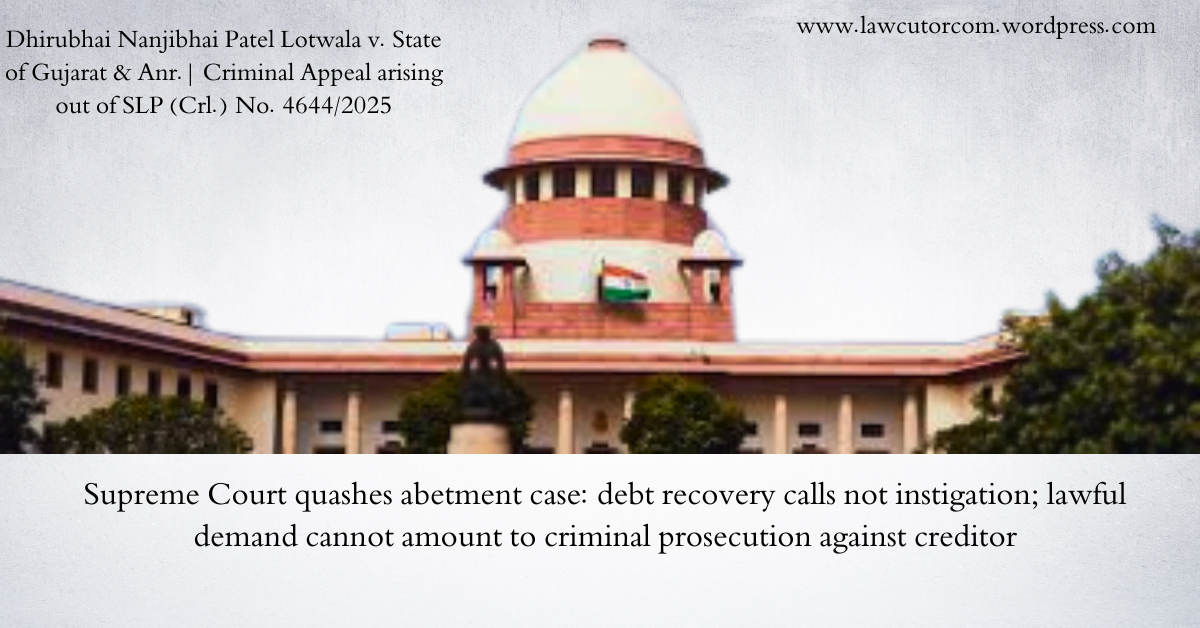
The Supreme Court on Monday quashed criminal proceedings under Sections 306 and 506(2) IPC against a creditor accused of abetting the suicide of a debtor, holding that persistent phone calls demanding repayment of a lawful debt do not amount to abetment of suicide.
A bench comprising Justices Manoj Misra and Manmohan allowed the appeal filed by Dhirubhai Nanjibhai Patel Lotwala and set aside the Gujarat High Court order dated 23.12.2024 which had refused to quash the FIR registered at P.S. Halvad, District Morbi.
The deceased had borrowed money from multiple persons including the appellant. He committed suicide by jumping under a tractor trolley. A suicide note recovered from his clothes named nine creditors, including the appellant, alleging repeated threats for repayment. The charge-sheet relied primarily on the suicide note and CDR records showing that the appellant had made about 40 calls to the deceased over six months.
The appellant contended that the suicide note lacked material particulars regarding the nature, time and place of the alleged threats. There was no audio recording of any call, no evidence of physical assault or specific role attributed to him, and the deceased had painted all nine creditors with one brush without showing they acted as a group.
The Supreme Court observed that the suicide note was cryptic and did not specify any particular act of abetment by the appellant. It noted:
“As far as the suicide note is concerned, we find that it lacks material particulars regarding the nature of those threats and the time and place when those threats were extended. Moreover, the suicide note indicts as many as 9 accused without specifying the role of any one of them… the deceased has painted all creditors with one brush. Therefore, a trial based on such a suicide note would be a futile exercise.”
The Bench further held that a mere demand for repayment of money lent is a lawful act and cannot constitute abetment:
“If a creditor makes a phone call to the debtor for return of his money that being a lawful act, it cannot on its own constitute a ground to prosecute the creditor.”
The Court added that there was no material on record to show that the deceased was beaten or physically assaulted to return the dues. Even the depression caused by inability to clear the debt could not be attributed as abetment by the appellant.
“In such circumstances, particularly when there is no material to indicate that the deceased was beaten or physically assaulted to return the dues, we are of the view that there is hardly any material on basis whereof it could be inferred that the appellant by demanding his dues abetted commission of suicide by the deceased.”
Consequently, the Court held that continuation of proceedings would be a futile exercise and amount to abuse of process of law. The impugned criminal proceedings against the appellant were quashed in their entirety.
Cause Title: Dhirubhai Nanjibhai Patel Lotwala v. State of Gujarat & Anr.
Citation: Criminal Appeal arising out of SLP (Crl.) No. 4644/2025 (Order dated 10.03.2026)
Click HERE for full judgment
 Lawcutor