
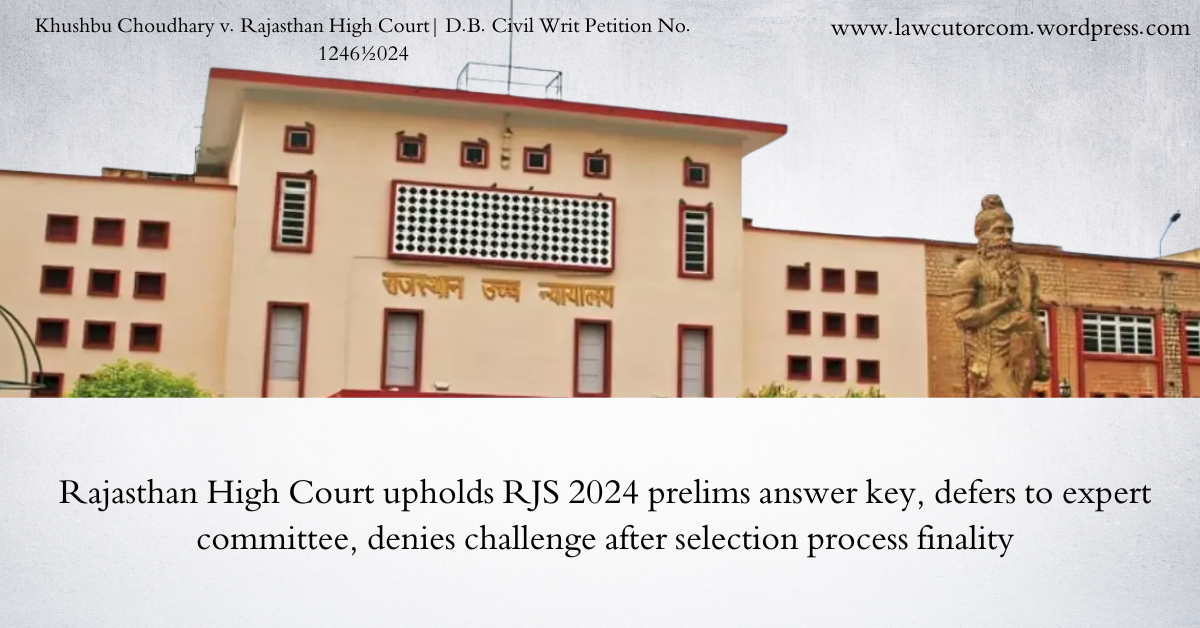
The Rajasthan High Court on Thursday dismissed a writ petition filed by an unsuccessful RJS aspirant seeking quashing of the final answer key dated 15.07.2024 and revision of the Preliminary Examination result held on 23.06.2024, holding that courts cannot sit as appellate authorities over decisions of Expert Committees in competitive examinations.
A Division Bench comprising Justices Arun Monga and Sunil Beniwal observed that the Expert Committee, consisting of persons with specialized knowledge, had duly considered all objections, and its academic opinion deserves due deference.
“Even assuming that the interpretation suggested by the petitioner is plausible, the existence of an alternative view cannot by itself justify interference. Where two reasonable views are possible in an academic matter, the view adopted by the Expert Committee must ordinarily prevail,” the Court held.
The Bench further emphasized the need for finality and certainty in large-scale competitive examinations:
“Competitive examinations involving large numbers of candidates require finality and certainty. Entertaining individual grievances regarding interpretation of answers, particularly after completion of the selection process, would unsettle the recruitment and adversely affect candidates who have already been selected and appointed.”
Key Observations
- The petitioner had raised objections to four questions (Q. Nos. 11, 51, 91 & 92). Questions 91 and 92 were deleted uniformly for all candidates due to ambiguity in options. The Court held that such uniform deletion does not cause discrimination or place any candidate at a disadvantage.
- For Q. 51 (relating to Section 300 CrPC and double jeopardy), the petitioner claimed Option 1 was correct. Even if accepted, it would add only one mark, taking her score from 65 to 66 — still below the cutoff of 68.
- For Q. 11 (interpretation rule), the petitioner argued for “Rule of Ejusdem Generis”. The Court found that “Rule of Homogenous Interpretation” (Option 3) conveyed substantially the same meaning, and the Expert Committee’s view could not be termed arbitrary.
The Bench also noted that the petitioner had participated in the selection process with full knowledge of the objection mechanism and had taken her chance of success. Having done so, she could not challenge the outcome merely because the result was unfavourable.
The Court balanced equities, observing that 222 successful candidates (who had already been issued appointment letters and were serving as Judicial Officers) were not parties before it. Any order adversely affecting them in their absence would amount to a “travesty of justice”.
While dismissing the petition, the Bench appreciated the petitioner’s earnestness:
“Despite the fact that the entire selection process has, in the meantime, attained finality… the petitioner did not give up her pursuit and has… displayed notable diligence, clarity of thought, and perseverance in advancing her submissions. Such dedication and commitment are indeed praiseworthy… we extend our best wishes to her in her future endeavours.”
The writ petition was dismissed with no order as to costs. Any pending applications also stood disposed of.
Cause Title: Khushbu Choudhary v. Rajasthan High Court
Citation: D.B. Civil Writ Petition No. 12461/2024 (Order dated 12.03.2026)
Click HERE for full judgment
 Lawcutor