
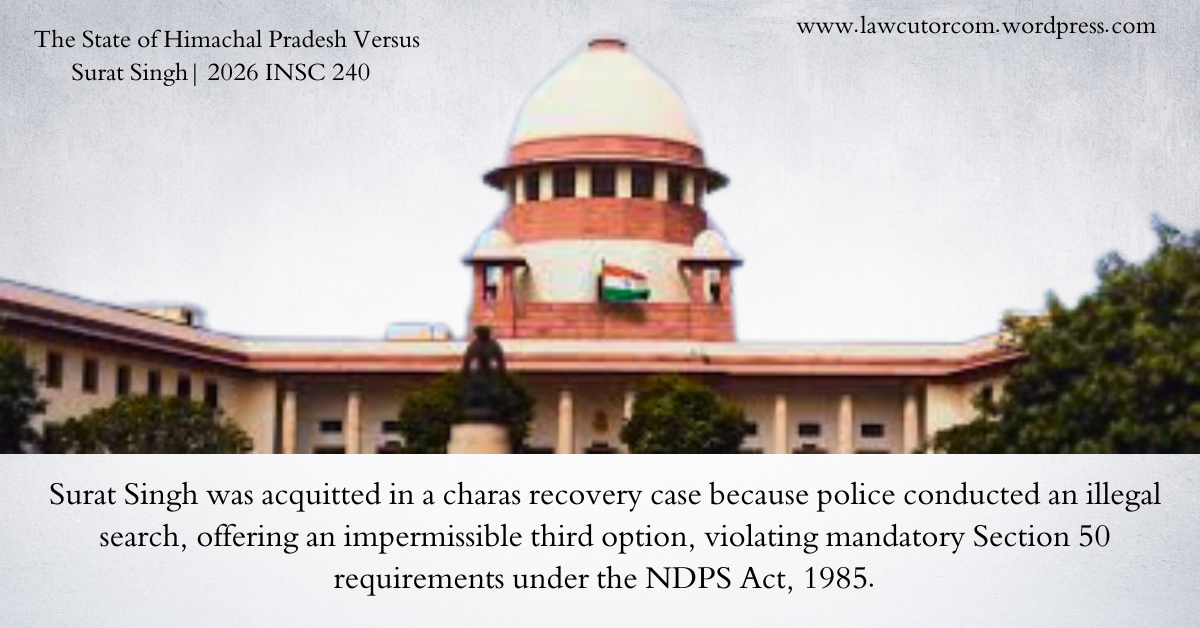
The Supreme Court on Monday upheld the acquittal of Surat Singh in a case involving recovery of 11 kg 50 grams of charas, holding that the search conducted by the police was illegal for offering a third impermissible option of being searched in the presence of the Investigating Officer, which is contrary to the mandatory requirement of Section 50 of the Narcotic Drugs and Psychotropic Substances Act, 1985.
A bench comprising Justices Pankaj Mithal and Prasanna B. Varale dismissed the appeal filed by the State of Himachal Pradesh against the judgment dated 08.10.2015 passed by the High Court of Himachal Pradesh in Cr. Appeal No. 155 of 2015. The High Court had set aside the conviction and 10-year rigorous imprisonment sentence awarded by the Special Judge-I, Shimla, in Sessions Trial No. 21-S/7 of 2013.
According to the prosecution, on 13.03.2013, a police party led by SHO Daya Ram apprehended the respondent near Dhangu Dhank while he was carrying a red-gray backpack. On suspicion, the accused was searched after obtaining his consent. The bag allegedly contained charas in the form of balls and sticks weighing 11 kg 50 grams. The contraband was seized, sealed and sent for FSL analysis, leading to registration of FIR and filing of chargesheet under Section 20 of the NDPS Act.
The trial court convicted the accused relying on the recovery. However, the High Court acquitted him after finding that the consent memo (Ext. PW-1/A) offered the accused three options: search before a Magistrate, before a Gazetted Officer, or before the Investigating Officer in the presence of witnesses. This third option was held to be contrary to Section 50 of the NDPS Act, which mandates that the accused must be informed only of his right to be searched before a Magistrate or a Gazetted Officer.
The Supreme Court endorsed the High Court’s reasoning and observed:
“The police has given option to the accused either to be personally searched before the Magistrate or the Gazetted Police Officer. The accused was also given option whether he wanted to be searched by the I.O. in the presence of witnesses mentioned in Ext. PW-1/A. According to Section 50 of the ND & PS Act, the accused has to be apprised of his legal right to be searched either before the Magistrate or the Gazetted Officer. There is no third option to be searched before the Police Officer. Thus, the consent obtained from the accused was not in conformity with Section 50 of the Act. It has vitiated the entire trial.”
The Court placed reliance on Suresh and others v. State of Madhya Pradesh, (2013) 1 SCC 550, and State of Rajasthan v. Parmanand, (2014) 5 SCC 345, to reiterate that merely asking the accused whether he consents to search by the police officer or a Gazetted Officer does not satisfy the mandatory safeguards under Section 50. The bench further noted that even the evidence regarding use of an electronic weighing scale was rendered doubtful by the testimony of PW-8, who stated that only a traditional weighing scale was available in his shop.
The Supreme Court concluded that once the search and seizure itself stands vitiated due to non-compliance with Section 50, the entire case of the prosecution collapses. Accordingly, the appeal was dismissed and the acquittal ordered by the High Court was upheld.
Cause Title: The State of Himachal Pradesh Versus Surat Singh
Citation: 2026 INSC 240 | Criminal Appeal No. 96 of 2018
Click HERE for full judgment
 Lawcutor