
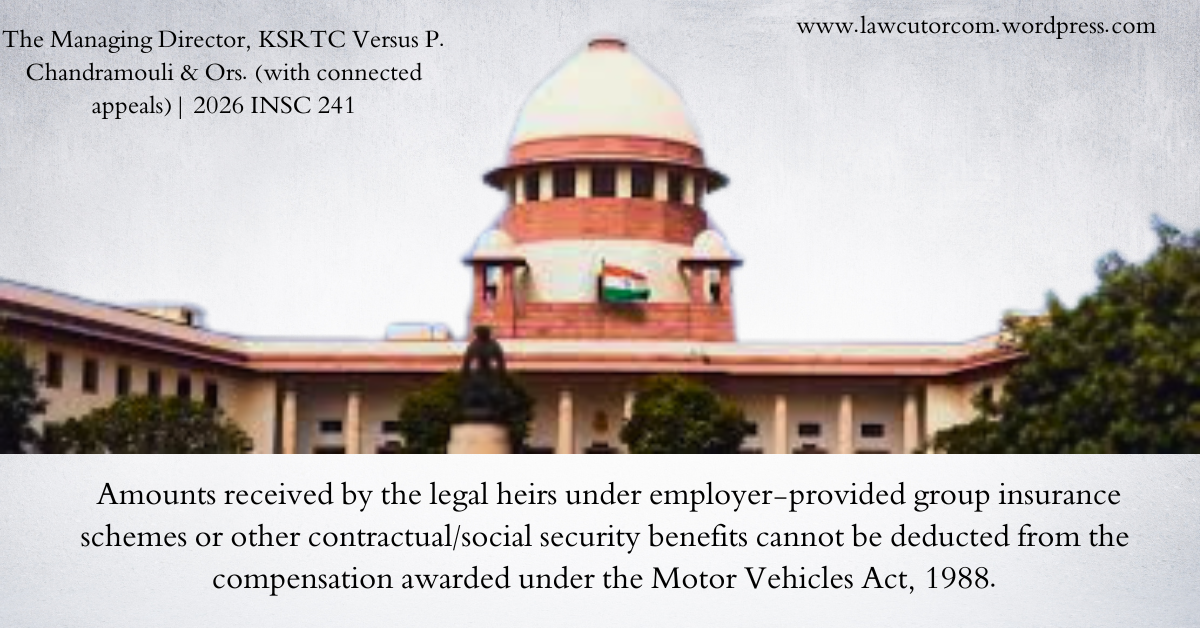
The Supreme Court has laid down that amounts received by the legal heirs under employer-provided group insurance schemes or other contractual/social security benefits cannot be deducted from the compensation awarded under the Motor Vehicles Act, 1988.
A bench comprising Justices Pankaj Mithal and Prasanna B. Varale dismissed two batches of appeals filed by the Managing Director, KSRTC and the insurer, affirming the judgments passed by the High Court of Karnataka which had set aside the deductions ordered by the Motor Accident Claims Tribunals.
In the first set of appeals (Civil Appeal Nos. 5490-5491 of 2025), the deceased P. Visweswar, aged 34 years and working as Team Manager at Accenture, Bangalore, died in a road accident on 30.07.2018 when a KSRTC bus bearing registration No. KA-06-F-1126 came on the wrong side and dashed against his motorcycle near Bharath Petrol Bunk, Murakambattu, Chittoor. The Tribunal had awarded ₹69,07,710 but deducted ₹35,48,000 received under the employer’s group insurance scheme. The High Court removed the deduction and restored the full compensation.
In the connected appeals (Civil Appeal Nos. 5492-5493 of 2025), the deceased Celestine Dsouza, aged 47 years and employed as Assistant Manager with M/s Cox and King Ltd., died on 20.01.2015 when a bus bearing registration No. KA-22/B-7817 hit her Honda Activa from behind near Johnson Market Junction, Bengaluru. The Tribunal deducted ₹10,00,000 received under the group insurance scheme from the award of ₹63,04,878. The High Court deleted the deduction and enhanced the compensation to ₹59,95,944.
The core issue before the Supreme Court was whether compensation receivable through an employer-provided group insurance scheme (without employee contribution) arising from the same motor accident can be deducted from the statutory compensation under the Motor Vehicles Act.
The Court categorically held that such benefits arise out of an independent contractual relationship and have no nexus with the statutory compensation payable for death in a motor vehicle accident. Relying on its earlier decisions in Helen C. Rebello v. Maharashtra SRTC, United India Insurance Co. Ltd. v. Patricia Jean Mahajan and Sebastiani Lakra v. National Insurance Co. Ltd., the bench observed:
“Amounts received by the dependants of the deceased under employer-provided group insurance or other contractual or social security benefits cannot be treated as ‘pecuniary advantages’ liable to be deducted… Such benefits arise out of an independent contractual relationship and lack the requisite nexus with the statutory compensation payable for death in a motor vehicle accident. The principle of balancing loss and gain cannot therefore be invoked to diminish the statutory entitlement of the claimants to just compensation.”
The Court also rejected the procedural objection regarding non-impleadment of the driver, reiterating that motor accident claims are summary proceedings meant to advance social justice and cannot be defeated by technicalities.
Accordingly, the appeals were dismissed. The Supreme Court directed the appellants to comply with the High Court awards and deposit the compensation (if not already paid) within six weeks from the date of the judgment. There shall be no order as to costs.
Cause Title: The Managing Director, KSRTC Versus P. Chandramouli & Ors. (with connected appeals)| 2026 INSC 241
Click HERE for full update.
 Lawcutor