
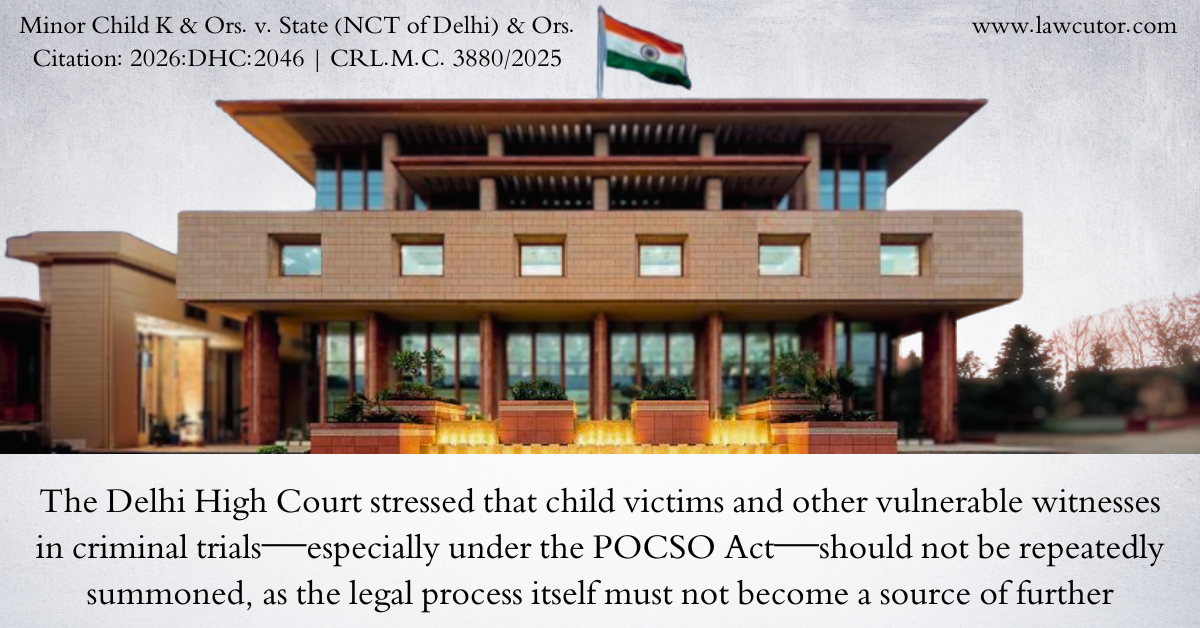
The Delhi High Court has emphasised that child victims and other vulnerable witnesses in criminal trials — particularly under the POCSO Act — must not be repeatedly summoned, as the criminal process itself should not become a source of further trauma.
Justice Swarana Kanta Sharma observed that while a victim has the right to be heard at the stage of bail applications, once her objections or views regarding grant of bail have been recorded, repeated insistence on her physical or virtual presence on every date of hearing ought to be avoided.
“The criminal justice system has increasingly recognised that certain witnesses, particularly victims of sexual offences and children, require special procedural protection while participating in court proceedings,” the Court said.
Justice Sharma added that courts are empowered to adopt appropriate procedural mechanisms, including recording of evidence through video conferencing or other suitable modes, so as to minimise the exposure of vulnerable witnesses to the accused and reduce the psychological stress associated with court proceedings.
The observations came while deciding a petition filed by three minor girl victims (aged about 15 years at the time of the alleged incident) challenging issuance of bailable warrants against one of them during trial in a POCSO case. The petitioners submitted that they had been summoned multiple times — petitioner no. 1 on nine occasions, petitioner no. 2 on four occasions, and petitioner no. 3 on six occasions — solely for recording testimony, causing severe distress and re-traumatisation.
The Court noted that the legislative intent behind Sections 33(5), 35 and 36 of the POCSO Act is to ensure child-friendly procedures, timely recording of evidence, and protection from repeated court appearances and confrontation with the accused. It also referred to the ‘Guidelines of the High Court of Delhi for Recording of Evidence of Vulnerable Witnesses, 2024’ and Supreme Court precedents including Smruti Tukaram Badade v. State of Maharashtra (2022) and Vikas v. State (2020).
Justice Sharma clarified that while the power to recall a witness under Section 311 CrPC exists, it must be exercised sparingly and harmonised with the mandate of Section 33(5) POCSO Act. The Court further held that once a child victim is summoned for recording evidence, the Special Court should endeavour to fix specific dates and ensure examination-in-chief and cross-examination are completed without unnecessary adjournments.
The Court stressed that in appropriate cases, particularly where requested by the victim, the facility of video-conferencing or live-link testimony (as envisaged under Section 36 POCSO Act and the 2024 Guidelines) must be utilised.
The bailable warrants issued against petitioner no. 1 were set aside earlier by the Court on 28.05.2025. No further directions were issued beyond reiterating compliance with existing statutory provisions and guidelines.
Case Title: Minor Child K & Ors. v. State (NCT of Delhi) & Ors.
Citation: 2026:DHC:2046 | CRL.M.C. 3880/2025
Click HERE for full judgment
 Lawcutor