
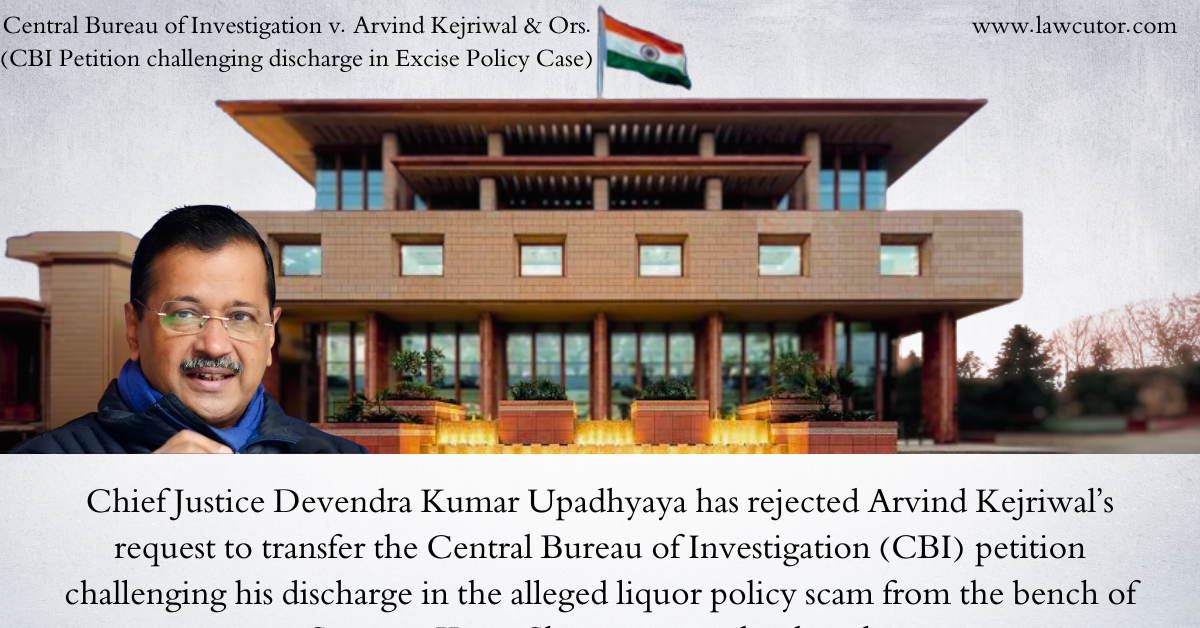
The Chief Justice of the Delhi High Court, Devendra Kumar Upadhyaya, has rejected AAP chief Arvind Kejriwal’s request to transfer the CBI’s criminal petition challenging his discharge in the alleged liquor policy scam from the bench of Justice Swarana Kanta Sharma to another bench.
Chief Justice Upadhyaya observed that the CBI petition is assigned to Justice Sharma as per the current roster and that any request for recusal has to be made before the judge concerned. “I, however, do not find any reason to transfer the petition by passing an order on the administrative side,” the Court said.
Kejriwal is one of the respondents in the CBI petition. The matter was listed before Justice Sharma on March 9, when she issued notice on the plea filed by the Central Bureau of Investigation challenging the discharge of Arvind Kejriwal, Manish Sisodia and 21 other accused persons.
While issuing notice, Justice Sharma had stayed certain observations made by the trial court while discharging the accused, noting that the remarks regarding statements of witnesses and approvers at the stage of charge were “prima facie erroneous and need consideration.” The judge had also stayed the trial court’s scathing remarks against the CBI Investigating Officer and the direction recommending departmental action against him.
In his transfer plea, Kejriwal contended that the March 9 order does not disclose reasons for the “specific perversity” in the trial court observations. He submitted that the concerned bench has already decided multiple matters arising from the excise policy case, recording prima facie observations against the accused persons, and that the Supreme Court has granted relief to them in some cases. Kejriwal stated that his submission is not directed at any personal predilection but only to test the “grave, bona fide, and reasonable apprehension” in the mind of a fair-minded and informed litigant that the matter may not receive a hearing marked by impartiality and neutrality.
The trial court had discharged all 23 accused, including Kejriwal, Sisodia and K Kavitha, after finding that the allegations against them were based primarily on statements of co-accused or witnesses without independent corroboration. The Special CBI Judge had strongly criticised the CBI for lapses in investigation and had observed that the voluminous chargesheet had many lacunae not supported by any witness or statement.
Justice Swarana Kanta Sharma, however, found that the trial court’s observations on the statements of witnesses and approvers at the charge stage were prima facie erroneous and required consideration. She had also stayed the trial court’s direction recommending departmental action against the Investigating Officer, describing it as “foundationally misconceived” when made at the stage of charge.
The excise policy, framed by the Delhi Government in 2021 to privatise liquor trade and boost revenue, was later withdrawn following allegations of irregularities. The CBI and ED have alleged that the policy was manipulated to grant undue benefits to private entities at the cost of the public exchequer.
Manish Sisodia was arrested by the CBI on February 26, 2023 and by the ED on March 9, 2023. Arvind Kejriwal was formally arrested by the CBI on June 26, 2024 while in ED custody. All accused were discharged by the trial court on February 27, 2026.
The CBI petition challenging the discharge remains pending before Justice Swarana Kanta Sharma. The High Court had also requested the trial court to adjourn the connected money laundering proceedings until after the outcome of the CBI petition.
Case Title: Central Bureau of Investigation v. Arvind Kejriwal & Ors. (CBI Petition challenging discharge in Excise Policy Case)
 Lawcutor