
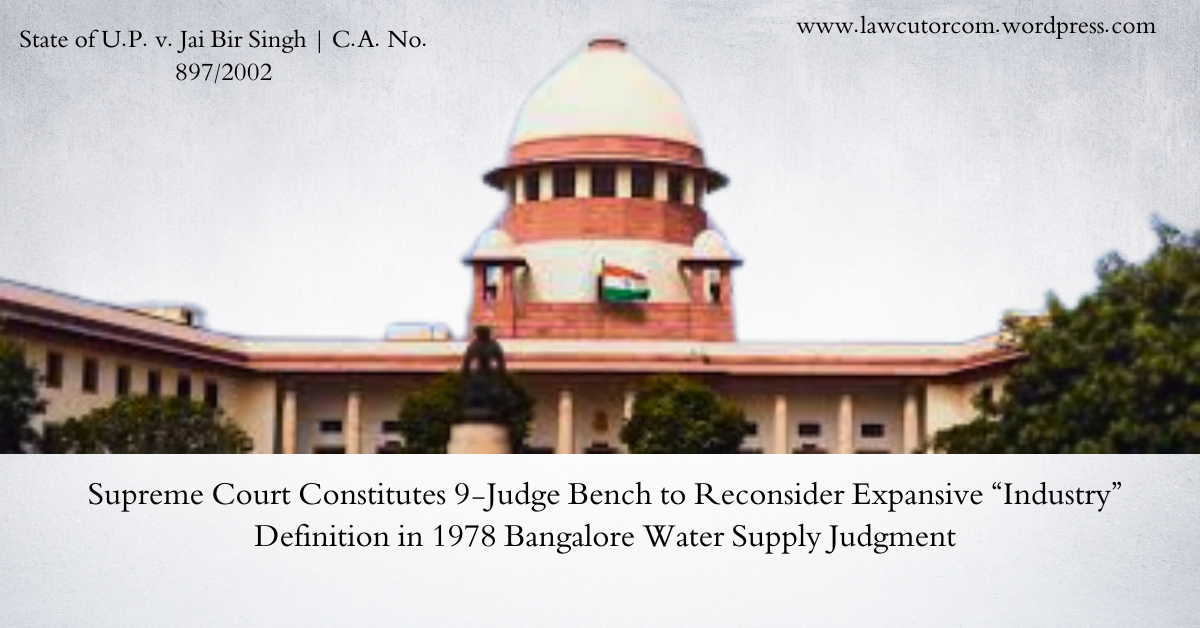
The Supreme Court has notified the composition of a nine-judge Constitution Bench to examine the correctness of the expansive interpretation of the term “industry” laid down in the 1978 seven-judge decision in Bangalore Water Supply and Sewerage Board v. A. Rajappa.
The bench will be headed by Chief Justice of India Surya Kant and will comprise Justices BV Nagarathna, PS Narasimha, Dipankar Datta, Ujjal Bhuyan, Satish Chandra Sharma, Joymalya Bagchi, Alok Aradhe and Vipul M. Pancholi.
The Constitution Bench will commence hearing on March 17 and conclude on March 18, 2026.
The reference arises from a 2002 appeal in State of U.P. v. Jai Bir Singh. In 2005, a five-judge bench referred the matter to a larger bench. In 2017, a seven-judge bench referred it to a nine-judge bench since the original Bangalore Water Supply decision was delivered by a seven-judge bench.
The 9-judge bench will examine whether the broad test laid down in paragraphs 140 to 144 of the opinion authored by Justice V.R. Krishna Iyer requires reconsideration. In Bangalore Water Supply, the Court held that any systematic activity organised by cooperation between employer and employee for the production or distribution of goods and services would fall within the definition of “industry” under the Industrial Disputes Act, 1947, even if the organisation was not engaged in profit-making.
The bench will also consider:
(i) Whether the test in paragraphs 140 to 144 of Justice Krishna Iyer’s opinion lays down correct law, and whether the Industrial Disputes (Amendment) Act, 1982 (which did not come into force) and the Industrial Relations Code, 2020 (effective 21.11.2025) have any legal impact on the interpretation of “industry” in the principal Act;
(ii) Whether social welfare activities and schemes or other enterprises undertaken by Government Departments or their instrumentalities can be construed as “industrial activities” for the purpose of Section 2(j) of the ID Act;
(iii) What State activities will be covered by the expression “sovereign function” and whether such activities fall outside the purview of Section 2(j) of the ID Act.
Case Title: State of U.P. v. Jai Bir Singh | C.A. No. 897/2002
 Lawcutor