
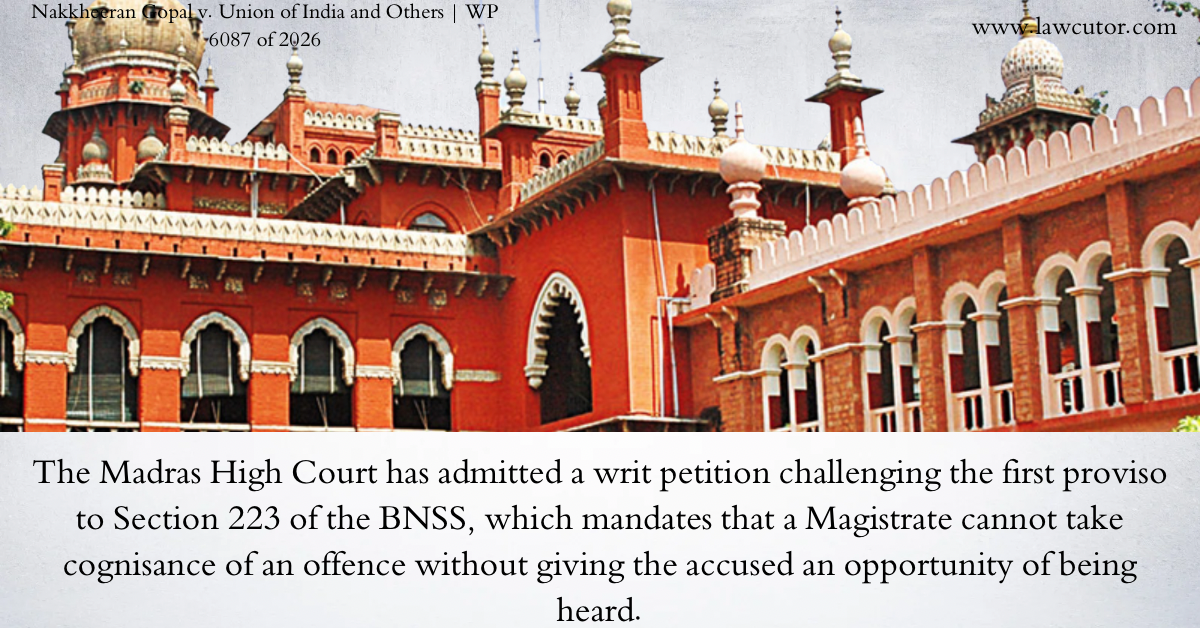
The Madras High Court has admitted a writ petition challenging the first proviso to Section 223 of the Bharatiya Nagarik Suraksha Sanhita (BNSS), 2023, which mandates that a Magistrate cannot take cognisance of an offence without giving the accused an opportunity of being heard.
A bench comprising Chief Justice SA Dharmadhikari and Justice G Arul Murugan issued notice to the Ministry of Law and Justice and the Ministry of Home Affairs after admitting the plea filed by investigative journalist Nakkheeran Gopal, owner of Nakkheeran Publications.
Gopal submitted that as part of his profession he had published critical articles about alleged illegalities at Isha Foundation run by Jaggi Vasudev. In response, Isha Foundation published a defamatory article against him. He filed a criminal defamation complaint before the Metropolitan Magistrate, Egmore.
After a pre-cognisance enquiry and recording of his sworn statement to establish the ingredients of defamation under Section 356(1) BNS, the Magistrate insisted on issuing summons to all accused and affording them an opportunity of being heard under the first proviso to Section 223(1) BNSS. This prompted Gopal to approach the High Court.
The petitioner contended that while Section 223 BNSS is pari materia with Section 200 CrPC, the first proviso is an additional insertion that is redundant, prolongs the trial, is repugnant to timely justice and ultra vires the Constitution.
He argued that under the old regime three defending opportunities existed — dismissal under Sections 202 and 203 CrPC, challenging cognisance under Section 190 CrPC, and appeal after conviction under Section 255 CrPC. The BNSS now adds two more — discharge opportunity under the proviso to Section 274 and pre-cognisance hearing under the proviso to Section 223(1).
Gopal submitted that the new proviso places a heavy burden on the complainant. If there are multiple accused, serving summons becomes practically difficult and the trial can drag on endlessly, denying timely justice.
He further pointed out inbuilt contradictions between BNSS provisions: Section 210 allows straight cognisance; Section 227 permits summons if sufficient grounds exist; Section 223 states no examination of complainant/witnesses is needed if complaint is in writing; and Section 225 requires evidence of witnesses to decide sufficiency of grounds. These conflicts put the Magistrate in a conundrum.
The plea seeks to declare the first proviso to Section 223(1) BNSS redundant and ultra vires the Constitution, and to lay down the correct trial procedure for criminal defamation complaints while settling conflicts between Sections 210, 223, 225 and 227 BNSS.
Case Title: Nakkheeran Gopal v. Union of India and Others | WP 6087 of 2026
 Lawcutor