
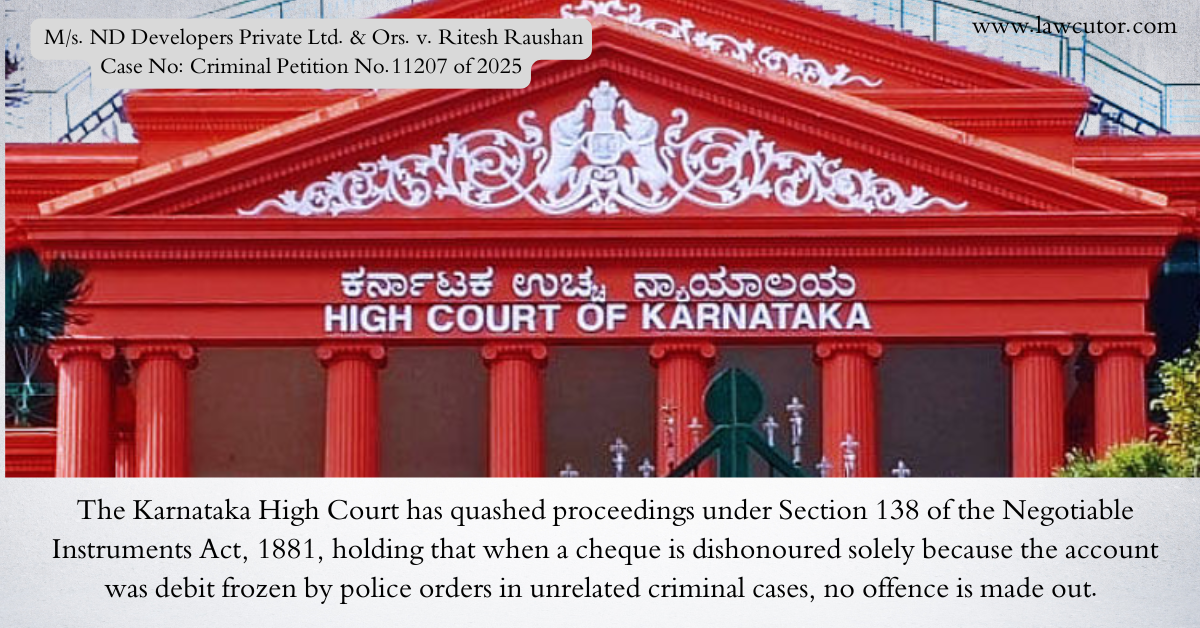
The Karnataka High Court has quashed proceedings under Section 138 of the Negotiable Instruments Act, 1881, holding that when a cheque is dishonoured solely because the account was debit frozen by police orders in unrelated criminal cases, no offence is made out. The single judge bench of Justice M. Nagaprasanna ruled that the drawer must have real control and authority over the account at the time of presentation for Section 138 to apply, and a police-initiated debit freeze removes such control.
The petitioners — M/s. ND Developers Private Ltd. and its directors — had issued a cheque for ₹41,00,000/- on 09.03.2024 to the complainant, Ritesh Raushan, towards compensation for breach of the No Pre-EMI Scheme in their ND Passion Elite project. The cheque was presented on 05.06.2024 and returned with the endorsement “Account blocked situation covered in 2125”.
The Court noted that on 24.05.2024 — after issuance but before presentation — the police issued a notice under Sections 91 and 102 Cr.P.C. directing Bank of Maharashtra to debit-freeze the company’s and Managing Director’s accounts in connection with Crime Nos.92/2022 and 116/2023 registered for offences under Sections 406, 420, 504 and 506 IPC. The petitioners became aware of the freeze only on 26.07.2024, after they had already replied to the statutory notice.
Justice Nagaprasanna observed:
“…The ostensible reason for dishonouring of the cheque has to be a voluntary act in the control of the accused and if the cheque has been dishonoured for being debit frozen it cannot be the voluntary act of the accused. The accused should be capable of executing the command to govern financial transaction which include clearance of cheques…”
The bench extensively relied on Delhi High Court judgments in Vijay Chaudhary v. Gyan Chand Jain (2008), Best Buildwell Pvt. Ltd. v. R.D. Sales (2025) and Farhad Suri v. Praveen Choudhary (2025), as well as Punjab & Haryana High Court’s ruling in Rajesh Meena v. State of Haryana (2019). All these precedents consistently hold that when an account is frozen by Court, police or statutory authorities, the drawer cannot be said to be “maintaining” the account within the meaning of Section 138, and the presumption under Sections 118 and 139 does not operate.
Referring to RBI’s Model List of Objections (Annexure D, 2012), the Court clarified that reason code 21 covers payment stopped by attachment order while code 25 covers withdrawal stopped due to insolvency — both situations where the drawer loses authority over the account.
The Court rejected the complainant’s argument that the cheque was issued against a legally enforceable debt, noting that the petitioners had already settled the claim by allotting two additional plots and executing a RERA settlement deed in 2022. Even otherwise, the dishonour was not attributable to insufficiency of funds but to external police action beyond the petitioners’ control.
Exercising powers under Section 482 Cr.P.C. (now Section 528 BNSS), the bench held that continuation of proceedings would result in miscarriage of justice.
Accordingly, the entire proceedings in C.C.No.1446/2025 pending before the XIII Additional Chief Judicial Magistrate, Bengaluru, were quashed.
Case Title: M/s. ND Developers Private Ltd. & Ors. v. Ritesh Raushan
Case No: Criminal Petition No.11207 of 2025
Date of Judgment: 04.03.2026
Click HERE for full judgment
 Lawcutor