
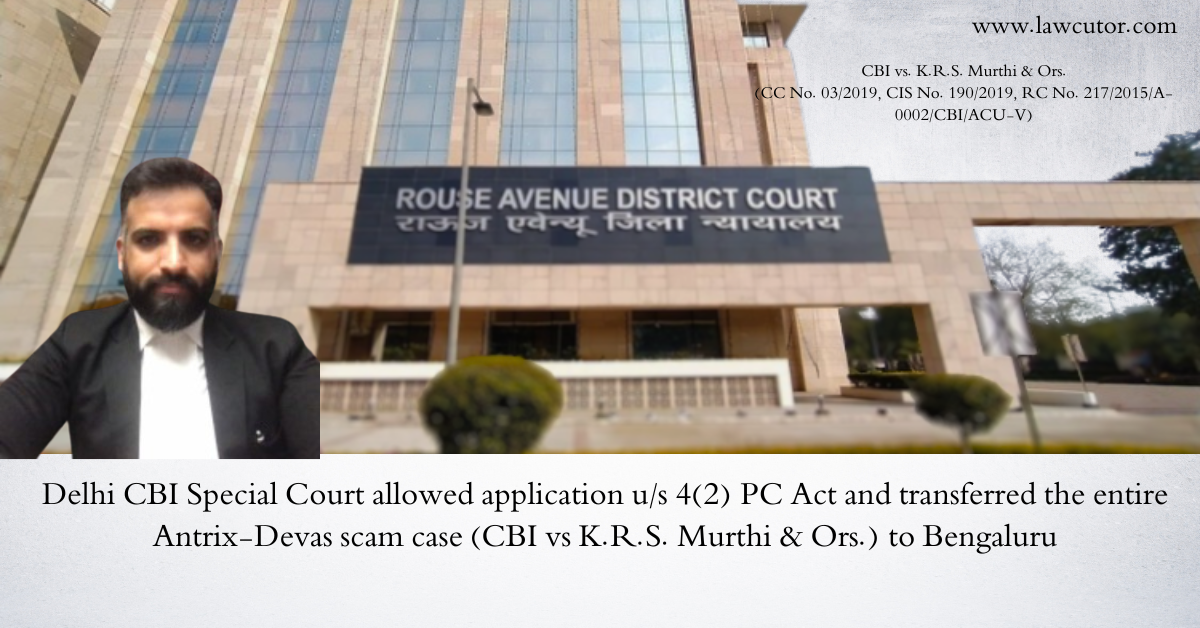
In a major procedural victory for one of the accused in India’s biggest space-sector corruption probe, the Special CBI Court (PC Act), RADC, New Delhi, has allowed the application filed by Accused No. 6, Veena Sri Ram Rao, and directed the return of the entire case file to the CBI Investigating Officer for presentation before the competent court in Bengaluru, Karnataka.
What the Application Was About
Accused No. 6 raised a preliminary objection during charge arguments that the entire conspiracy and the substantive offences under the Prevention of Corruption Act, 1988 (PC Act) were committed in Bengaluru. She argued that:
• All key events — from the submission of the Joint Venture proposal, constitution of the Shankara Committee, incorporation of Devas Multimedia Pvt. Ltd., signing of the Antrix-Devas Agreement on 28.01.2005, board meetings of Antrix, processing of the Cabinet Note, and the amendment to Article 31 — took place in Bengaluru.
• No part of the substantive PC Act offences occurred in Delhi.
• Section 4(2) of the PC Act mandates trial by the Special Judge “for the area within which the offence was committed.” The PC Act, being a special statute, overrides general CrPC/BNSS provisions on territorial jurisdiction.
The court had earlier directed her to file a formal application, which was done on 08/2025.
CBI’s Stand
The CBI opposed the application, claiming:
• Multiple acts (Space Commission meetings, TAG meetings, Cabinet approval, signing of the internet licence agreement) occurred in New Delhi.
• The objection was raised belatedly after seven years and after the accused had submitted to Delhi’s jurisdiction.
• Relying on CBI vs. Narayan Niryat (2025) and V.K. Puri vs. CBI (2007).
Court’s Reasoning & Key Findings
After a detailed examination of the charge-sheet, the chronological table of events submitted by A-6, and extensive arguments, the court held:
1. The substantial and main acts constituting the offences under Sections 13(2) r/w 13(1)(d) of the PC Act occurred in Bengaluru.
2. Acts in Delhi were mostly “allied”, “consequential”, or “in furtherance” and did not form the core of the criminal misconduct.
3. The sole determinative factor under Section 4(2) PC Act is the place where the main offence was committed — not the place of FIR or allied acts. The court heavily relied on the three-judge bench judgment in CBI vs. Braj Bhushan Prasad (2001) 9 SCC 432, which has been consistently followed by the Supreme Court and High Courts.
4. The PC Act’s non-obstante provision displaces general CrPC provisions (Sections 178–181) on concurrent jurisdiction when the main offence is under the PC Act.
5. The belated nature of the objection does not bar the court from deciding the issue of territorial jurisdiction, which goes to the root of the matter.
Operative Order
The application under Section 4(2) of the Prevention of Corruption Act, 1988, was allowed.
The entire case file, annexures, and all documents (relied or unrelied) have been ordered to be returned to the IO, CBI, who is at liberty to present the same before the competent Special Court in Bengaluru, Karnataka.
Why This Order Matters
This ruling reinforces the principle that in PC Act cases, courts cannot assume jurisdiction merely because the FIR was registered in Delhi or because some procedural steps (like Cabinet approval) happened in the national capital. The place of commission of the substantive offence is decisive.
Case Name:
CBI vs. K.R.S. Murthi & Ors.
(CC No. 03/2019, CIS No. 190/2019, RC No. 217/2015/A-0002/CBI/ACU-V)
(IA No. 08/2025)
Date of Order: 11 March 2026
Presiding Judge: Atul Krishna Agrawal, Special Judge, CBI-19 (PC Act)
Advocates Appearing
For Applicant/A-6 Veena Sri Ram Rao:
• Sh. Chirag Madan
• Sh. Ronit Bose
• Sh. Rahul Agarwal
• Ms. Rachael Tuli
For CBI (Prosecution):
• Sh. Neeraj Jain
• Sh. Rishi Raj Sharma (Ld. Special Public Prosecutors)
Investigating Officer:
Sh. Surender Kumar Rohilla, DSP, AC-II, CBI
Click HERE for full judgment.
 Lawcutor