
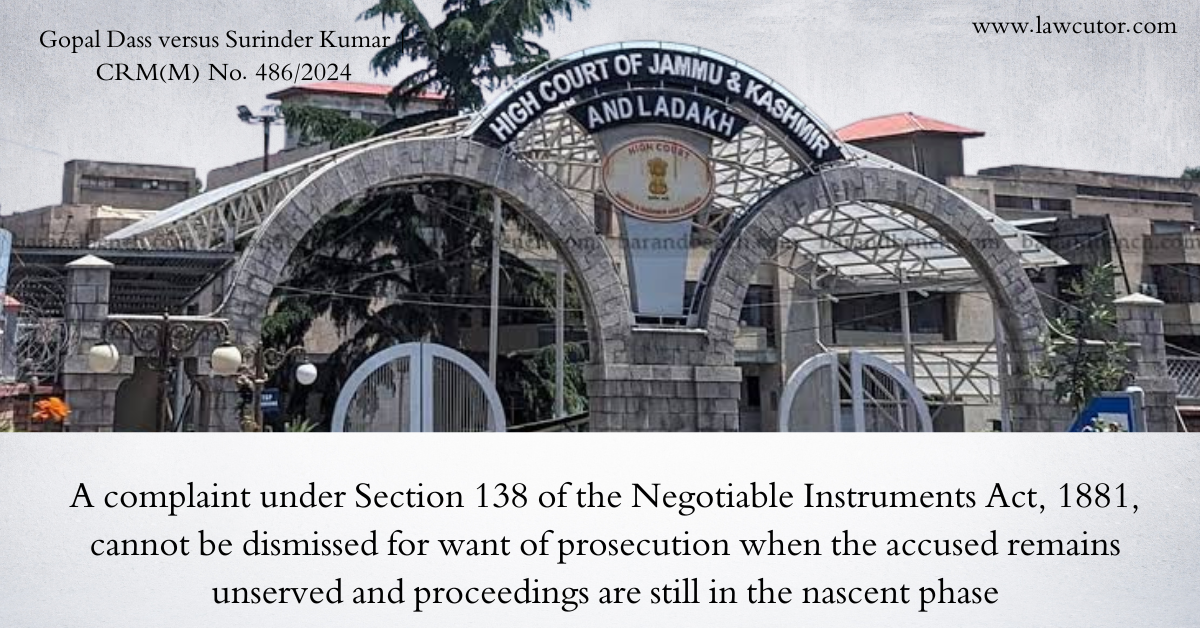
The High Court of Jammu & Kashmir and Ladakh has ruled that a complaint under Section 138 of the Negotiable Instruments Act, 1881, cannot be dismissed for want of prosecution when the accused remains unserved and proceedings are still in the nascent phase. Justice Sanjay Parihar, in his March 6, 2026, order, quashed the trial court’s October 12, 2022, dismissal of Complaint No. 114/2019, restoring it to its original number and directing expeditious proceedings.
The petitioner, Gopal Dass, had instituted four separate complaints against Surinder Kumar under Section 138 NI Act before the City Judge (JMIC), Jammu, all arising from dishonored cheques and pursued concurrently. While three complaints remain active—with the respondent regularly appearing—the fourth was inadvertently listed on November 12, 2019, and dismissed nearly three years later due to the complainant’s absence. Invoking inherent powers under Section 482 CrPC, the petitioner contended this prejudiced his case, as service on the accused was incomplete and the matter segregated erroneously from the bundled hearings.
Senior Advocate A.K. Sawhney, assisted by Advocates Khushboo Sharma, Tehseena Bukhari, and Harsh Singh, argued that the respondent, aware of the proceedings through the parallel cases, deliberately evaded service post-dismissal. The court concurred, noting the e-Courts record confirmed joint tracking of the four complaints until a scheduling reshuffle led to the mishap. It emphasized that the trial court’s order solely noted the complainant’s non-appearance without assessing the accused’s status, underscoring the proceedings’ preliminary nature.
Delving into the NI Act’s framework, the bench observed: “Once a cheque is drawn and the complaint satisfies the statutory requirements of the Negotiable Instruments Act, a presumption arises under Sections 118 and 139 of the Act that the cheque has been issued in discharge of a legally enforceable debt or liability.” Thus, routine complainant absences—absent bad faith—cannot justify closure pre-accused involvement. The court faulted the trial court for not first securing the respondent’s presence, rendering personal attendance non-indispensable at that juncture.
Highlighting the miscarriage of justice, Justice Parihar held the dismissal deprived the complainant of statutory remedies, especially given the unchallenged presumptions favoring the holder. “Although the complainant could have been more vigilant… the mere absence… could not have persuaded the Trial Court to dismiss the complaint for want of prosecution, particularly when the service of the respondent had not yet been effected.”
Parties were directed to appear before the trial court on April 7, 2026, with a copy of the order furnished to the petitioner. This ruling safeguards NI Act complainants from procedural pitfalls, reinforcing that presumptive liabilities demand full adjudication before premature termination.
Case Title: Gopal Dass versus Surinder Kumar | CRM(M) No. 486/2024
Click HERE for full judgment
 Lawcutor