
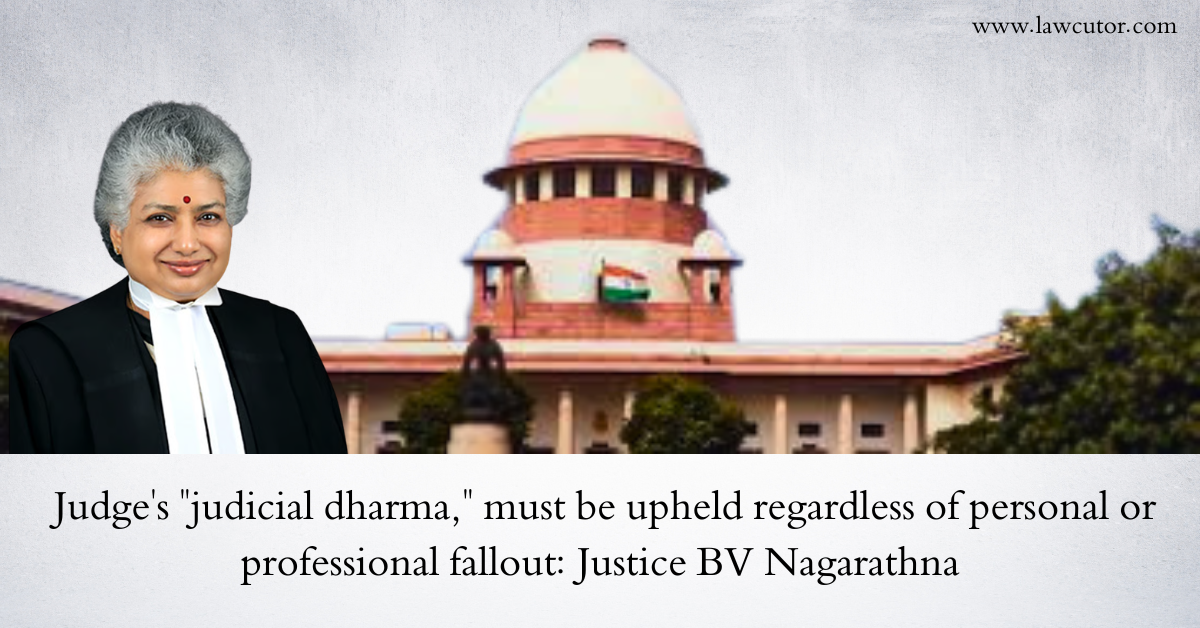
Supreme Court Judge Justice BV Nagarathna has called upon the judiciary to exhibit unwavering courage and conviction, stressing that judges must not hesitate in delivering the right decision—even if it risks their elevation or invites displeasure from those in power. Delivering the 2nd Justice T.S. Krishnamoorthy Iyer Memorial Lecture at the Kerala High Court on March 3, 2026, she highlighted that true judicial review demands fearlessness in the face of political consequences.
She pointed out that courts often have to strike down laws, curb executive overreach, or even invalidate constitutional amendments passed by majorities. “These are not easy tasks. They often carry political consequences,” Justice Nagarathna observed. Judges may be aware that an unpopular ruling could impact their career advancement or place them in disfavor with influential quarters. Yet, she asserted, such awareness must never compromise what the Constitution requires.
The oath of office, she described as a judge’s “judicial dharma,” must be upheld regardless of personal or professional fallout. If rulings are influenced by fears over elevation, extension, or standing with authorities, judicial review becomes merely symbolic rather than a substantive safeguard.
Justice Nagarathna drew inspiration from Justice H.R. Khanna’s iconic dissent in the ADM Jabalpur case during the Emergency. While the majority held that fundamental rights, including access to courts for personal liberty, could be suspended, Justice Khanna stood firm, declaring that the Constitution did not allow the State to extinguish life and liberty even in emergencies. His principled stand cost him the Chief Justiceship, but it was later vindicated when the Supreme Court in the Puttaswamy judgment overruled ADM Jabalpur, reaffirming that fundamental rights cannot bow to executive whim.
Judicial independence, she explained, has both external and internal facets. Externally, it means freedom from political pressure, institutional threats, or public opinion. Internally, it includes every judge’s right to form and voice their own reasoned view of the law—even when it differs from colleagues. Dissenting or separate opinions reflect intellectual autonomy and represent judicial independence at its most enlightened level.
“A judicial opinion is not a negotiation document; it is an articulation of constitutional conviction,” she emphasized. Judges should avoid diluting their reasoning for consensus when the law demands clarity and firmness.
On the lecture’s theme—“Transformative Constitutionalism and the Basic Structure Doctrine”—Justice Nagarathna described these as interconnected pillars reliant on an independent judiciary. The Basic Structure Doctrine, born from Kesavananda Bharati and strengthened in cases like Minerva Mills and S.R. Bommai, protects core features such as constitutional supremacy, secularism, federalism, separation of powers, and judicial review from being destroyed through amendments.
Transformative constitutionalism, meanwhile, drives the realization of the Constitution’s promises of liberty, equality, and fraternity, addressing historical injustices and evolving social realities. The two doctrines balance each other: the basic structure prevents erosion of essentials, while transformative constitutionalism keeps commitments alive and responsive.
Both converge in judicial review, where courts police power limits and enforce constitutional values. Without fearless independence, this role weakens, allowing majoritarian excesses to go unchecked. Legitimacy for the judiciary flows not from popularity but from fidelity to the Constitution.
In conclusion, Justice Nagarathna reiterated that the survival of constitutional governance hinges on the moral courage of judges to protect the Constitution’s identity, even at personal cost.
 Lawcutor