
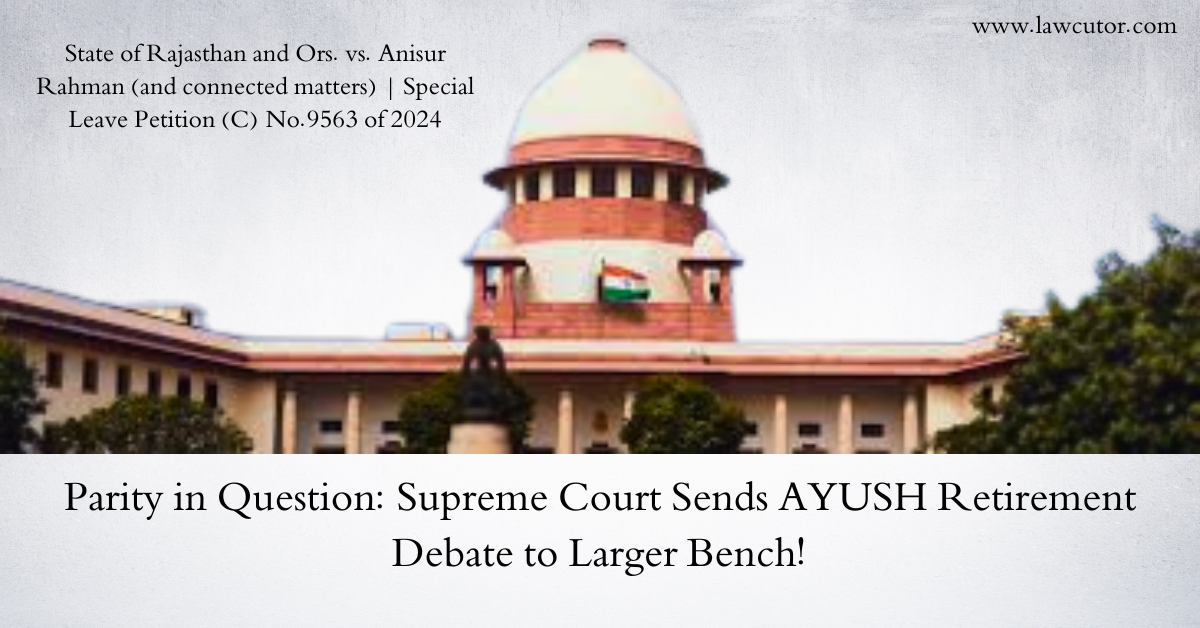
In a significant development addressing disparities in service conditions for medical professionals, the Supreme Court of India has referred the question of whether doctors practicing allopathy and indigenous systems of medicine (such as Ayurveda, Homeopathy, and Unani—collectively AYUSH) can be treated equally for retirement age to a larger bench. The order, issued on October 17, 2025, highlights ambiguities in prior rulings and seeks an authoritative resolution on whether such parity aligns with constitutional principles under Articles 14 and 16. Pending the larger bench’s decision, the court provided interim directions allowing states to extend AYUSH doctors’ service up to 65 years (matching allopathy doctors) but with half pay and no regular allowances, adjustable based on the final outcome.
The batch of special leave petitions, led by State of Rajasthan vs. Anisur Rahman, stems from challenges by AYUSH doctors seeking equal retirement ages and pay scales as their allopathy counterparts. States like Rajasthan argued that allopathy doctors handle critical care, emergencies, and surgeries—roles not typically performed by AYUSH practitioners—justifying differential treatment due to public health needs and shortages in allopathy. Petitioners contended that both groups provide essential healthcare, warranting parity to avoid discrimination.
The bench, comprising Chief Justice B.R. Gavai and Justice K. Vinod Chandran, reviewed conflicting precedents. In New Delhi Municipal Corporation vs. Dr. Ram Naresh Sharma (2021), AYUSH doctors were granted retirement at 65 following a Union Cabinet decision. However, State of Gujarat vs. Dr. P.A. Bhatt (2023) and Dr. Solamon A. vs. State of Kerala upheld classifications based on qualifications and duties, denying pay parity. The court noted that while pay scales differ due to unequal work, retirement age requires evaluation on identity of functions and public good.
Emphasizing that “unequals cannot be treated as equals,” the judges observed that allopathy involves life-saving interventions absent in indigenous systems, yet footfalls in allopathy hospitals are higher. The reference aims to clarify if service conditions can equate the two streams, given their distinct curricula, diagnostics, and treatments.
Interim measures include:
- States may continue AYUSH doctors post-retirement age without full pay; half salary to be paid, adjustable if the larger bench rules in their favor.
- If not continued, doctors retire as per existing rules but may claim benefits if parity is upheld.
- No pension during extension periods.
This order balances immediate healthcare needs with legal clarity, potentially impacting thousands of doctors. Legal experts anticipate the larger bench will reconcile precedents, influencing recruitment and retention in public health.
Case Details:
- Case Title: State of Rajasthan and Ors. vs. Anisur Rahman (and connected matters)
- Citation: Non-Reportable (Order dated October 17, 2025)
- Court: Supreme Court of India (Civil Appellate Jurisdiction)
- Petition Numbers: Special Leave Petition (C) No. 9563 of 2024 (lead); includes SLPs Nos. 27110/2023, 27095-27096/2023, and others up to Diary No. 11533/2025
- Judges: Chief Justice B.R. Gavai and Justice K. Vinod Chandran
- Date of Order: October 17, 2025
- Key Issue: Parity in retirement age between allopathy and AYUSH doctors.
- Outcome: Matter referred to larger bench; interim directions for continuation with half pay.
Click HERE for full order/judgment.
 Lawcutor