
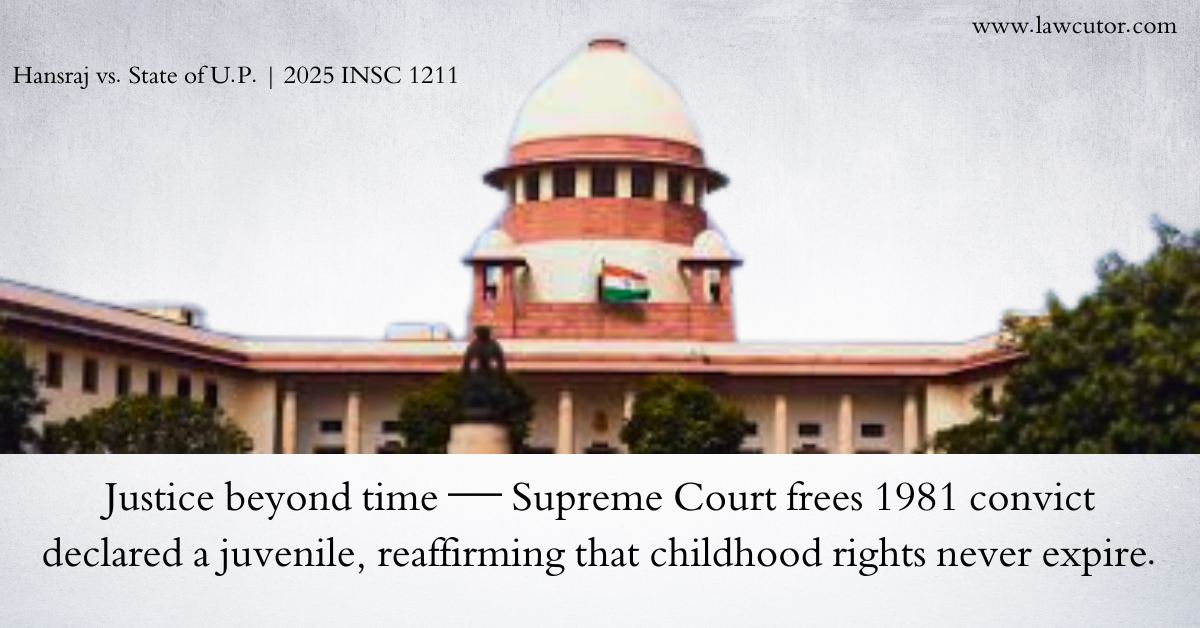
In a significant ruling emphasizing the retrospective application of juvenile justice laws, the Supreme Court of India has directed the immediate release of Hansraj, a convict in a 1981 murder case, after he served over three years in custody post-arrest in 2022. The court, invoking Article 21’s right to life and liberty, held that as a juvenile at the time of the offense, Hansraj’s detention exceeded the maximum permissible period of three years under the Juvenile Justice (Care and Protection of Children) Act, 2000 (JJ Act, 2000). The non-reportable judgment, dated October 9, 2025, underscores that juvenility claims can be raised at any stage, even after final disposal, and that excessive detention constitutes a breach of fundamental rights.
The case dates back to November 2, 1981, when Hansraj, then approximately 12 years and 5 months old, along with five others, allegedly assaulted the father of the complainant with knives and lathis in Sultanpur, Uttar Pradesh. The victim succumbed to injuries the next day. Hansraj was arrested on November 6, 1981, and released on bail after about a month. In 1984, the Special Additional Sessions Judge, Sultanpur, convicted him under Sections 302/149, 147, and 148 of the Indian Penal Code but, noting his age of about 16 at trial, sentenced him under the Children Act, 1960, to a children’s home for reformation.
The Allahabad High Court acquitted all accused in 2000, but the Supreme Court, in a 2009 appeal by the state, reversed the acquittal and restored the trial court’s sentence for Hansraj. However, Hansraj absconded and was only arrested on May 19, 2022. By August 14, 2025, he had been in custody for 3 years, 10 months, and 28 days.
Invoking Article 32, Hansraj filed a writ petition seeking mandamus for release, arguing his juvenile status entitled him to benefits under Section 7-A of the JJ Act, 2000, which allows juvenility claims post-conviction. The bench, comprising Justices Dipankar Datta and Augustine George Masih, agreed. Citing precedents like Pratap Singh (2005), Satya Deo (2020), and Vinod Katara (2023), the court affirmed that the JJ Act, 2000, applies to pending or concluded cases where juvenility is raised, overriding the 1960 Act’s limitations.
The court noted no dispute over Hansraj’s age and dismissed arguments that the heinous nature of the crime (murder) barred relief, clarifying that under Section 15(1)(g) of the JJ Act, 2000, maximum detention for juveniles is three years. It also criticized the joint trial with adults, violating Section 24 of the 1960 Act. Rejecting pleas for mercy denial due to absconding, the bench prioritized constitutional protections, ordering release if not required in other cases.
This verdict reinforces the rehabilitative focus of juvenile justice, ensuring laws protect children even in grave offenses. It may influence similar retrospective claims, highlighting the need for prompt age determinations in trials.
Case Details:
- Case Title: Hansraj vs. State of U.P.
- Citation: 2025 INSC 1211
- Court: Supreme Court of India (Criminal Original Jurisdiction)
- Petition Number: Writ Petition (Crl.) No. 340 of 2025
- Judges: Justice Dipankar Datta and Justice Augustine George Masih
- Date of Judgment: October 9, 2025
- Original Incident Date: November 2, 1981
- Offences: Sections 302/149, 147, 148 IPC
- Trial Court: Conviction in Sessions Trial No. 8 of 1983 (dated August 16, 1984)
- High Court: Acquittal in Criminal Appeal No. 631 of 1984 (dated April 7, 2000)
- Previous SC Ruling: Reversal in Criminal Appeal No. 276 of 2002 (dated May 8, 2009)
- Outcome: Petition allowed; immediate release ordered.
Click HERE for full judgment
 Lawcutor