
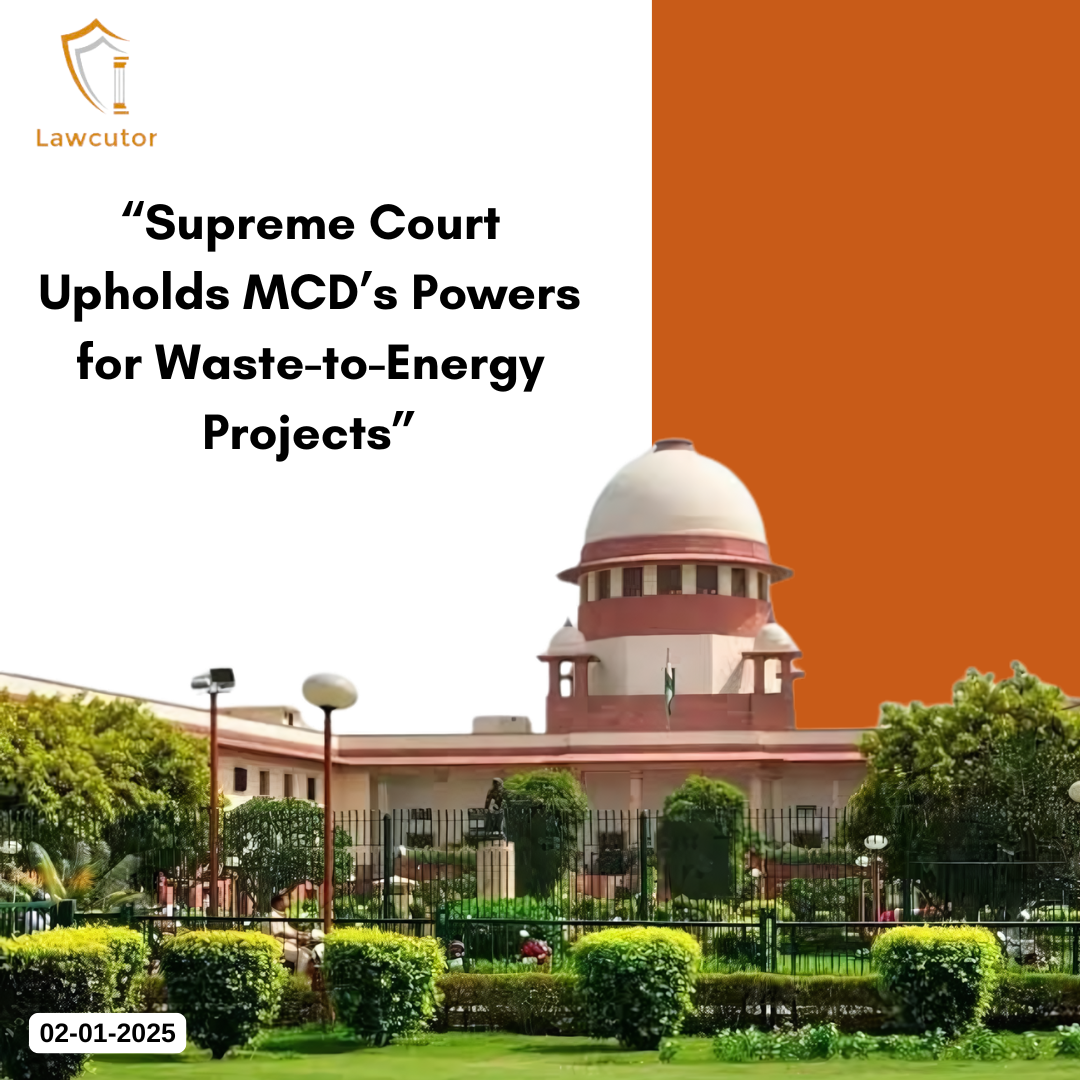
On January 2, the Supreme Court reaffirmed the Municipal Corporation of Delhi’s (MCD) authority to issue tariff-based bids for Waste-to-Energy (WTE) projects under the Electricity Act, 2003. The bench of Justices B.R. Gavai and K.V. Viswanathan set aside the Appellate Tribunal for Electricity’s (APTEL) order and restored the Delhi Electricity Regulatory Commission’s (DERC) 2023 decisions. The Court emphasized that the larger public interest in addressing Delhi’s massive waste management problems must prevail.
APTEL’s Order Overturned: Public Interest at the Core
APTEL had previously ruled that the DERC lacked jurisdiction to entertain MCD’s petition regarding the tariff-based bidding for WTE projects. However, the Supreme Court held that APTEL overlooked the public interest involved in ensuring efficient waste disposal in the national capital. The Court observed that WTE projects align with environmental priorities, as mandated under the Solid Waste Management (SWM) Rules, 2016.
Section 63: Supreme Court Adopts Literal Interpretation
The core legal issue before the Court was whether MCD, a local authority under Section 2(41) of the Electricity Act, 2003, could invoke Section 63 of the Act, which provides for tariff determination through competitive bidding.
The Court applied the principle of literal interpretation, holding that Section 63 unambiguously allows State Commissions to adopt tariffs determined transparently through a bidding process. The bench stated that APTEL’s interpretation added unnecessary restrictions to Section 63, contrary to the legislature’s intent.
“When a statutory provision is clear and unambiguous, courts should refrain from adding words or altering its plain meaning,” the Court emphasized, citing its earlier judgment in Punjab State Power Corporation Ltd. v. Emta Coal Ltd.
Harmonious Interpretation of Section 63 and Section 86(1)(b)
The Court highlighted that Section 63 must be read harmoniously with Section 86(1)(b), which empowers State Commissions to regulate electricity procurement, including tariffs, to ensure a balance between the interests of generators, discoms, and consumers.
The Court reiterated that the State Commission is not merely a “post office” but must ensure that bidding processes are transparent and equitable. Citing Jaipur Vidyut Vitran Nigam Ltd. v. MB Power (MP) Ltd., the Court underlined the need to harmonize legislative provisions for a coherent statutory framework.
MCD’s Statutory Mandate Under SWM Rules, 2016
The Supreme Court held that MCD’s role in WTE projects is mandated by Rule 15 of the SWM Rules, 2016, enacted under the Environment (Protection) Act, 1986. The rule requires local bodies to construct, operate, and maintain solid waste processing facilities, including WTE plants.
Additionally, the Court noted that Section 175 of the Electricity Act provides that its provisions are in addition to, and not in derogation of, other laws. This ensures that the SWM Rules and the Electricity Act operate concurrently, strengthening MCD’s mandate for WTE projects.
Addressing Tariff Policy and Renewable Energy
The Court also referred to Rule 6.4 of the National Tariff Policy, 2016, which mandates distribution licensees to procure 100% of the power generated by WTE plants. Further, Section 86(1)(e) of the Electricity Act obliges State Commissions to promote renewable energy sources, including cogeneration from waste.
By approving MCD’s tariff of ₹7.38/KWh for the Narela-Bawana WTE project, the DERC acted within its regulatory authority to support renewable energy initiatives and public welfare.
Conclusion:
Supreme Court Restores DERC’s Orders
The Supreme Court allowed MCD’s appeal, setting aside APTEL’s judgment and restoring DERC’s orders dated March 6 and 7, 2023. The Court’s judgment reaffirmed the MCD’s powers under the Electricity Act and highlighted the environmental and public interest significance of WTE projects.
Case Details:
Title: Municipal Corporation of Delhi v. Gagan Narang & Ors. Etc.
Citation: Civil Appeal Nos. 7463-7464 of 2023.
 Lawcutor