
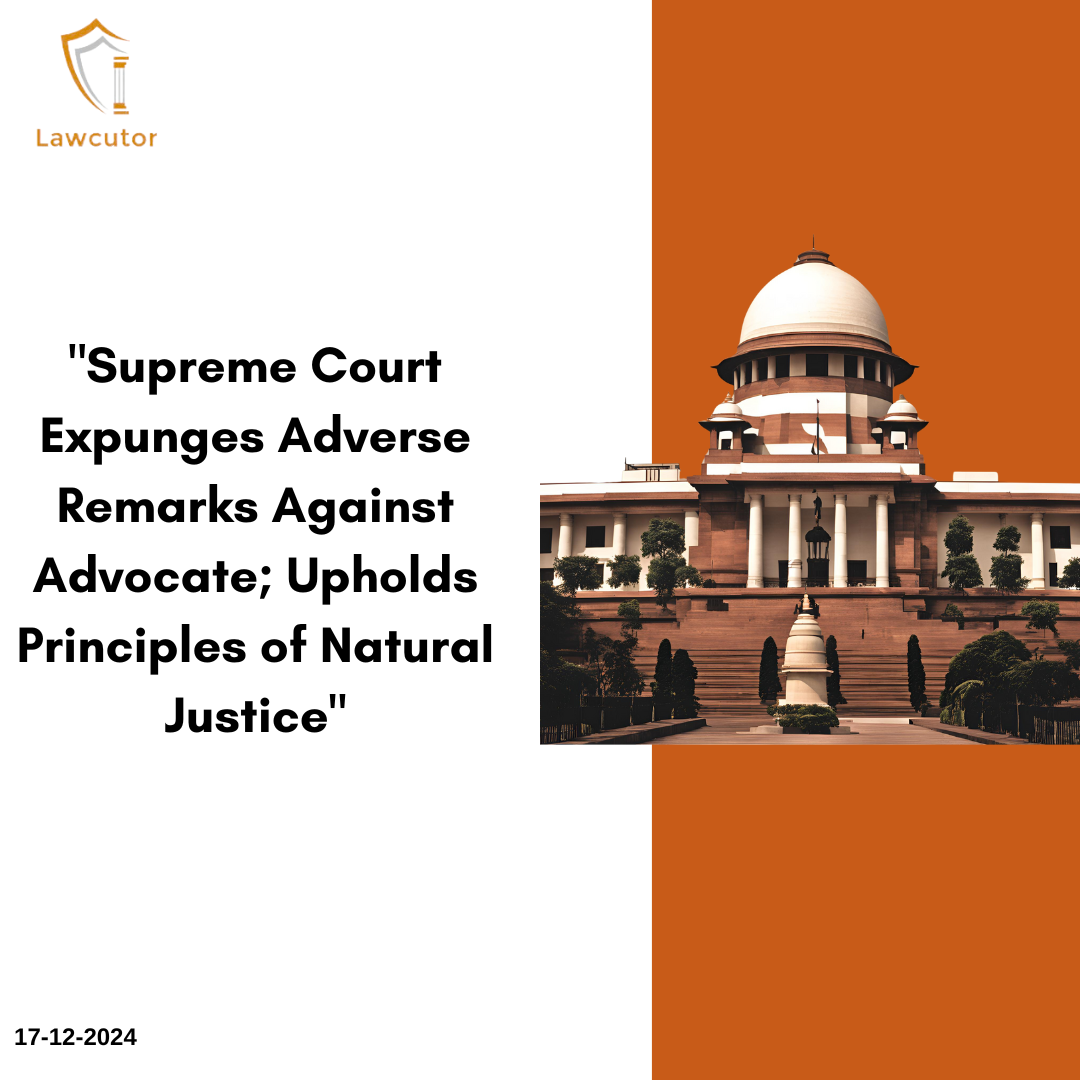
The Supreme Court recently expunged adverse remarks made against advocate Dushyant Mainali by the Uttarakhand High Court, which were recorded without granting him an opportunity of hearing. The apex court also quashed the High Court’s direction to the State Bar Council to initiate misconduct proceedings against the advocate, emphasizing the violation of natural justice principles.
Observations by the Supreme Court
A bench of Justices B.R. Gavai and K.V. Viswanathan strongly criticized the High Court’s approach, noting:
“We are of the considered view that the approach of the High Court in making the observations against the appellant without giving him any opportunity of being heard is totally unsustainable in law.”
The Court stressed that no one can be condemned unheard, a fundamental tenet of natural justice.
- Adverse Remarks Without Evidence: The Supreme Court highlighted that the Uttarakhand High Court recorded adverse remarks against Mainali for alleged professional misconduct without concrete evidence.
- Lack of Hearing: The appellant was neither a party to the civil case nor representing any litigant, yet the High Court accused him of misleading a litigant and causing delay in filing a revision petition. The observations were made without affording him an opportunity to respond.
Judicial Precedent and Restraint
The Supreme Court referred to earlier judgments, including:
Neeraj Garg Vs. Sarita Rani & Ors. (2021)
Siddhartha Singh Vs. Assistant Collector First Class/Sub Divisional Magistrate & Ors. (2024)
In both cases, the same High Court Judge had made unwarranted remarks against advocates. The apex court reiterated the need for judicial restraint and fairness while making observations against legal professionals.
The bench observed:
“Even the Courts, including the highest court of the country, are bound by principles of natural justice. Nobody can be condemned unheard.”
Supreme Court’s Decision
The Court allowed the appeal, expunging the adverse remarks and setting aside the direction to initiate disciplinary proceedings against the appellant.
Case Reference
Case Title: Dushyant Mainali v. Diwan Singh Bora & Anr.
This judgment serves as a significant reaffirmation of the principles of natural justice and judicial restraint. The Supreme Court’s decision underscores that adverse remarks against advocates or any individual cannot be made without granting them an opportunity to defend themselves.
 Lawcutor