
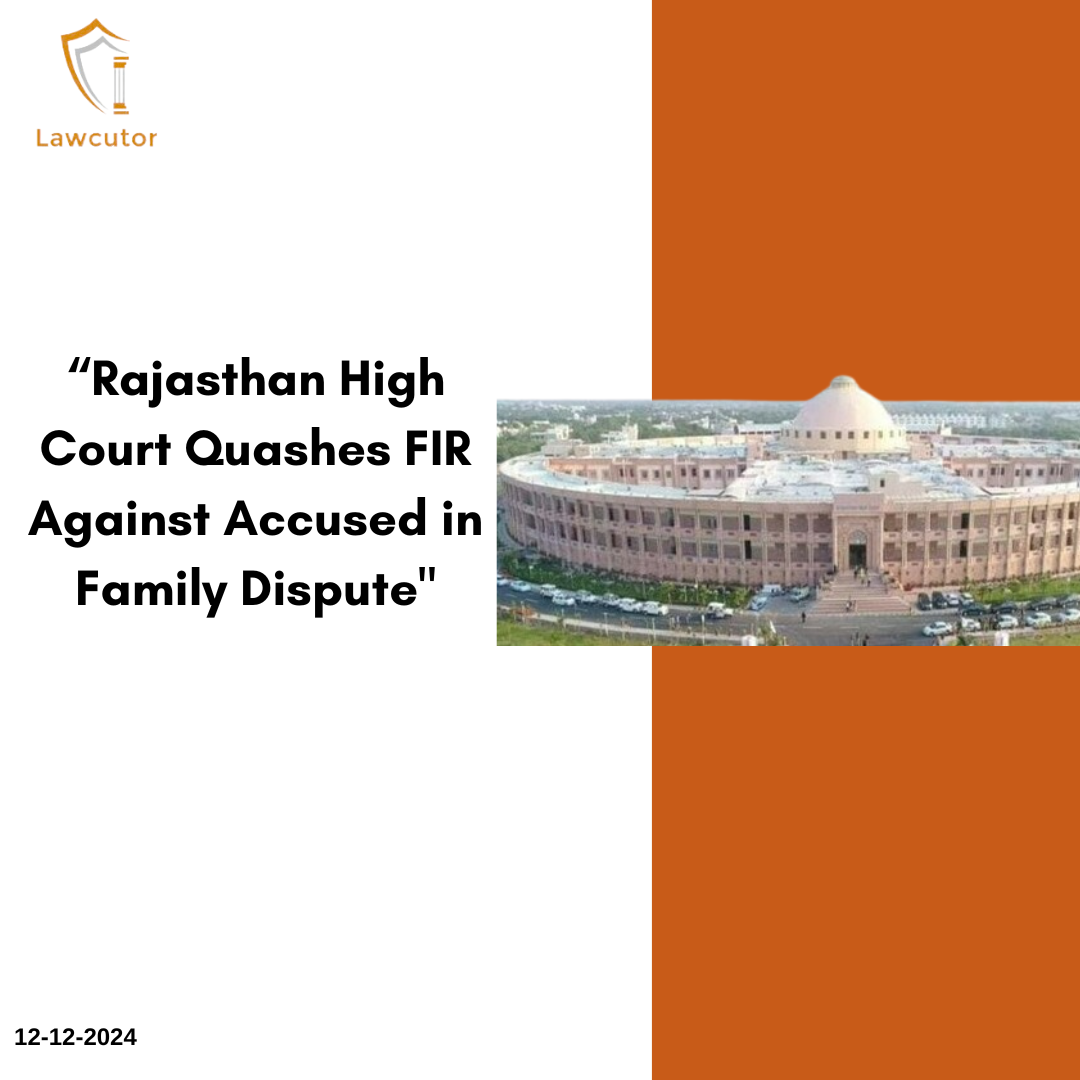
In a significant ruling, the Rajasthan High Court quashed an FIR filed under Section 175(3) of the BNSS (akin to Section 156(3) CrPC) against three accused—son-in-law, daughter, and daughter-in-law—based on a complaint by an elderly woman alleging cheating. Justice Arun Monga criticized the judicial approach of the Chief Judicial Magistrate (CJM), calling it a “rubber-stamp decision-making process” and highlighting the lack of independent judicial scrutiny before ordering the registration of the FIR.
Context of the Case
The complainant alleged that the accused had taken money and jewelry on several occasions and refused to return them, framing this as a criminal offense. However, the petitioners argued that the complainant had breached an agreement to transfer property by selling it to a third party and was using criminal law to settle personal scores. The CJM ordered an FIR based on a police inquiry report without independently assessing whether the allegations constituted a cognizable offense.
Judicial Oversight and Procedural Fairness
The Court underscored that the CJM failed to apply judicial mind before ordering the FIR, merely accepting the police inquiry report. It was emphasized that the refusal to return money or jewelry in this context was not a criminal offense and lacked material to substantiate allegations of fraud. The judgment noted, “The learned CJM simply directed the police to register an FIR without independently determining whether a prima facie case exists. A proactive approach asking for supporting documentation could have ensured procedural fairness and prevented miscarriage of justice.”
Misuse of Criminal Law in Family Disputes
The bench stressed the importance of caution while handling family disputes, advocating for harmony over hostility. Criminal complaints in family matters, it held, should not be entertained casually as they could lead to undue harassment and weaponization of the justice system for personal vendettas. This aligns with the Supreme Court’s guidance in Priyanka Srivastava v. State of Uttar Pradesh, which cautioned against mechanical orders to register FIRs without judicial scrutiny.
Importance of Judicial Vigilance
The Court noted that Section 175(3) BNSS is a mechanism to balance effective investigation of cognizable offenses with judicial vigilance to prevent frivolous complaints. Magistrates were urged to conduct independent inquiries, corroborate allegations with evidence, and ensure the authenticity of complaints. Affidavits, often treated as formalities, must be verified through verbal or other inquiries.
Conclusion
The High Court ruled that the case was purely civil in nature but was given a criminal color. It quashed the FIR, reiterating the need for magistrates to meticulously ascertain the credibility of allegations in family disputes to prevent undue harassment. The judgment serves as a reminder of the critical role of judicial oversight in safeguarding procedural fairness and preventing the misuse of criminal law.
Case Title: Gordhan Lal Soni & Ors. v. State of Rajasthan & Anr.
 Lawcutor