
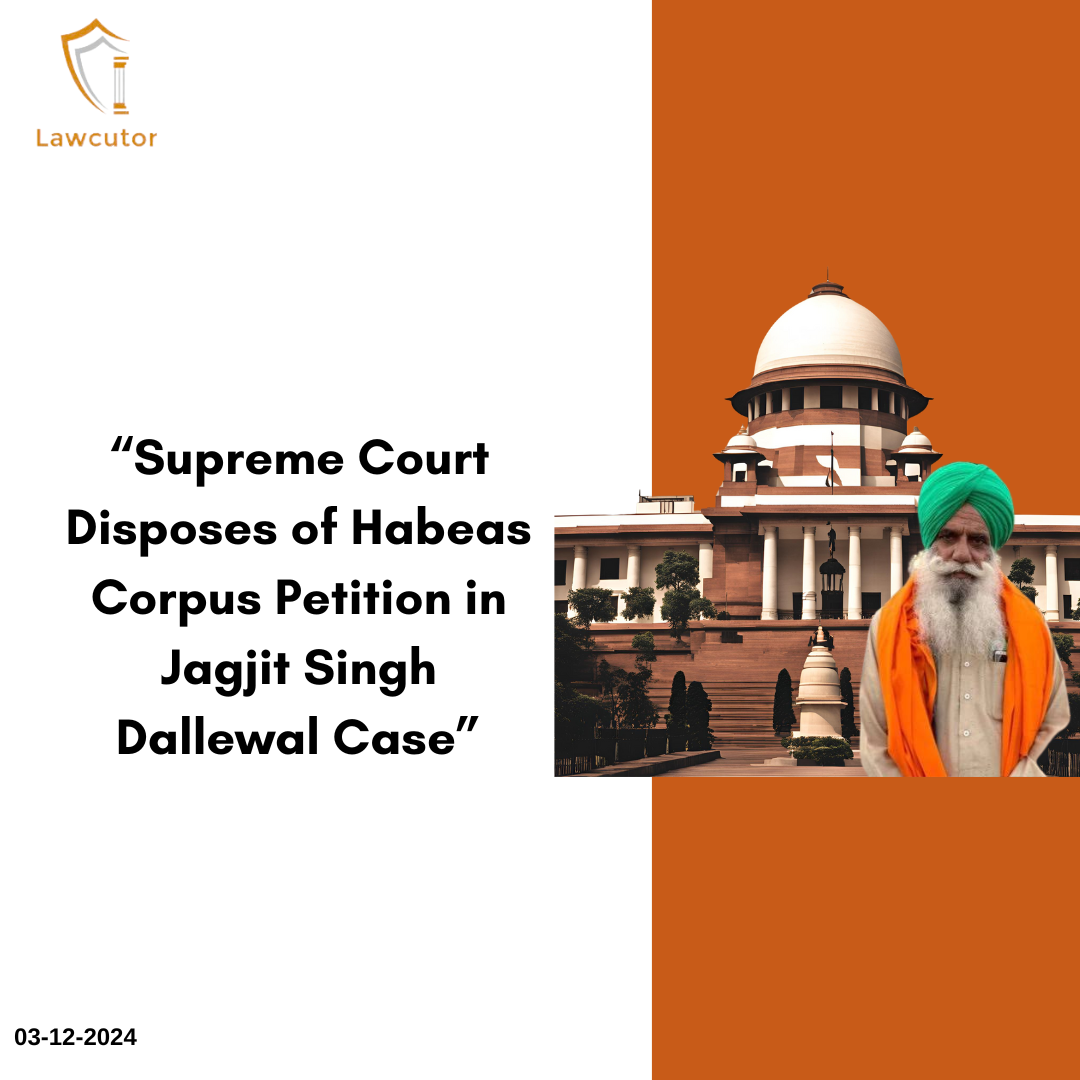
On December 2, 2024, the Supreme Court disposed of a habeas corpus petition filed on behalf of farmer leader Jagjit Singh Dallewal, who had been allegedly detained illegally by the Punjab Police. The petition raised concerns about Dallewal’s detention before he was set to begin a fast-unto-death on November 26, 2024, in support of the farmers’ protest. The petitioners alleged that Dallewal was forcibly removed from the protest site at the Khanuari border and taken to a hospital in Ludhiana, from which he was later released.
A bench comprising Justices Surya Kant and Ujjal Bhuyan noted that Dallewal had been released and had subsequently rejoined the farmers’ protest. While the Court refrained from commenting on the merits of the protest, it did address the issue of public inconvenience caused by the protests, remarking that, “In a democratic setup, you can engage in peaceful protests but do not cause inconvenience to people…the Khanauri border is a lifeline for Punjab.” Furthermore, the Court acknowledged that the issues raised in this case were already being addressed in a separate matter.
Farmers have been protesting at the Shambhu and Khanauri borders between Punjab and Haryana since February 2024. This ongoing protest is linked to the 2020 protests against three controversial farm laws, which were repealed in 2021 by the government. However, farmers remain dissatisfied with the government’s failure to meet other demands, particularly the implementation of a minimum support price (MSP) for all crops.
The case, titled Jagjit Singh Dallewal v. Union of India & Ors., is recorded under W.P.(Crl.) No. 491/2024. The Court’s decision underscores the complex balance between the right to protest and maintaining public order, highlighting broader issues of agricultural reforms in India.
 Lawcutor