
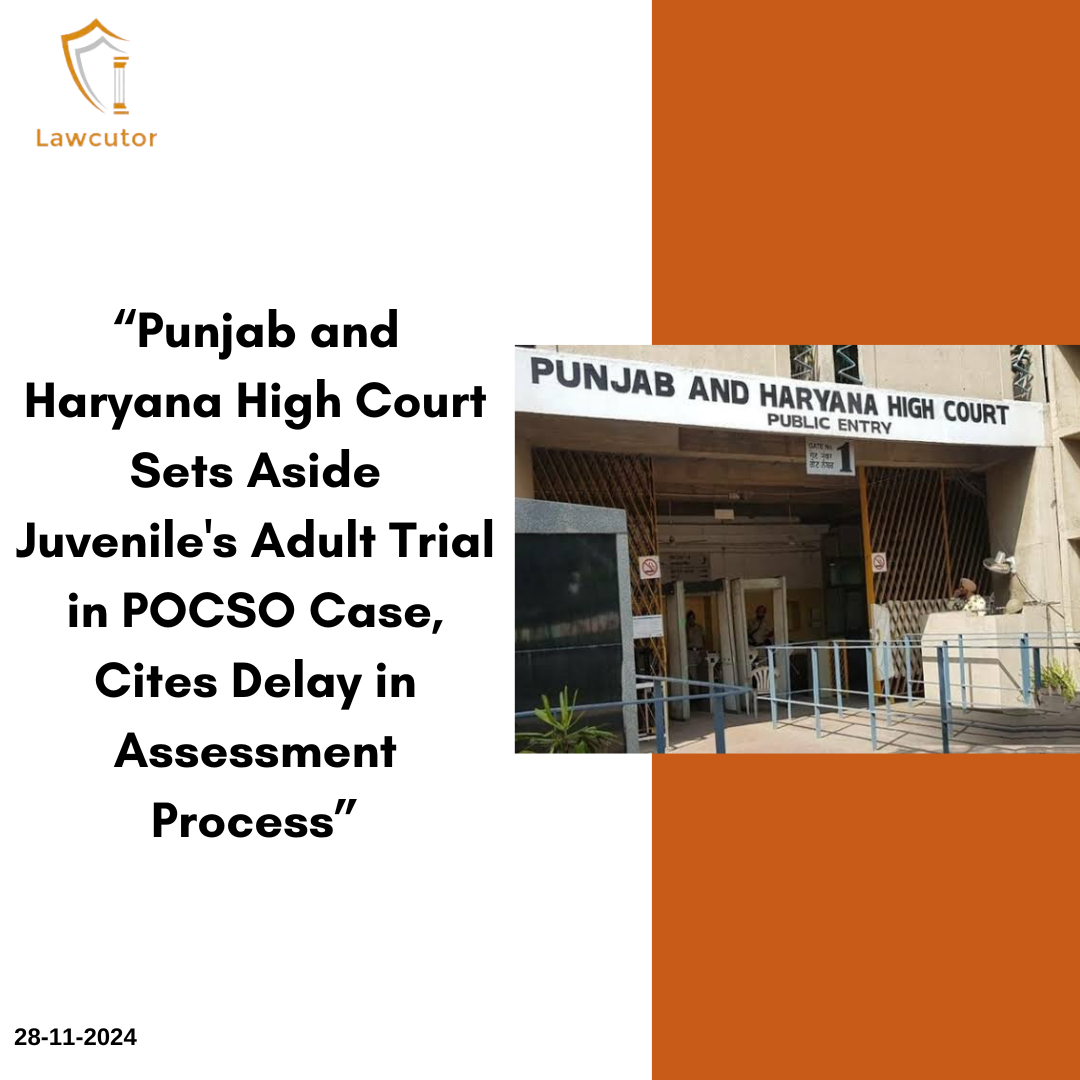
The Punjab and Haryana High Court recently overturned an order from a Children’s Court that had tried a juvenile as an adult in a case involving sexual assault under the Protection of Children from Sexual Offences (POCSO) Act. The juvenile, initially arrested on the day of the alleged incident in May 2018, had been sentenced to 20 years of rigorous imprisonment for sexually assaulting a 4-year-old girl. However, the High Court found multiple flaws in the process followed by the Children’s Court.
According to Section 15(1) of the Juvenile Justice (Care and Protection of Children) Act (JJ Act), a Juvenile Justice Board (JJB) is required to conduct a preliminary assessment of the juvenile’s mental and physical capacity to commit an offence, and the ability to comprehend its consequences. This assessment must be completed within three months of the juvenile’s first production in court, as per Section 14(3) of the JJ Act. In this case, however, the assessment was conducted over five years after the alleged incident, leading the Court to conclude that it was “practically impossible” to accurately assess the juvenile’s psychological state at the time of the offence.
The bench, led by Justice Sanjeev Prakash Sharma and Justice Sanjay Vashisth, also criticized the delay in moving the application for the preliminary assessment. After more than three years, the Public Prosecutor filed the application for the assessment in September 2021, with the juvenile having already turned 20. The Court remarked that such delays had rendered the statutory timeframes ineffective, frustrating the purpose of the law.
Further, the High Court found that the Children’s Court had failed to follow due procedure under the Code of Criminal Procedure (CrPC). The required steps, including the examination of the police report, framing of charges, and recording of prosecution witness statements, had not been followed. The Court described this process as a “rarely heard” occurrence, where the accused was convicted and sentenced without a proper trial.
In light of these legal deficiencies, the Court held that the juvenile should not have been tried as an adult. The Court set aside the Children’s Court’s order and treated the appellant as a Child in Conflict with Law (CCL). Upon reviewing the evidence, the High Court found the juvenile guilty of penetrative sexual assault under the POCSO Act and other related offences. However, the Court sentenced him to the maximum punishment permissible for a juvenile—three years in a special home, as mandated by the JJ Act.
Given that the juvenile had already served three years and nine months in detention, the Court ruled that he had completed the sentence. Additionally, the Court recommended a compensation of Rs. 5 lakh to the victim, citing the case of Nipun Saxena v. Union of India.
The case highlights significant issues in juvenile justice procedures, emphasizing the importance of adhering to statutory timelines and ensuring that due process is followed when determining the trial of juveniles. The Court’s decision reflects a commitment to safeguarding the rights of juveniles while ensuring that justice is served.
Title: XXXX v. XXXX.
 Lawcutor