
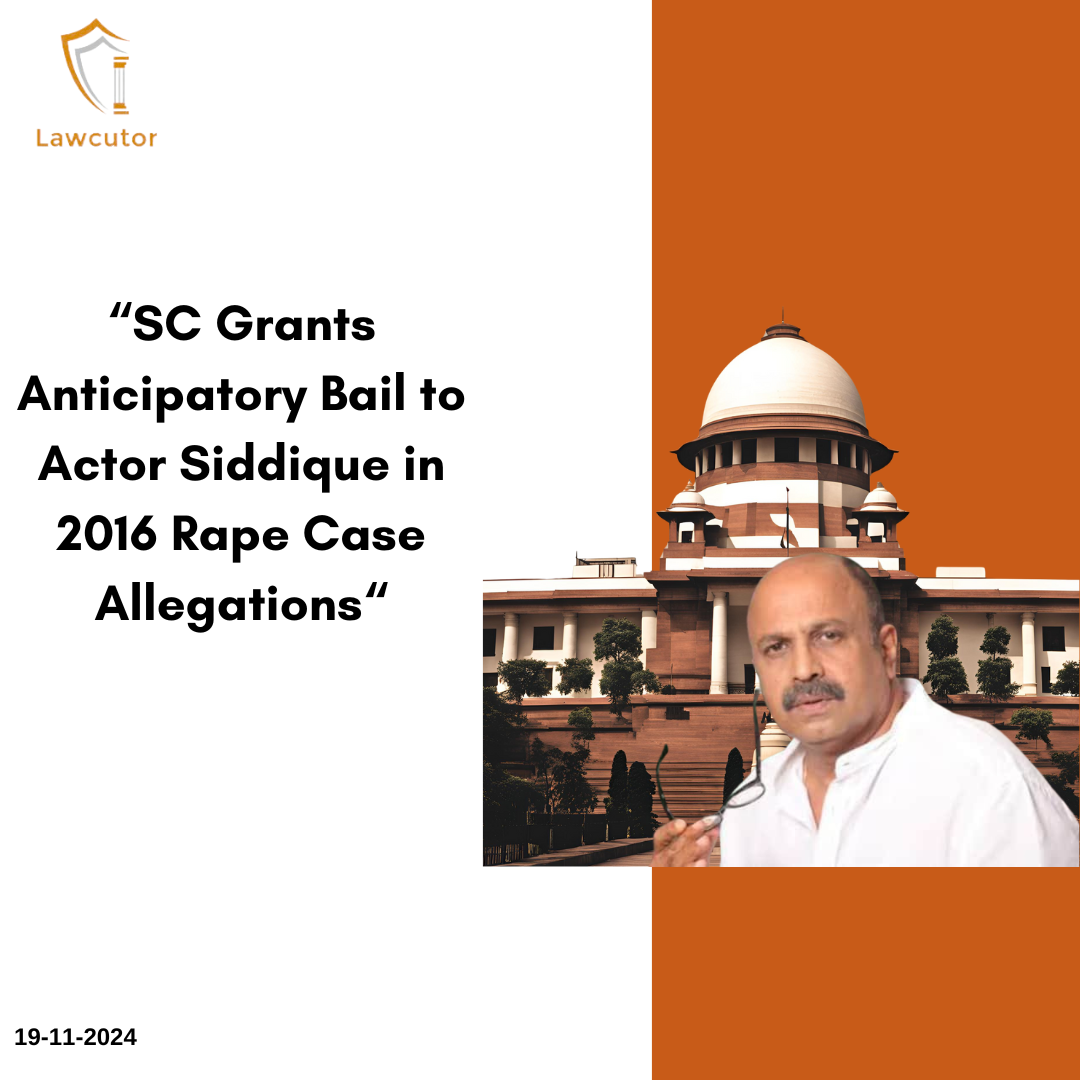
The Supreme Court today (November 19) granted anticipatory bail to prominent Malayalam actor Siddique in a rape case filed by a young actress alleging sexual exploitation in 2016. A bench comprising Justices Bela Trivedi and Satish Chandra Sharma converted the interim anticipatory bail, granted on September 30, into an absolute order.
SC’s Observations and Reasoning
The Court chose not to provide elaborate reasoning due to the sensitivity of the case but considered several factors in favor of Siddique. These included the eight-year delay in filing the complaint, Facebook posts made by the complainant in 2018 accusing multiple individuals, and her decision not to approach the Hema Committee, which was set up by the Kerala Government to address sexual abuse in the Malayalam film industry.
Also Read: Supreme Court Extends Anticipatory Bail for Malayalam Actor Siddique in Rape Case
“We deem it appropriate not to assign elaborate reasons, particularly considering the sensitivity of the case. However, the delay in filing the complaint and the complainant’s actions raise questions, which incline us to accept the appeal,” the Court observed.
The Court also imposed conditions for granting bail, including:
- Siddique must surrender his passport to the trial court.
- He must cooperate fully with the ongoing investigation.
- The trial court may impose additional conditions as deemed necessary.
The Court acknowledged the importance of balancing the rights of the accused with the seriousness of the allegations.
Background of the Case
The allegations date back to 2016 when the complainant, a young actress, accused Siddique of sexually exploiting her at a hotel after inviting her to a movie preview. The case gained traction following the publication of the Justice Hema Committee report in August 2024, which exposed systemic exploitation of women in Malayalam cinema.
The complainant filed an FIR in August 2024, accusing Siddique under Sections 376 (rape) and 506 (criminal intimidation) of the Indian Penal Code. She also alleged in Facebook posts since 2018 that Siddique, along with others, had exploited her.
Siddique’s Arguments
Senior Advocate Mukul Rohatgi, representing Siddique, argued that the case was fabricated and driven by organizational rivalries between the Association of Malayalam Movie Actors (AMMA), where Siddique was an office-bearer, and the Women in Cinema Collective (WCC), to which the complainant belonged.
Rohatgi highlighted the following points:
- Delay in Filing: The complaint was made eight years after the alleged incident.
- Social Media Allegations: The complainant accused 14 individuals in Facebook posts but did not approach the police or the Hema Committee.
- Lack of Evidence: Siddique could not produce gadgets from 2016 as he no longer possessed them.
- Cooperation with Authorities: Siddique had attended all police summons and denied non-cooperation claims.
State and Complainant’s Arguments
Senior Advocate Ranjit Kumar, for the State of Kerala, emphasized the complainant’s courage in coming forward despite systemic challenges. He also raised concerns about Siddique’s alleged attempts to destroy evidence, including deactivating social media accounts. Advocate Vrinda Grover, for the complainant, argued that Siddique groomed the victim and exploited her trust.
Grover stated:
The complainant had been vocal about her experiences on social media since 2018 but took time to muster the courage to file a complaint.
The Justice Hema Committee report, which exposed systemic exploitation, emboldened her to file the FIR.
Siddique’s influence in the Malayalam film industry posed a significant barrier to justice.
Previous Proceedings
Kerala High Court’s Denial of Bail (September 24): The High Court dismissed Siddique’s plea, stating there was prima facie evidence of his involvement. It held that delays in reporting sexual violence must be understood in the context of trauma.
Interim Bail by SC (September 30): The Supreme Court granted interim bail, subject to conditions, and extended it on October 22 to allow Siddique time to respond to the police’s status report.
The police status report alleged Siddique’s non-cooperation, destruction of evidence, and misuse of his influence to hinder the investigation.
Significance of the Justice Hema Committee Report
The Justice Hema Committee report revealed widespread sexual harassment in Malayalam cinema, creating a significant shift in how cases of exploitation were viewed. The complainant argued that this report encouraged her to take legal action, despite the challenges and risks involved.
SC’s Final Directions
The Supreme Court concluded by granting anticipatory bail with the following directives:
- Siddique must deposit his passport with the trial court.
- He must cooperate fully with the investigation.
- The trial court may impose additional conditions as necessary.
The Court emphasized that while delays in reporting sexual assault should be contextualized, the complainant’s actions, such as public allegations on Facebook and failure to approach the Hema Committee, raised questions.
Case Details
Title: Siddique v. State of Kerala and Anr.
SLP(Crl): No. 13463/2024
 Lawcutor