
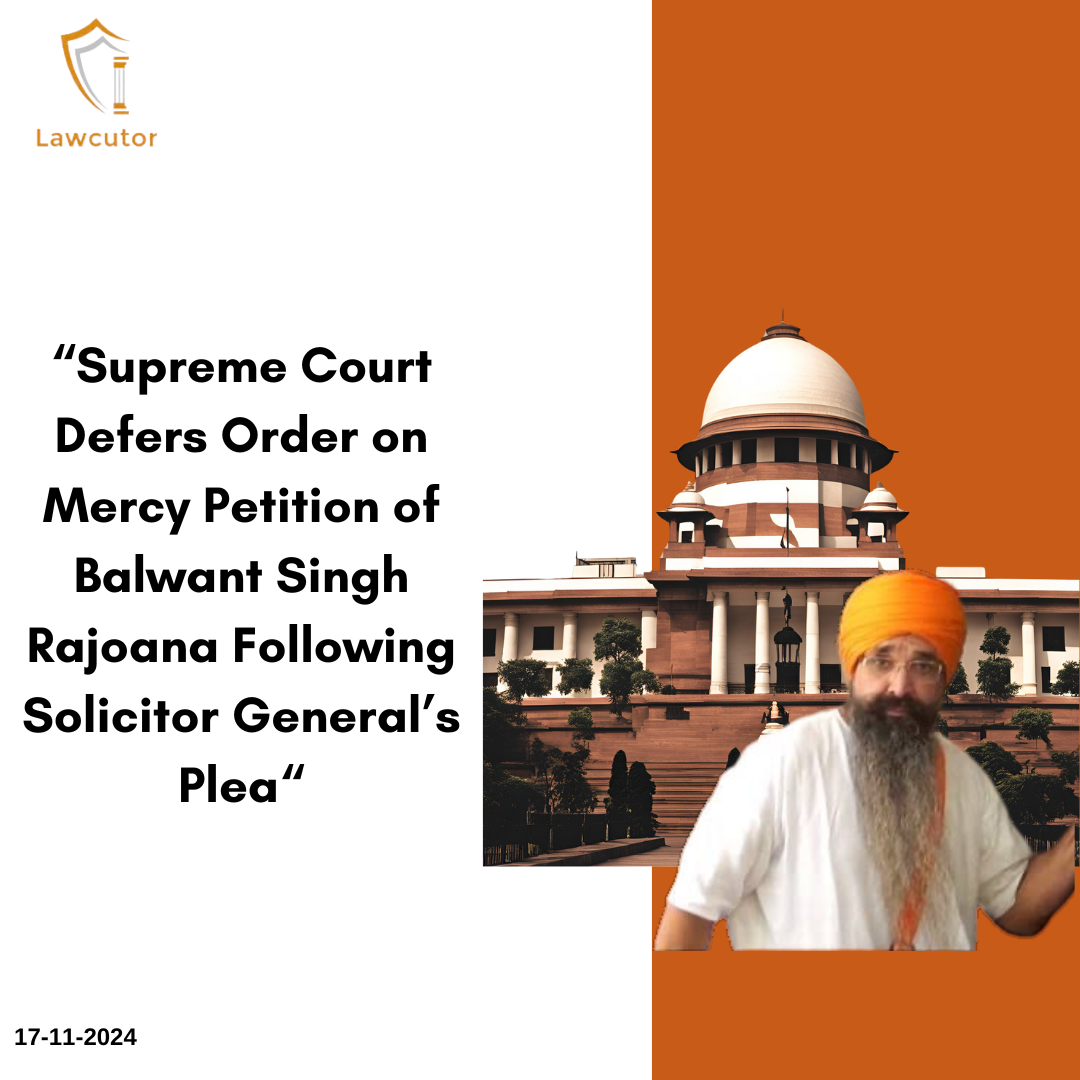
The Supreme Court witnessed significant developments on November 18, 2024, in the case concerning Balwant Singh Rajoana, a death row convict in the 1995 assassination of Punjab Chief Minister Beant Singh. The day saw an initial directive from the apex court urging the President of India to decide Rajoana’s mercy petition within two weeks, followed by the Government’s request for a reconsideration of the order in light of procedural and sensitive concerns.
Morning Proceedings: Supreme Court Seeks Timely Decision
In the morning session, a special bench comprising Justices BR Gavai, Prashant Kumar Mishra, and KV Viswanathan issued an order instructing the Secretary to the President of India to place Rajoana’s mercy petition before the President and requested the President to decide on the matter within two weeks.
The court was addressing Rajoana’s writ petition under Article 32, which sought the commutation of his death sentence due to a significant delay of over 12 years in deciding his mercy plea, initially filed in 2012 by the Shiromani Gurudwara Prabandhak Committee (SGPC).
Key Observations by the Bench
The bench expressed dissatisfaction with the Government’s lack of response, remarking that the delay violated Rajoana’s fundamental rights and undermined judicial directives.
It clarified that if no decision was made within the specified period, the court would consider granting interim relief, including the commutation of Rajoana’s death sentence.
Arguments Presented
Mukul Rohatgi (Senior Advocate for Rajoana): Rohatgi emphasized that keeping a convict on death row for decades constituted inhuman treatment, contrary to Supreme Court precedents.
Union of India: The Government’s counsel failed to provide a clear timeline for deciding the mercy petition, prompting criticism from the bench.
Afternoon Proceedings: Solicitor General Requests Reconsideration
Later in the day, Solicitor General (SG) Tushar Mehta made an urgent mentioning before Justices Gavai and Viswanathan, seeking a stay on the morning’s directive. SG Mehta apologized for his absence during the earlier hearing and provided additional context regarding the pending decision.
Solicitor General’s Submissions
File with the Home Ministry: The SG clarified that the mercy petition file had not yet reached the President and was still under consideration by the Ministry of Home Affairs.
Sensitive Nature of the Case: Highlighting national security concerns and other sensitivities, the SG urged the court to reconsider its directive.
Request for Adjournment: The SG sought additional time to gather instructions from the Government and requested the bench to hear the matter on Friday or Monday.
Bench’s Response
Justice Gavai, acknowledging the SG’s request, deferred the matter to Monday, November 20, 2024. He assured the SG that the court would not finalize or upload its morning order until further submissions were heard.
Background of the Case
Balwant Singh Rajoana, convicted for his role in the 1995 suicide bombing that killed Chief Minister Beant Singh and 16 others, has been on death row for nearly three decades.
Conviction and Sentence: In 2007, Rajoana was sentenced to death, a decision upheld by the Punjab & Haryana High Court in 2010. Unlike his co-accused Jagtar Singh Hawara, whose death sentence was commuted, Rajoana declined to appeal his conviction.
Mercy Petition: The SGPC filed a mercy petition on his behalf in 2012. However, procedural delays and security concerns have stalled the decision.
The Union Government had announced in 2019 its intent to commute Rajoana’s sentence as part of a humanitarian gesture but later clarified that the petition was still under review.
Legal and Constitutional Implications
This case highlights the complexities of balancing judicial urgency with executive discretion:
- Judicial Review: The court’s directive reflects its concern over the prolonged delay, which it deems a violation of Rajoana’s fundamental rights.
- Executive Prerogative: The Solicitor General’s intervention underscores the Government’s responsibility to address national security concerns in sensitive cases.
- Delay and Human Rights: Prolonged incarceration on death row raises serious questions about the humane treatment of prisoners under constitutional and international law.
Conclusion
By agreeing to defer its earlier directive, the Supreme Court demonstrated a willingness to accommodate the Government’s concerns while maintaining oversight of the case’s progress. The matter, now scheduled for November 20, 2024, will require the court to carefully weigh constitutional rights against executive prerogatives and national sensitivities.
The evolving proceedings reflect the court’s attempt to ensure accountability and uphold justice without compromising institutional harmony.
 Lawcutor