
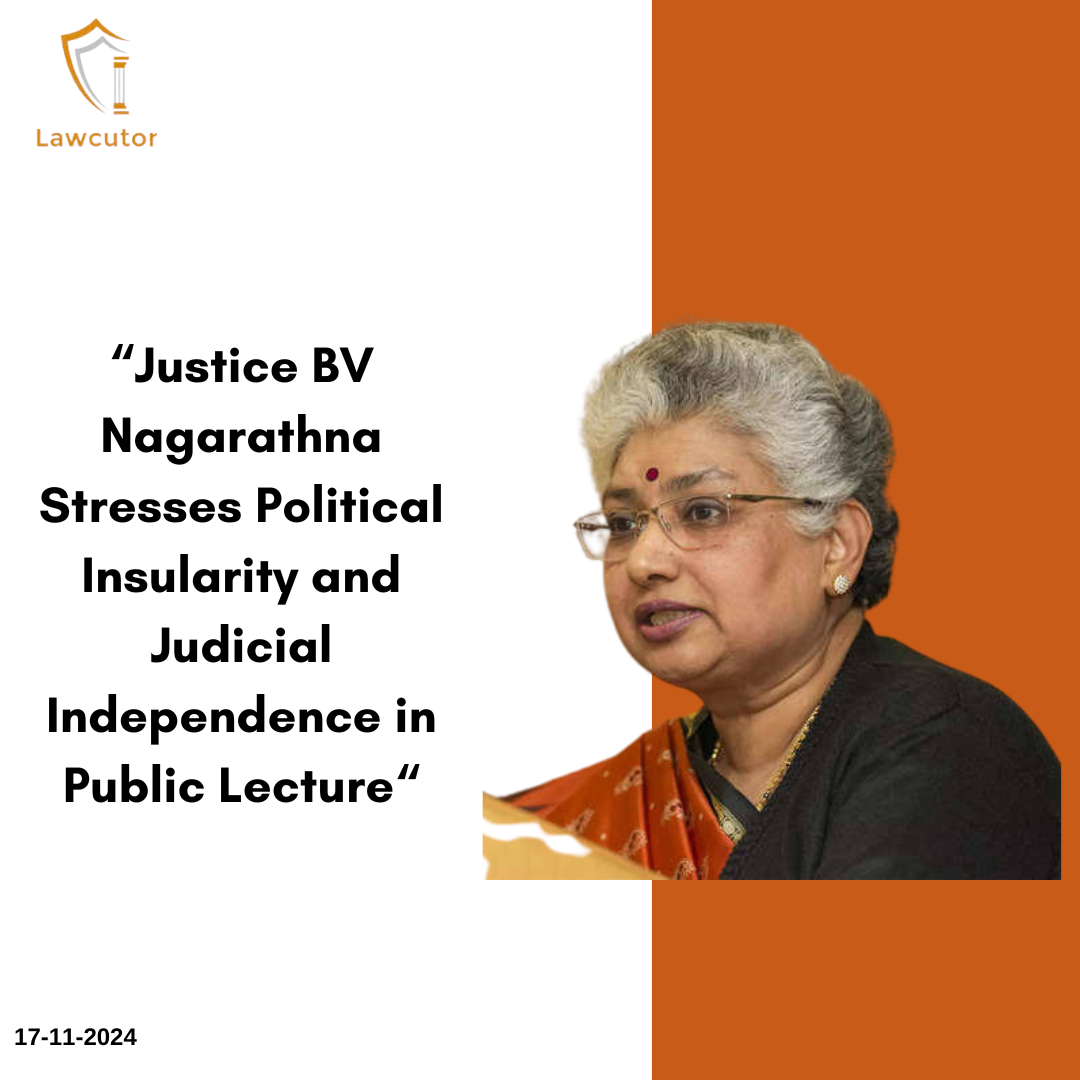
In a recent lecture delivered at the Justice Natarajan Centenary Memorial Lecture in Chennai on November 16, Justice BV Nagarathna of the Supreme Court highlighted the importance of political insularity in safeguarding judicial independence.
Political Insularity Essential for Judicial Independence
Justice Nagarathna explained that political insularity is vital for ensuring the independence of the judiciary. This concept relates to the idea that courts should not become instruments for achieving political goals. Insularity can be achieved by granting judges security of tenure and instituting proper checks and balances during their appointment. The judiciary, she stated, must be detached from political influence and social pressures, focusing solely on regulating the legality of state actions and ensuring justice.
She defined judicial independence as the extent to which judges decide cases according to their interpretation of the law, even if their decision conflicts with public opinion or political objectives. Judicial independence, she said, is a key aspect of the separation of powers and supremacy of the law, which ensures that the judiciary remains free from external interference and upholds the rule of law.
Judicial Independence and Accountability
Justice Nagarathna acknowledged that judicial independence should not shield judges from accountability. She emphasized that judicial independence and accountability are complementary principles, not opposing ones. Independence, she noted, depends on the integrity and impartiality of judges, and it is crucial that judges are selected based on merit, with a deep understanding of Indian society and the rule of law.
She highlighted the duty of judges to exercise their judicial power independently and in accordance with their conscience. She also pointed out that differing or dissenting opinions in a court are a manifestation of judicial independence, illustrating the autonomy of judges from one another.
Courts and Judicial Review in a Democracy
Justice Nagarathna also addressed the power of the judiciary to review executive and legislative actions that violate the Constitution or fundamental rights. She rejected criticisms that judicial review should be restricted in a democracy with a popular majority, arguing that democracy thrives on diverse opinions and that the judiciary’s role is to refine public opinion and protect rights.
She emphasized that without judicial protection of equality and liberty, democracy would fail. The judiciary, she argued, ensures that even majority decisions do not infringe upon fundamental rights. Furthermore, when courts exercise judicial review, they are not legislating or using political power but rather applying the law as set out in the Constitution, ensuring that state actions do not exceed the authority granted to them.
Justice Nagarathna concluded by stating that the judiciary must enforce the Constitution, which is the highest law, and that judges have no choice but to do so when acts of the state exceed their constitutional bounds.
 Lawcutor