
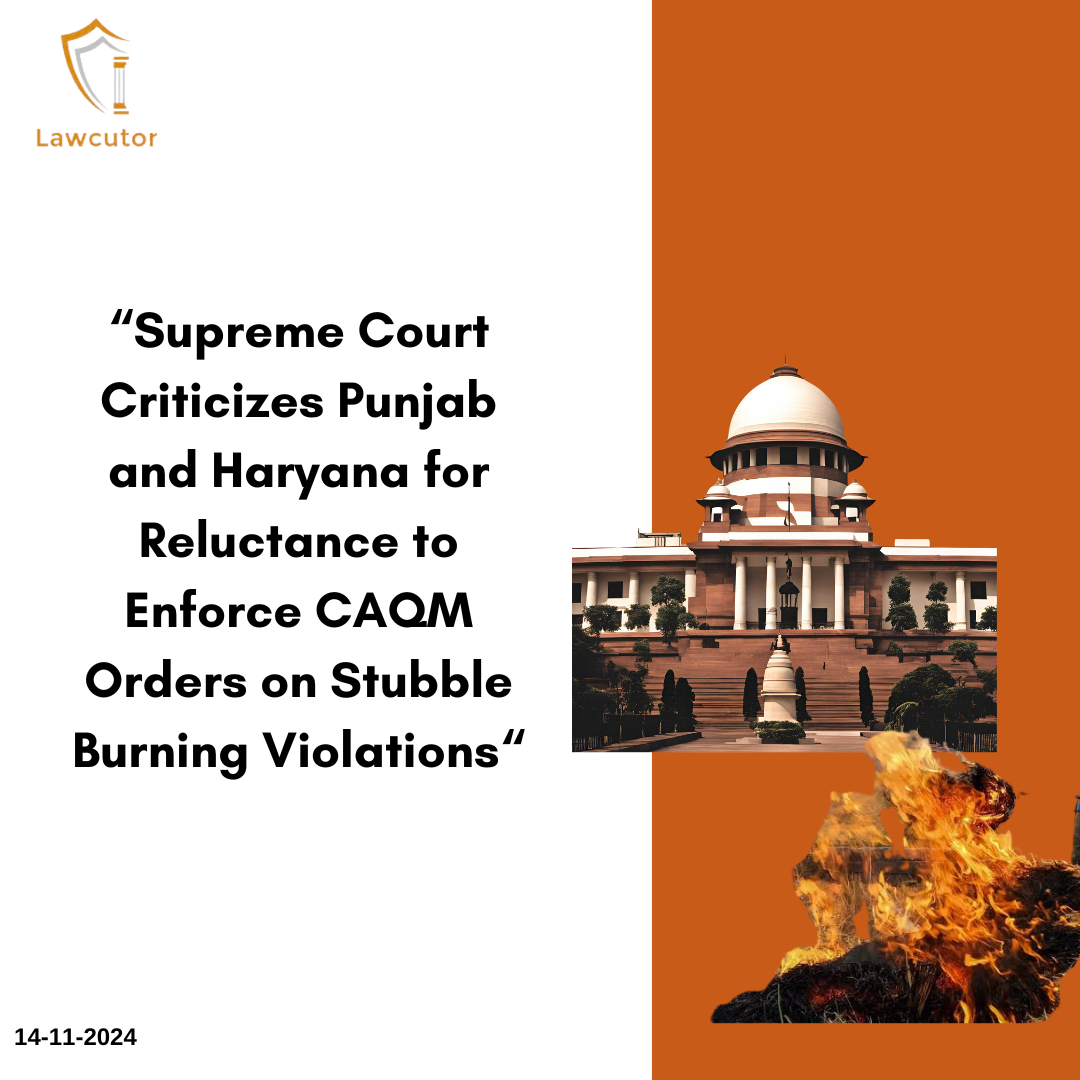
On Monday, November 11, the Supreme Court expressed concern over the hesitancy of Punjab and Haryana to prosecute officials for violations of the Commission for Air Quality Management (CAQM) orders related to stubble burning, under Section 14 of the CAQM Act. This issue came up during a hearing in the landmark MC Mehta v. Union of India case, which addresses various pollution control measures in Delhi-NCR, including vehicular emissions, solid waste management, and stubble burning.
A bench consisting of Justices Abhay Oka and Augustine George Masih reviewed compliance affidavits from the states. These documents revealed high numbers of stubble-burning incidents around the Diwali season, indicating continued non-compliance with CAQM directives. The Court voiced its disappointment, noting the states’ ongoing reluctance to hold errant officials accountable.
Justice Oka observed, “Even today, we find reluctance on the part of both governments in taking action under section 14 of the CAQM Act.” The Court criticized the states for opting to issue show-cause notices to officials rather than prosecuting them, emphasizing that the orders from the CAQM to address stubble burning have been in place for three years.
The Court directed Punjab and Haryana to submit revised compliance affidavits detailing concrete actions taken, with a deadline set for three weeks. The Court will revisit this matter on December 16, 2024.
Concerns Over Inadequate Support for Farmers in Stubble Management
The Court highlighted a “disturbing feature” where farmers approached the Court with grievances over insufficient access to machinery and equipment necessary for stubble management. The Court stressed that it is the responsibility of the state governments to provide farmers with these resources to prevent stubble burning, which contributes significantly to air pollution in the region.
Additionally, Punjab and Haryana were instructed to consult ISRO to address complaints about inaccurate data concerning farm fires, as reported by state authorities.
Enforcement of New Environmental Rules
The Delhi Government reported that the Environment Protection (Manner of Holding Enquiry and Imposition of Penalty) Rules, 2024, along with the CAQM Amendment Rules, 2024, had been formally enacted. The Supreme Court directed all relevant authorities, including state governments, to implement these rules effectively.
The Court also urged state governments to begin imposing fines under Section 15 of the Environment Protection Act, 1986. In line with this, adjudicating officers have been appointed to oversee enforcement. Compliance with this direction is expected to be included in the forthcoming affidavits regarding Section 14 of the CAQM Act.
Court’s Previous Emphasis on Article 21 and the Right to a Pollution-Free Environment
Earlier, on October 23, the Court had underscored the fundamental right to a pollution-free environment under Article 21 of the Constitution, noting that stubble burning not only contravenes legal norms but also infringes upon this basic right. The Court observed that penalties under Section 15 of the Environment Protection Act, 1986, had been rendered “toothless” after amendments replaced punishments with fines. Following this, ASG Bhati assured the Court that enforcement mechanisms for penalties would be established within two weeks.
Upcoming Hearings and Observations on Pollution from Vehicles
The Supreme Court scheduled a hearing on vehicular pollution for November 25, 2024. Additionally, it will review the implementation of color-coded vehicle stickers on January 3, 2025. In a general observation, the Court noted that no religion endorses activities that harm the environment, emphasizing the universal responsibility to prevent pollution.
Case Information
Case Number: WP (C) 13029/1985
Case Title: MC Mehta v. Union of India
 Lawcutor