
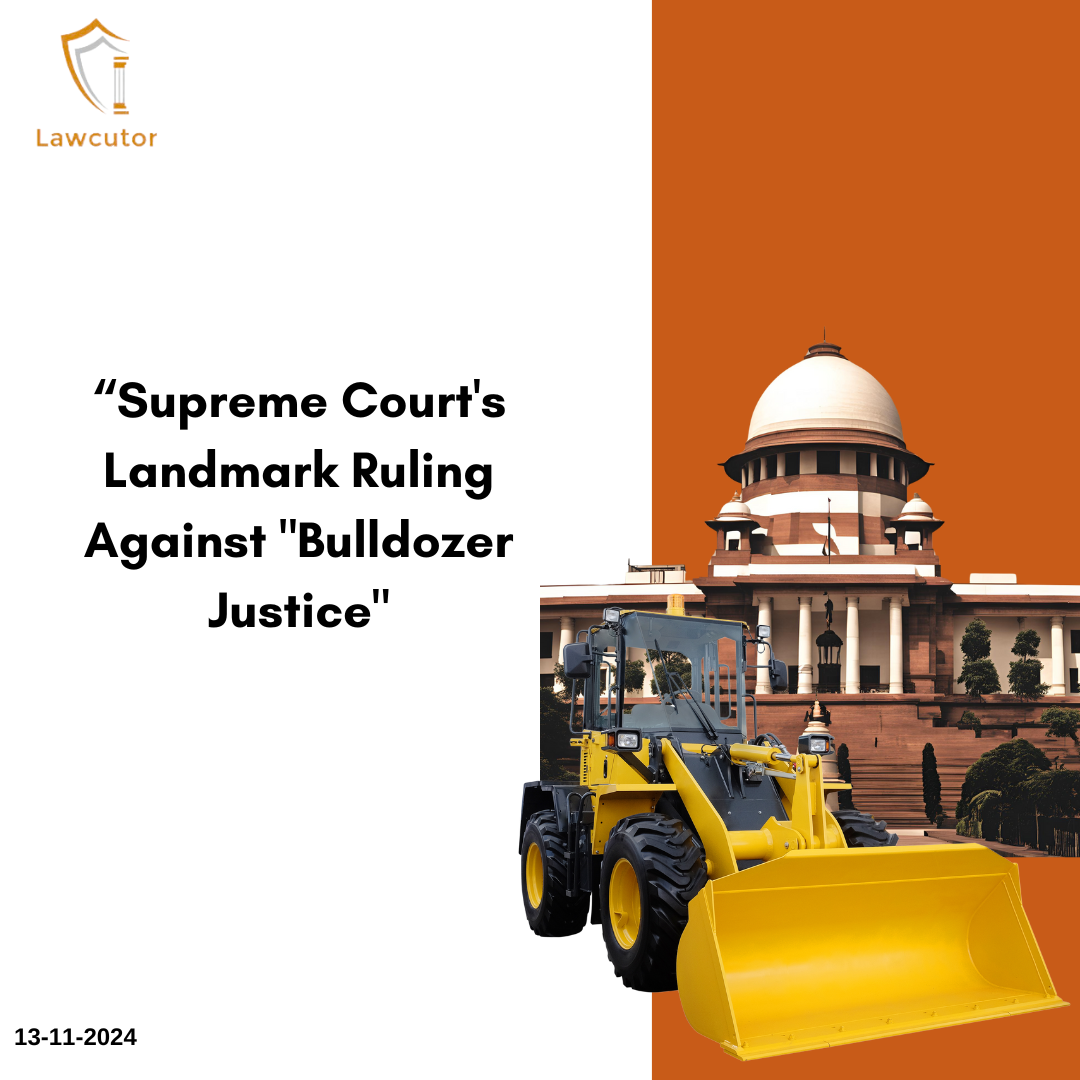
In Re: Directions in the matter of demolition of structures, 2024 INSC 866
In a decisive stance against extrajudicial demolitions, the Supreme Court on November 13, 2024, ruled that the executive branch cannot demolish homes solely because the occupants are accused or convicted of a crime. Such actions, the Court held, breach the rule of law and violate the principle of separation of powers, which grants the judiciary the sole authority to determine guilt.
This judgment was delivered by a bench comprising Justices B.R. Gavai and K.V. Viswanathan in response to a batch of petitions led by Jamiat Ulema-i-Hind, filed under Writ Petition (Civil) No. 295 of 2022. The petitions sought to end the trend of using “bulldozer justice” as a punitive measure against individuals merely accused of criminal activities.
Key Observations
The Court condemned executive actions that bypass judicial due process, stating, “The executive cannot pronounce a person guilty. Only on the basis of accusation, if the executive demolishes the property of the person, it will strike at the rule of law. The executive cannot become a judge and demolish the properties of the persons accused.”
The Court further expressed concern over the humanitarian impact of such demolitions, which often displace families, including women, children, and elderly people. It remarked, “The chilling sight of a bulldozer demolishing a building when authorities have failed to follow the basic principles of natural justice and have acted without due process reminds one of a state of affairs wherein might was right… Such highhanded and arbitrary actions have no place in a constitutional democracy.”
Accountability and Restitution
The Court asserted that public officials engaging in unauthorized demolitions should be held accountable. Any demolition that disregards judicial protocols would render the responsible officials personally liable for restitution, including rebuilding the demolished property and paying damages.
Guidelines Issued by the Court
To ensure due process, the Court provided comprehensive guidelines for demolitions:
- Show-Cause Notice: Authorities must issue a show-cause notice before demolitions, with a 15-day response period, regardless of local municipal laws.
- Personal Hearing: The affected party is entitled to a personal hearing, with all procedural details documented and a final order provided.
- Digital Record-Keeping: Authorities are required to maintain a digital record of the demolition process, accessible on a public portal within three months.
- Inspection and Documentation: Before any demolition, a thorough inspection report is required, and the entire demolition process must be videographed, with reports archived on the public portal.
- Time to Vacate: Even when a demolition order is upheld, sufficient time must be provided for affected individuals to vacate, with authorities expected to act humanely and avoid abrupt actions.
- Judicial Scrutiny: Affected parties must be granted at least 15 days to appeal a demolition order. The order will not be executed if an appeal is pending.
- Limitations on Scope: The guidelines exclude demolitions of unauthorized structures on public roads, streets, footpaths, or bodies of water, or those ordered by a court.
Background and Case Context
The Court’s ruling stemmed from a wave of public concerns following instances in Delhi’s Jahangirpuri, Uttar Pradesh, Madhya Pradesh, and other states, where demolitions were conducted without due process, often following public disturbances or protests. In these cases, properties were allegedly destroyed as a punitive measure, disregarding legal procedures. Petitioners, including Jamiat Ulema-i-Hind, contended that such actions were intended to punish accused individuals without trial, violating their fundamental rights.
The case specifically addressed events following an April 2022 demolition drive in Delhi’s Jahangirpuri area, carried out after violence erupted during the Hanuman Jayanti procession. Although the demolition drive was ultimately stayed, petitioners called for a permanent declaration that authorities cannot use demolitions as a punishment method. Similar events in states like Uttar Pradesh, Madhya Pradesh, and Gujarat were also cited, where demolitions occurred following public order incidents, allegedly without due legal processes.
During the hearings, the State of Uttar Pradesh argued that demolitions were conducted following municipal laws, with notifications issued to alleged violators. However, petitioners argued that notices were often insufficient or absent, and that demolitions disproportionately impacted marginalized communities.
Pan-India Directive
The Court clarified that this directive would apply nationwide and mandated the immediate dissemination of this ruling to Chief Secretaries of all states and Registrar Generals of all High Courts. All states were instructed to circulate official notices of this judgment to municipal and administrative bodies.
Conclusion
This landmark judgment not only halts the trend of “bulldozer justice” but also emphasizes due process, judicial oversight, and respect for the rule of law. The Supreme Court’s directives are poised to set a national precedent, ensuring that demolitions are conducted transparently, fairly, and within the bounds of the law. The ruling further highlights the judiciary’s commitment to constitutional principles, reinforcing the safeguards of a democratic society.
 Lawcutor