
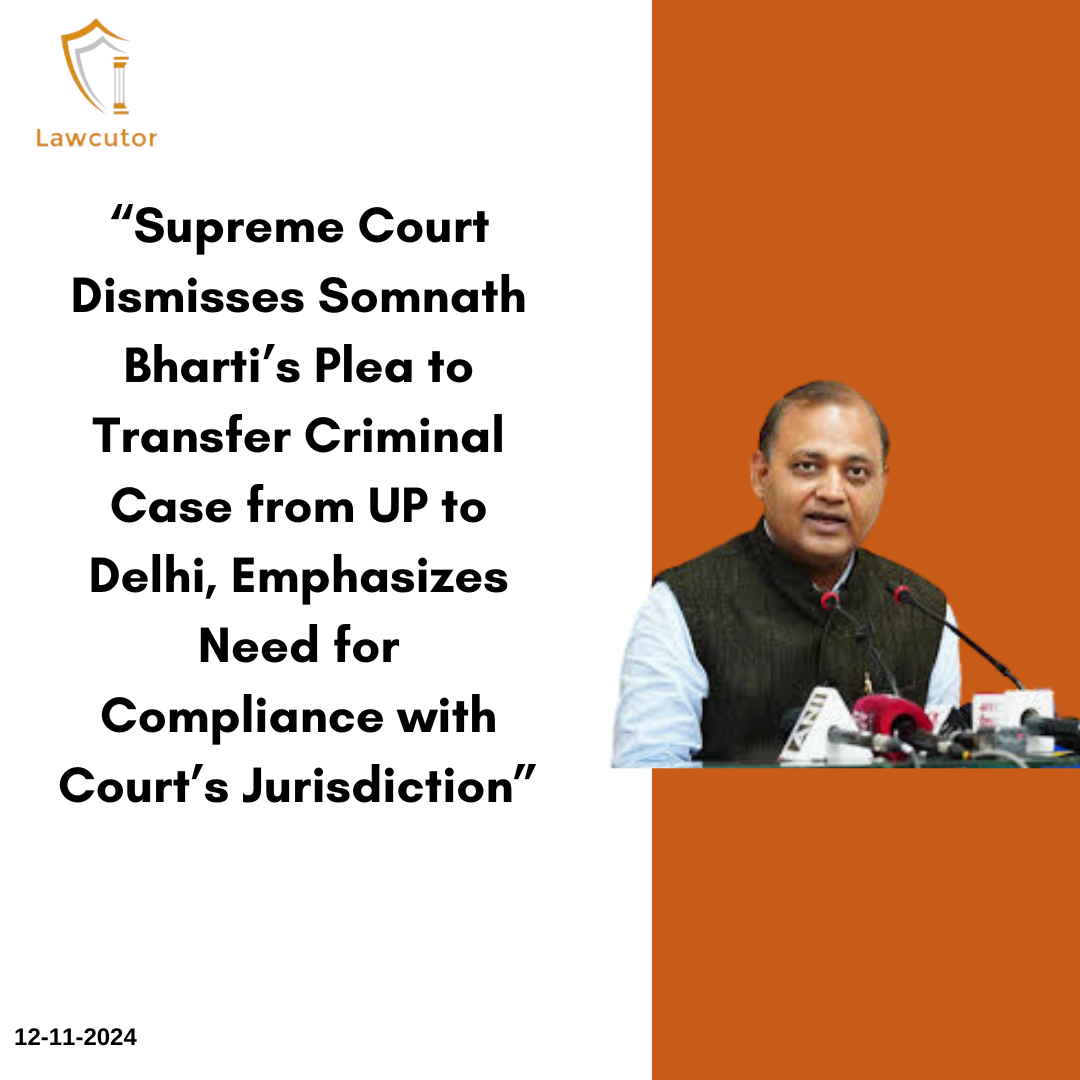
On Tuesday, November 12, 2024, the Supreme Court dismissed a transfer petition filed by Aam Aadmi Party (AAP) leader and former Delhi Law Minister Somnath Bharti, who sought to relocate a criminal case against him from Sultanpur, Uttar Pradesh, to New Delhi. The case involves charges of criminal intimidation and promoting enmity between groups, stemming from Bharti’s statements about Uttar Pradesh’s healthcare and educational facilities during a campaign event in Prayagraj in December 2020.
The bench, comprising Justice MM Sundresh and Justice Aravind Kumar, expressed skepticism regarding Bharti’s rationale for the transfer. During the morning hearing, Justice Sundresh remarked, “He is an MLA; he can very well travel,” underscoring the Court’s view that Bharti’s political position and ability to travel negated the necessity for transferring the proceedings.
Bharti’s counsel initially requested a pass-over of the case in the morning session, and when it was taken up later in the afternoon, the Court dismissed the plea, finding no compelling grounds for relocation.
Background and Details of Allegations
The criminal case against Bharti began with his statements made in December 2020, when he visited a government healthcare facility in Uttar Pradesh. Bharti reportedly criticized the unsanitary conditions, particularly at a hospital where puppies were allegedly found in the doctor’s room. His comments, reportedly including a statement that “though children were taking birth in these hospitals, they were not of humans but of dogs,” led to an FIR on charges of criminal intimidation and promoting enmity between groups.
Following these remarks, Bharti was arrested and produced before a Special Court, which placed him in judicial custody. Additionally, an FIR was filed alleging that Bharti used offensive language toward police officers and made derogatory remarks about the Chief Minister of Uttar Pradesh, Yogi Adityanath.
Arguments for the Transfer
In prior hearings, Senior Advocate Siddharth Dave, representing Bharti, contended that the criminal cases stemmed from political motivations. Dave raised concerns regarding Bharti’s safety in Uttar Pradesh, asserting that Bharti faced significant threats from ruling party members in the state. He argued that Bharti’s presence in Uttar Pradesh for court proceedings could pose a serious risk to his life.
Dave highlighted that Bharti had been an outspoken critic of the state administration and claimed the charges were intended to silence him. “We want a transfer. There are serious apprehensions that we have. The threats are from MLAs in the Government (Uttar Pradesh) presently,” Dave stated, underscoring his client’s safety concerns and the likelihood of a biased trial in Uttar Pradesh.
The plea also underscored Bharti’s apprehensions about political retaliation, arguing that such hostility could undermine his right to a fair trial. Dave further noted that a chargesheet had been filed and cognizance taken in one of the cases, which he argued reinforced the need for the trial to be shifted outside Uttar Pradesh.
Previous Interim Relief and Observations
The Supreme Court previously granted interim relief in the form of a temporary stay on the proceedings in Sultanpur after Bharti filed a transfer petition. In 2023, a bench of Justices SK Kaul and Ahsanuddin Amanullah issued a notice regarding the transfer plea and stayed proceedings pending a final decision.
However, in Tuesday’s decision, the Court found Bharti’s arguments insufficient to warrant a transfer. The bench dismissed the plea, emphasizing that there was no evidence of immediate threat that justified relocation from the jurisdiction where the incident took place.
Conclusion and Next Steps
With the dismissal of Bharti’s petition, the trial will proceed in Sultanpur, Uttar Pradesh. The decision underscores the Supreme Court’s emphasis on the principle of jurisdictional integrity and its skepticism toward claims of political persecution without substantive evidence.
Bharti’s counsel may explore additional legal remedies or pursue protective measures to address his safety concerns within the legal framework, but the Court’s decision reflects a firm stance on adherence to jurisdictional boundaries in cases involving criminal allegations.
Case Information
Case No.: TP (Crl.) No. 256/2023
Som Nath Bharti v. State of Uttar Pradesh
 Lawcutor