
Suo Motu Writ Petition on the Illegal Demolition in Uttar Pradesh (2020)
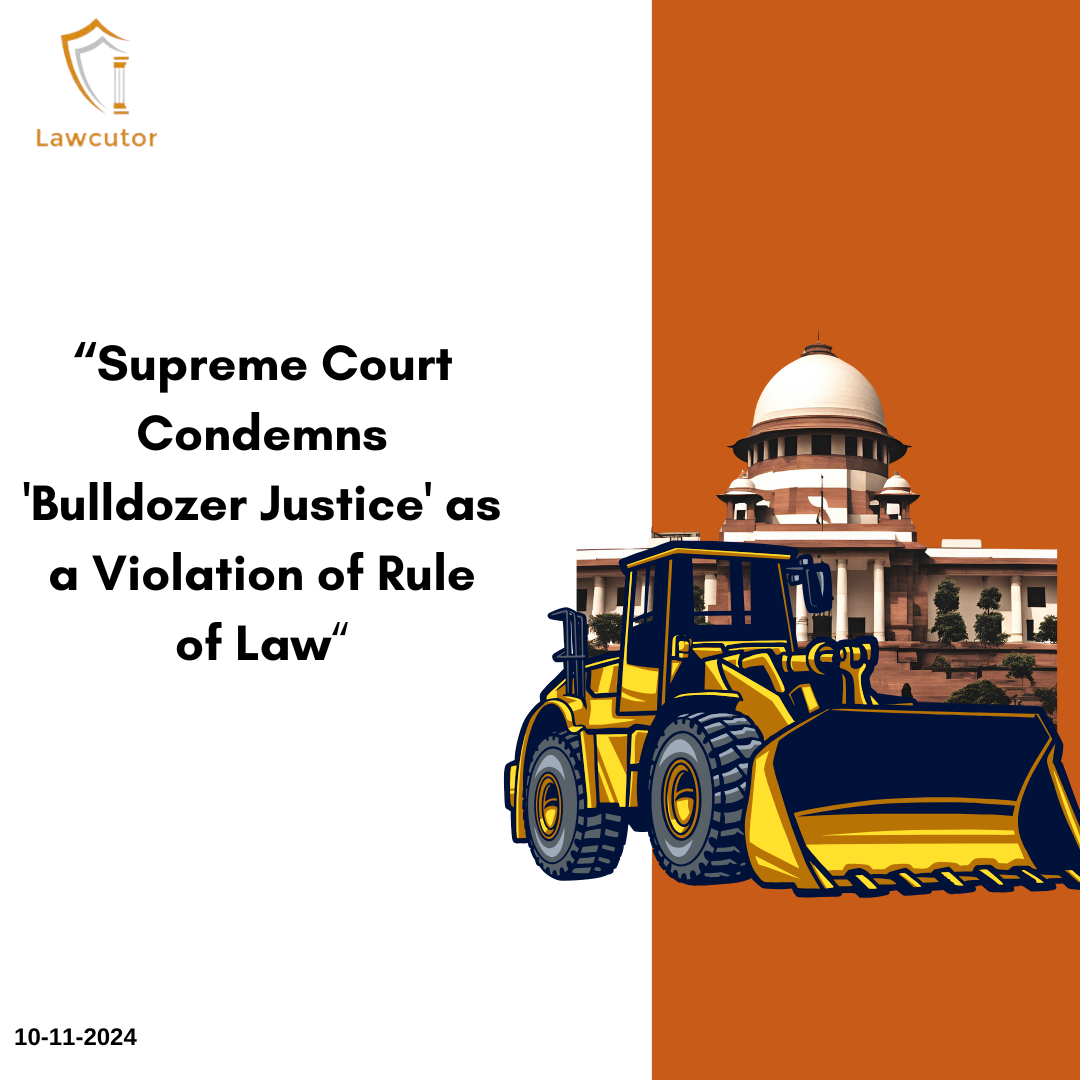
The Supreme Court, in its final judgment under Chief Justice of India D.Y. Chandrachud, denounced the growing trend of “bulldozer justice,” in which State authorities demolish homes as punitive measures against those allegedly involved in crimes. In this judgment, uploaded just before Chief Justice Chandrachud’s retirement, the Court stressed, “Bulldozer justice is simply unacceptable under the rule of law. If it were to be permitted, the constitutional recognition of the right to property under Article 300A would be reduced to a dead letter.”
The case concerned the unlawful demolition of a house in Uttar Pradesh in 2019. On November 6, a bench of CJI DY Chandrachud, Justice J.B. Pardiwala, and Justice Manoj Misra found the demolition violated due process, and orally directed the State to pay an interim compensation of Rs 25 lakhs to the petitioner. The State was further ordered to initiate disciplinary proceedings against the officers responsible for the illegal demolition.
In the final judgment, CJI Chandrachud expressed strong views against bulldozer justice, underscoring, “Justice through bulldozers is unknown to any civilized system of jurisprudence. There is a grave danger that if high-handed and unlawful behavior is permitted by any wing or officer of the State, demolition of citizens’ properties will take place as a selective reprisal for extraneous reasons. Citizens’ voices cannot be throttled by a threat of destroying their properties and homesteads.” The Court emphasized that the “ultimate security which a human being possesses is to the homestead,” warning that such demolitions undermine the foundational principles of lawful governance.
The judgment also established a set of procedural safeguards to be followed by State authorities in cases of property encroachment, especially for road-widening processes. It reiterated that the rule of law requires due process, particularly for any government action infringing on citizens’ property rights.
This decision follows recent related actions by other Supreme Court benches addressing unlawful demolitions. On September 17, a separate bench (Justices B.R. Gavai and K.V. Viswanathan) issued an interim order halting demolitions nationwide, except with Supreme Court permission. Earlier, on September 12, another bench led by Justices Hrishikesh Roy, Sudhanshu Dhulia, and SVN Bhatti observed that alleged criminal involvement does not justify the demolition of a legally constructed property. The bench stressed that, under the rule of law, threats of demolition cannot be tolerated.
The case before CJI’s bench originated from a 2020 suo motu writ petition after a complaint by Manoj Tibrewal Aakash, whose house in Maharajganj was demolished in 2019. Notably, the demolition had been carried out without a written notice or proper demarcation disclosure. Instead, authorities had only made a public announcement (Munadi) without further warning or documentation. Even though the alleged encroachment involved a minimal area, the entire property was destroyed without legal justification.
In rejecting the authorities’ actions, the Supreme Court concluded, “From the above facts… it is clear that the demolition was high-handed and without the authority of law.” Although the petitioner suggested that the demolition was retaliatory, tied to a news report critical of the local administration, the Court refrained from addressing that specific claim, finding in any case that the State’s unilateral action could not be condoned.
With this judgment, the Court reiterates the importance of property rights and due process, marking a firm stance against punitive demolitions devoid of legal basis.
 Lawcutor