
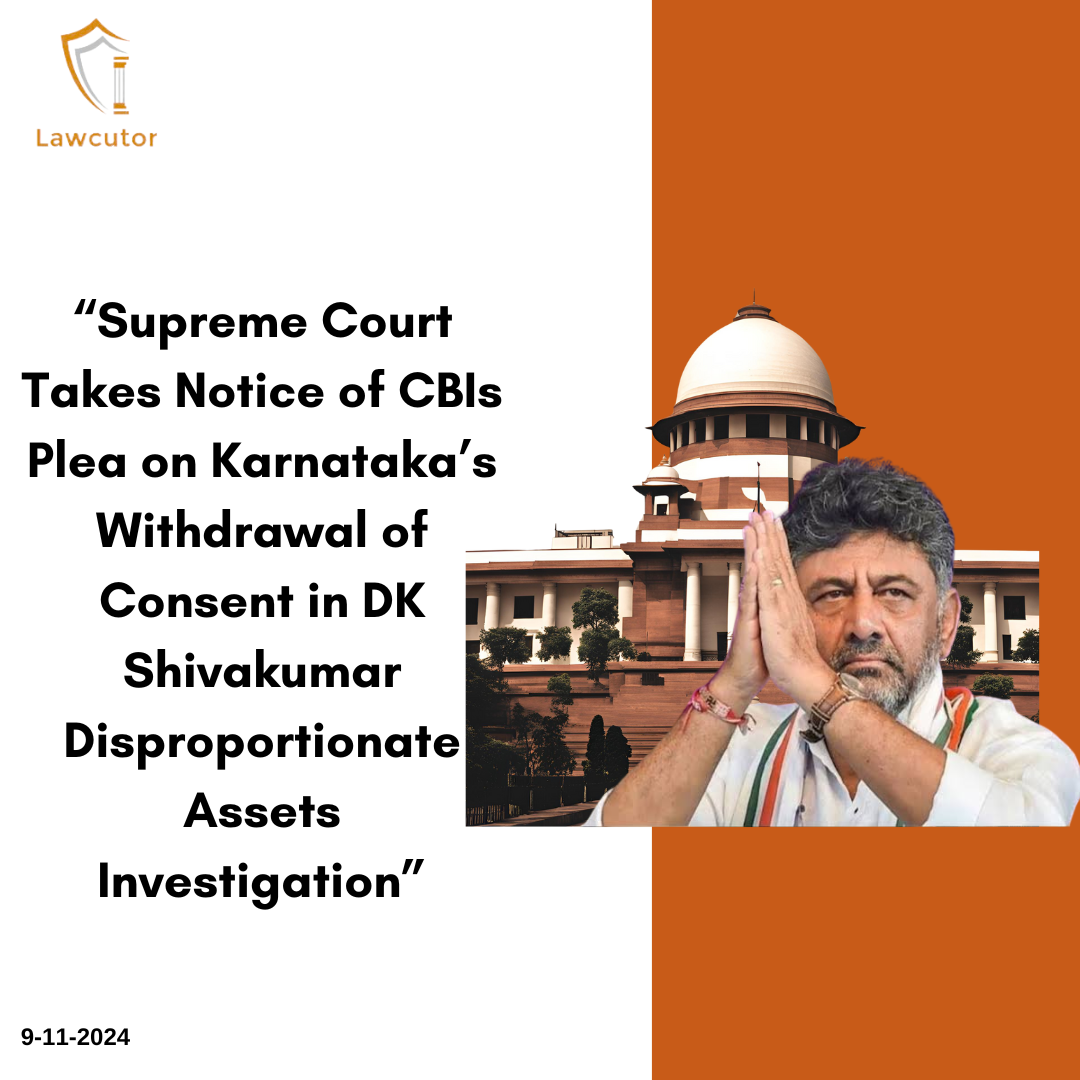
Central Bureau of Investigation v. The State of Karnataka and Others, SLP(Crl) No. 14992/2024
The Supreme Court recently issued a notice in response to the Central Bureau of Investigation’s (CBI) petition challenging the Karnataka government’s decision to withdraw consent for an ongoing probe against DK Shivakumar, Karnataka’s Deputy Chief Minister and senior Congress leader, in a disproportionate assets case. A bench comprising Justices Surya Kant and Ujjal Bhuyan tagged the CBI’s case with another similar petition filed by BJP MLA Basangouda Patil Yatnal, which contests the state’s withdrawal of consent. The matter is scheduled for further hearing on December 13.
Background of the Case and the High Court Ruling
The case’s origins trace back to an income tax raid conducted in August 2017 on Shivakumar’s properties in Delhi and other locations. During the raid, the Income Tax Department reportedly recovered Rs. 8.6 crore, of which Rs. 41 lakhs were allegedly seized from Shivakumar’s premises. Following these findings, a case was registered against Shivakumar in the Special Court for Economic Offenses under the Income Tax Act. This development led to an investigation by the Enforcement Directorate (ED) and Shivakumar’s subsequent arrest on September 3, 2019, in connection with charges under the Prevention of Money Laundering Act (PMLA).
With the Karnataka government’s sanction, CBI was granted consent to investigate Shivakumar’s disproportionate assets under Section 6 of the Delhi Special Police Establishment (DSPE) Act, 1946. However, after the Congress assumed power in Karnataka in May 2023, the state government withdrew this consent, effectively halting the investigation by the central agency.
CBI and BJP MLA Basangouda Patil Yatnal subsequently filed petitions before the Karnataka High Court challenging the state government’s decision. In August 2024, the High Court dismissed these petitions, holding that the issue was primarily between the Union and the State, and therefore could only be adjudicated under Article 131 of the Constitution by the Supreme Court in its original jurisdiction.
“We hold that present writ petitions are not maintainable. The dispute is between the CBI representing the Union Government and the State government. Such disputes which involve Central Government authority and State government autonomy are more appropriately addressed within the original jurisdiction of the Supreme Court. Accordingly, writ petitions are dismissed as not maintainable. Petitioners are granted liberty to pursue appropriate remedies before the Supreme Court,” opined the Karnataka High Court.
CBI’s Contentions Against the High Court Ruling
CBI challenges the High Court’s reliance on Article 131, arguing that the dispute does not present a constitutional conflict between the Union and the State. According to CBI, the matter is a statutory issue regarding Karnataka’s withdrawal of previously granted consent under the DSPE Act, rather than a constitutional matter necessitating adjudication under Article 131.
The agency further contends that Karnataka’s High Court mistakenly framed the issue as a “complex constitutional question,” invoking Article 131, despite the matter being limited to the state’s consent withdrawal. In its petition, CBI asserts that the High Court’s interpretation wrongfully inflated the nature of the dispute, given it concerns “illegality and arbitrariness” in the Karnataka government’s recent orders revoking consent.
Additionally, CBI argues that once the state has granted consent under Section 6 of the DSPE Act, there is no legal provision permitting retrospective withdrawal. Rather, the revocation of consent must be prospective and cannot affect ongoing investigations, as that would hinder law enforcement and judicial processes. CBI argues that the Karnataka government’s withdrawal of consent was “inordinately delayed” and questions the intent behind the action, implying that it was “tailored for the benefit” of DK Shivakumar.
Legal and Procedural Significance
One of CBI’s principal arguments is that the High Court erred by disregarding significant procedural and legal aspects, especially concerning Section 21 of the General Clauses Act, 1897. According to CBI, Section 21 does not permit an order to have retrospective effect, and as such, Karnataka’s revocation of consent can only operate prospectively. Consequently, CBI argues that the withdrawal of consent should not apply to matters already under investigation prior to the revocation.
The petition underscores that CBI’s probe against Shivakumar was initiated legally and was in advanced stages. Halting this investigation, the agency argues, disrupts the legal process and risks allowing alleged corruption to go unchecked. CBI also asserts that it has the jurisdictional authority to pursue the investigation, as the Karnataka government initially granted consent and cannot later obstruct the process arbitrarily.
Constitutional and Federal Implications
The case raises broader questions about the federal interplay between central and state powers, particularly regarding law enforcement and the independence of investigative agencies like CBI. CBI argues that Karnataka’s revocation of consent disrupts not only its investigation but also has potential ramifications for agency autonomy and the consistency of law enforcement across states.
The Supreme Court’s forthcoming hearing will consider whether Karnataka’s withdrawal of consent interferes with federal principles or compromises statutory interpretation under the DSPE Act, and whether the matter should indeed fall under the Supreme Court’s jurisdiction under Article 131, as held by the High Court. The top Court’s interpretation will bear considerable impact on the powers of state governments in revoking consent previously granted to central agencies, particularly in politically sensitive cases.
 Lawcutor